
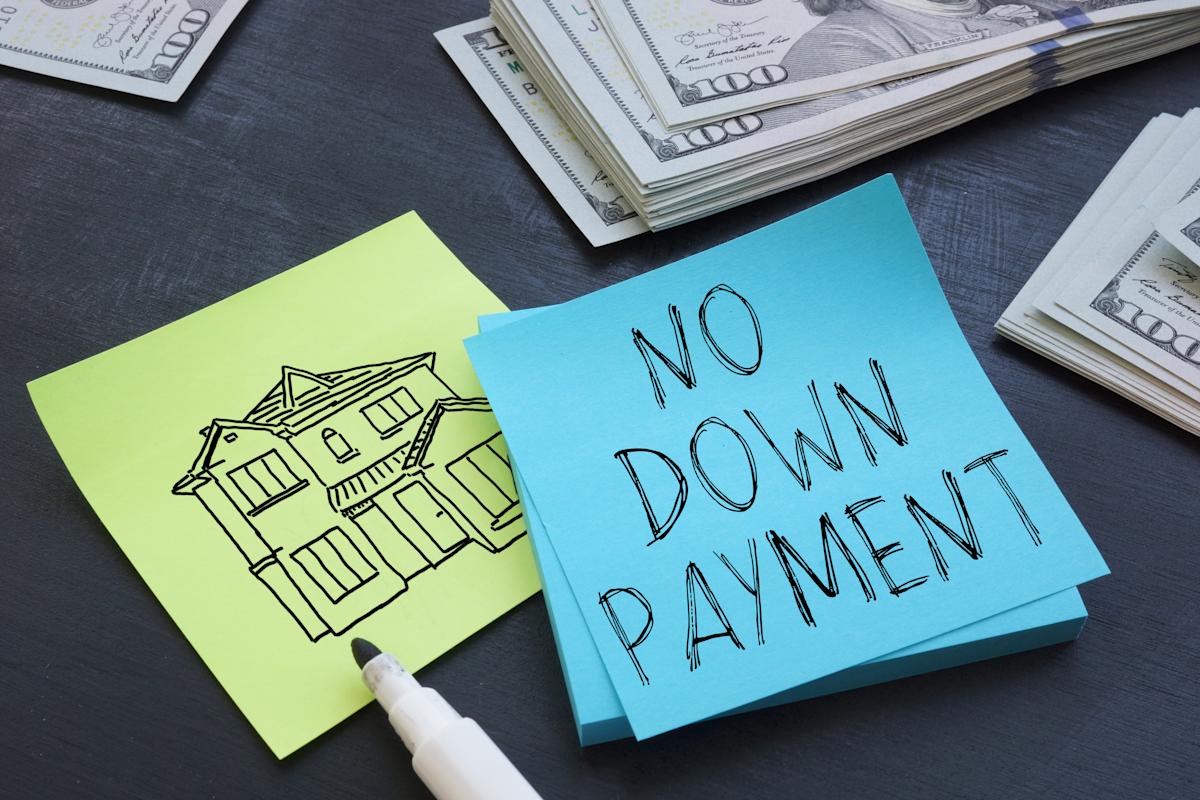
While having a 20% down payment for a house is a worthy goal, the reality is that many buyers can’t afford such a hefty up-front expense. You can still buy a home with as little as 3% — or sometimes even no down payment at all. These are the best low- and no-down-payment lenders of February 2026.
Why Bank of America mortgages stand out: Bank of America has an outstanding record of customer satisfaction and offers a wide variety of low-down-payment loans.
-
Availability: All 50 states and Washington, D.C.
-
Low/no-down-payment loans: Conventional, FHA, and VA loans
-
Minimum down payments: 3% for conventional, 3.5% for FHA, and 0% for VA
Why Chase mortgages stand out: Conventional loans can have low down payments too. Chase is a top-10 lender in conventional loan volume and offers grants that can be applied to borrowers’ down payments or closing costs.
-
Availability: All 50 states and Washington, D.C.
-
Low/no-down-payment loans: Conventional, FHA, and VA loans
-
Minimum down payments: 3% for conventional, 3.5% for FHA, and 0% for VA
-
The Chase DreaMaker loan allows a down payment as low as 3% with relaxed credit qualifications.
-
Eligible borrowers can receive up to $5,000 in grants, which they can use toward a down payment or to reduce closing costs. Available in select areas.
-
Chase guarantees a closing within three weeks, or qualified borrowers receive $5,000.
-
Chase ranks above average in the 2025 J. D. Power mortgage lender satisfaction survey.
Why PNC mortgages stand out: Borrowers may qualify for grants that can be applied to FHA closing costs.
-
Availability: All 50 states and Washington, D.C.
-
Low/no-down-payment loans: Conventional, FHA, VA, and USDA loans
-
Minimum down payments: 3% for conventional, 3.5% for FHA, 0% for VA, and 0% for USDA
-
PNC helps borrowers of modest means with FHA loan closing cost grants of $5,000 to $15,000, depending on where they live.
-
An FHA mortgage calculator is based on your credit score and location, yielding a more accurate rate estimate.
Cons
-
PNC looks for a FICO score of 600 to qualify for an FHA loan. You’ll find other FHA loan lenders willing to accept a 580 score.
-
The lender ranks well below average in customer satisfaction as measured by J.D. Power.
Why Pennymac mortgages stand out: Pennymac’s low credit score requirement makes its VA loan offerings even more attractive.
-
Availability: All 50 states and Washington, D.C.
-
Low/no-down-payment loans: Conventional, FHA, VA, and USDA loans
-
Minimum down payments: 3% for conventional, 3.5% for FHA, 0% for VA, and 0% for USDA
-
While the Department of Veterans Affairs doesn’t require a minimum credit score, many lenders do. Pennymac’s FICO 580 is among the lowest of the VA lenders we’ve reviewed.
-
Pennymac services many of the loans it underwrites. That means you’ll likely continue working with Pennymac after closing on your loan rather than making your payments to a company you’ve never dealt with before.
-
A “close on time guarantee” allows a $2,500 lender credit if your loan closing is delayed.
Why U.S. Bank mortgages stand out: U.S. Bank is a full-service bank that makes USDA loans accessible to borrowers nationwide and prioritizes lending to underserved households.
-
Availability: All 50 states and Washington, D.C.
-
Low/no-down-payment loans: Conventional, FHA, VA, and USDA loans
-
Minimum down payments: 3% for conventional, 3.5% for FHA, 0% for VA, and 0% for USDA
-
You don’t have to be a first-time homebuyer to qualify for a no-down-payment USDA loan.
-
U.S. Bank has a rent vs. buy calculator that can help you decide whether buying a home right now is a good idea.
-
USDA loans are made in eligible rural and suburban areas with populations generally under 35,000.
Cons
MORE: See our picks for the best USDA loan lenders.
Why Rocket Mortgage stands out: Rocket’s 1% down mortgage is available to first-time home buyers as well as homeowners looking for their next house.
-
Availability: All 50 states and Washington, D.C.
-
Low/no-down-payment loans: Conventional, ONE+, FHA, and VA loans
-
Minimum down payments: 3% on conventional, 1% for One+, 3.5% on FHA, and 0% for VA
-
The Rocket Mortgage ONE+ program offers a 2% grant to allow a 1% down mortgage. Income qualifications apply.
-
With a “RentRewards” incentive, you can earn closing costs credits equal to 10% of the rent you pay.
-
In summer 2025, Rocket Mortgage launched bridge loans to accommodate homeowners struggling to sell their houses quickly enough to afford the down payment on another house.
-
Garnered above-average marks for customer satisfaction, according to J.D. Power.
-
Rocket provided typical mortgage rates to borrowers in 2024, but with higher loan costs of over $7,600.
-
The ONE+ program requires a credit score of at least 620, and loans are limited to $350,000 or less.
Read our complete Rocket Mortgage review.
Why Cross Country Mortgage stands out: CrossCountry offers several types of down payment assistance and lists the programs in an easy-to-understand table for borrowers.
-
Availability: All 50 states, Washington, D.C., and Puerto Rico
-
Low/no-down-payment loans: Conventional, FHA, VA, and USDA loans
-
Minimum down payments: 3% for conventional, 3.5% for FHA, 0% for VA, and 0% for USDA
-
CrossCountry allows up to $6,000 in down payment assistance to qualified buyers.
-
The CrossCountry down payment assistance page simply explains DPA offers and the details on all five programs it offers.
-
A FAQ section offers direct answers and even the pros and cons of down payment assistance programs.
Cons
-
CrossCountry offered below-median interest rates and much-higher-than-median loan costs to borrowers in 2024.
-
Scored well below average in customer satisfaction in the 2025 J.D. Power survey.
-
You’re in the house sooner because you didn’t wait years to save for a large down payment.
-
You may be able to dedicate extra cash to home improvements or repairs.
-
Since you’re not paying rent, you begin building equity in your home.
-
A lower down payment results in higher monthly payments.
-
Depending on the type of mortgage you choose, you could have the added up-front and ongoing expense of mortgage insurance.
-
You’ll pay a greater amount of interest over the life of the loan.
-
If home values drop, you could end up owing more than your house is worth. That’s called having an underwater mortgage.
Minimum credit scores for low- and no-down-payment mortgages are sometimes defined by the federal agency or government-sponsored enterprise that backs the loan. However, lenders can add “overlays,” boosting the credit score or other loan qualifications.
Here are the standard minimums for common loans in the category:
-
Conventional loans require a FICO score of 620.
-
FHA loans require a 500 credit score with a 10% down payment, or a 580 score with 3.5% down.
-
VA loans have no credit score minimum, but many lenders will look for a 620 score.
-
USDA loans also don’t have minimum credit score requirements, but lenders may look for a score in the 580 to 620 range.
The more financial security you can prove, the more credit score leniency mortgage lenders may allow.
Saving for the down payment on a house isn’t really a matter of giving up your daily latte. It’s more about conscious spending in general — and diligent saving in particular. Here are some tips for saving for a house:
-
Dedicate windfalls to your down payment savings. That tax refund, work bonus, or unexpected cash gift can boost your savings account statement.
-
Save before you spend. Rather than saving what’s left over each month, automatically transfer a reasonable sum to savings every payday.
-
Delay big purchases. Just say to yourself, “I’ll get that or go there later,” and save the money instead.
-
Cancel a couple of subscriptions and/or memberships and dedicate that ongoing monthly stream of cash to your nest egg with automatic deposits of an equal amount.
-
Make random savings deposits. Frequent small contributions to your down payment account will eventually add up and give you a sense of chipping away at a big number.
Yes, you may qualify for a VA or USDA mortgage loan without a down payment. Many mortgage lenders and local governments offer down payment assistance programs that could supply enough money to cover your full down payment.
If you want a zero-down mortgage, a VA loan is often the best option for qualified buyers. However, you’ll need to be an eligible military-affiliated borrower. You could also consider a USDA loan, which usually has no down payment requirement. To qualify, you must meet income restrictions and buy a house in a USDA-approved rural area.
The lowest down payment on a mortgage is 0%. For that, you must be eligible for a VA loan (which requires having a military affiliation) or a USDA loan (which requires a modest income and a property to buy in a rural and USDA-approved area).
No — buying a house with no down payment can help you get your foot in the door as a homeowner, start building equity, and maybe even land a lower mortgage interest rate if you get a VA or USDA loan. However, you should be aware of the cons. No down payment means your mortgage payments will be higher, and you’ll start out with 0% equity in your home.
Yahoo Finance reviews mortgage lenders based on five primary considerations: 1) Interest rates. Using 2024 Home Mortgage Disclosure Act data from almost 5,000 mortgage companies, we analyze mortgage lenders based on issued mortgage rates below or above the annual median of reporting lenders. 2) Affordability. A measure of loan product availability and the willingness of a lender to offer government-backed loans, low down payments, down payment assistance, and consideration of nontraditional credit. 3) Loan costs. HMDA data is again analyzed, and total loan costs are compared to the annual median. 4) Rate transparency. The ability of a website user to obtain a mortgage interest rate estimate. We also consider whether rates are enhanced with discount points or high credit score requirements, disclaimers revealing rate assumptions, sample advertised rates, and whether adjustable or no discount point rate estimates are available. 5) Online features. An analysis of the educational material, calculators, and additional resources available to users.
Advertisers or sponsorships do not influence ratings.
Editorial disclosure for mortgages:
The information in this article has not been reviewed or approved by any advertiser. The details on financial products, including interest rates and fees, are accurate as of the publish date. All products or services are presented without warranty. Check the lender’s website for the most current information. This site doesn’t include all currently available offers.
Laura Grace Tarpley edited this article.









Leave a Reply