

Welcome to this week’s issue of The Week in Medicine – a round-up of all the happenings in the world of Irish medicine
There was an interesting story in the Irish Times recently about an Irish woman – Lisa McNally – who is currently working as a Public Health Director in Worcestershire in the UK with responsibility for 600,000 people. Currently seeking a job in Ireland which ‘sort of feels like home to us’ (and the Irish Times only too happy to provide an advertisement for same) she pointed out that because she trained as a psychologist, she cannot get a similar position here.
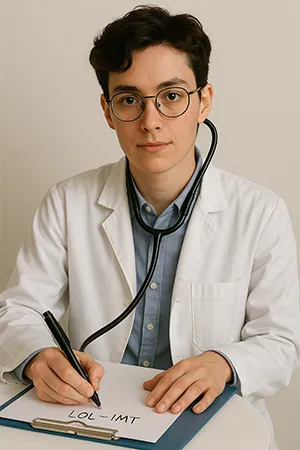
Dr Leslie O’Looney
In Ireland, a primary medical degree and post-graduate training are required for a candidate to be become a Director of Public Health. “I’ve got 15 or 17 years left in my career and would love to do that in Ireland. But I quickly realised there’s no chance. You can work in public health as a non-medic but only up to a certain grade. You cannot work as a consultant or director of public health,” she told Shauna Bowers, health correspondent with The Irish Times .
Prof McNally said it was a ‘missed opportunity’ for the country in not allowing people with non-medical backgrounds to pursue career progression in public health.
Possibly, though hardly the most, eh, pressing issue for the press?
A 2023 Crowe report, commissioned by the Institute of Public Health, said that ‘highly qualified and skilled people with backgrounds other than medicine’ have moved from Ireland to the UK to pursue careers in public health for ‘career pathways that would not be open to them if they had remained in Ireland’.
We would be foolish not to actively seek out medical talent in the UK – especially among doctors who would seek to make a life here.
***************
It’s not uncommon for an Irish nurse to go to Sydney, Australia, but a Roscommon nurse has now made the trip to the other side of the world by bicycle.
Arigna native, Fergal Guihen (27) is due to arrive at Sydney Opera House this coming Saturday, February 7, marking the completion of an extraordinary 23-month journey that saw him cycle from Roscommon to Sydney in the name of a good cause – the Mayo Roscommon Hospice Foundation.
Departing from Ireland in March 2024, Fergal, from the village of Arigna near Lough Allen, covered thousands of kilometres travelling through three continents and 28 countries before reaching Australia. The journey took him across some of the world’s most remote and demanding terrain, as well as through major cities and communities along the way.
Congratulations to Fergal on a supreme effort to help a organisation with a great mission – the Mayo Roscommon Hospice Foundation. Read all about their work here: https://www.hospice.ie/
***************
An estimated 30–50 per cent (maybe half?) of all cancers are preventable through changes to lifestyle and environmental factors, according to the World Health Organisation, and increasing physical activity is one of the most effective steps individuals can take to reduce their risk.
To mark World Cancer Day tomorrow (4/2/26), the Irish Cancer Prevention Network (ICPN) will host a free public webinar, Small Steps, Big Impact: Physical Activity for Cancer Risk Reduction, aimed at raising awareness of the role movement plays in cancer prevention.
World Cancer Day is an international awareness initiative held annually on February 4 to encourage individuals, communities and governments to take action on cancer prevention and control. In Ireland, one in two people will be diagnosed with cancer during their lifetime, with risk shaped by a combination of non-modifiable factors such as age and genetics, and modifiable factors including diet, alcohol intake, physical activity and sun protection.
The ICPN — comprising the HSE National Cancer Control Programme (NCCP), Marie Keating Foundation, Irish Cancer Society, Breakthrough Cancer Research and the HSE National Screening Service — is focusing this year’s campaign on physical activity as a key cancer prevention strategy.
Dr Breeda Neville, Consultant in Public Health with the HSE NCCP, said physical activity is one of the most accessible and evidence-based ways to reduce cancer risk, noting that even small, realistic changes can have a meaningful impact.
Research shows that regular physical activity can lower the risk of at least seven common cancers, including breast, bowel, womb and kidney cancers, by helping regulate hormones and insulin, reducing inflammation and supporting a healthy body weight.
The webinar will feature a panel of experts including Prof. Niall Moyna, Professor of Clinical Exercise Physiology at Dublin City University; Dr Emer Guinan, Associate Professor in Cancer Rehabilitation and Survivorship at Trinity College Dublin and St James’s Hospital; Janette Boran, Healthy Kilkenny Co-ordinator with Kilkenny County Council; and Dr Patricia Sheehan, Lecturer and Active Exercise Oncology Researcher at South East Technological University (SETU). A live Q&A session will follow the presentations.
Further information on cancer prevention is available at hse.ie/preventcancer.
***************
The Irish Heritage Trust has introduced the JAM Card initiative across its visitor attractions, reinforcing its commitment to making Ireland’s heritage sites welcoming and accessible to all.
The Trust, an independent non-profit organisation that cares for some of the country’s most significant heritage locations, has partnered with the NOW Group to roll out the JAM Card (Just A Minute) scheme. The initiative enables visitors and staff with hidden disabilities or communication barriers to discreetly request additional time, patience or support during interactions.
The JAM Card is used by people with autism, neurodivergence, speech, language or communication difficulties, as well as those with other hidden disabilities. By presenting a physical JAM Card or using the JAM Card mobile app, users can quietly signal to JAM Card–trained staff that they may need extra understanding or assistance, helping to improve everyday interactions and the overall visitor experience.
As part of the partnership, the Irish Heritage Trust has committed to staff training, awareness-raising and ongoing collaboration with the NOW Group to embed inclusive practices across its visitor services.
The initiative has been introduced at Fota House and Gardens in Cork, Johnstown Castle, Estate Museum & Gardens in Wexford, and Strokestown Park and the National Famine Museum in Roscommon. These sites offer calm and reflective environments where nature and history intersect, making accessibility and inclusion a central priority.
Trump would call this ‘DEI’ and unfair to white people.
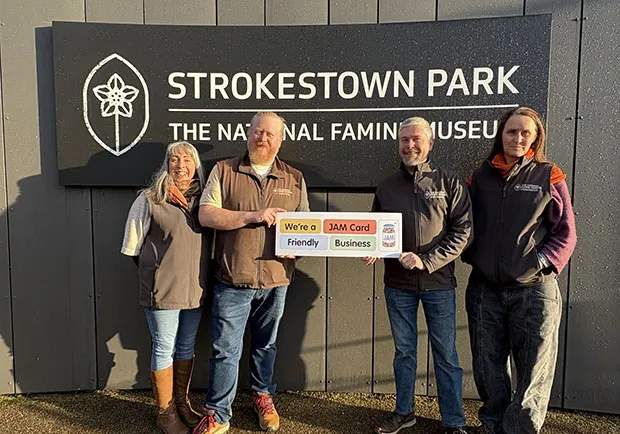
Pictured at Strokestown Park and the National Famine Museum in Roscommon is Tara Carroll, Aidan McBride, John O’Driscoll and Ciara McCormac
<








Leave a Reply