Photographer: Eva Marie Uzcategui/AFP/Getty Images
(Bloomberg) —
After Maura Fonseca moved to Houston from Mexico in 2011, she often waited hours in line at Western Union to send money to her three children and her mother. The fees were so steep she sometimes had to borrow money to pay them.
Most Read from Bloomberg
These days, Fonseca sends money home using Felix Pago, a WhatsApp-based digital app.
“It’s so much better because it’s cheaper, instantaneous and I don’t have to leave my house,” said the 60-year-old who operates rental properties in Houston and opened a bank account four years ago. “Now I can send money from my bed.”
Photographer: Danielle Villasana/Bloomberg
Fonseca is part of a broader transformation in how migrants in the US send money to Latin America. Policy changes and shifting demographics are accelerating the move to digital transfers, which overtook cash in the US-to-Mexico remittance corridor for the first time in 2025, according to Mexico’s central bank.
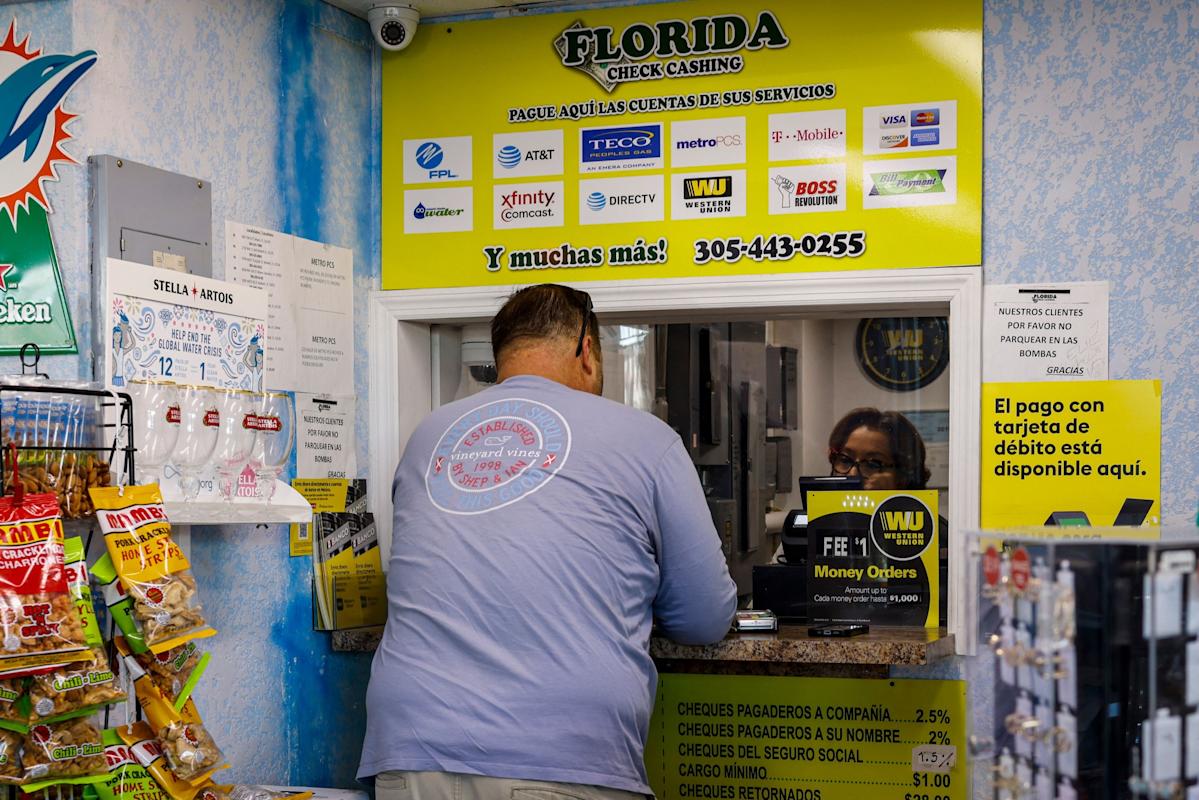
The move away from cash — where senders and recipients use physical pickup locations — is reshaping an industry long-dominated by traditional companies like The Western Union Co. and Moneygram International Inc. As migrants turn to apps or bank transfers to send money to Latin America and the Caribbean, fintech firms like Felix Pago, Remitly and Wise, along with cryptocurrency exchanges like Bitso, are trying to capture a bigger slice of a Latin American market worth more than $160 billion a year, roughly $62 billion of which goes to Mexico.
“We’re seeing a clear trend toward the digitalization of remittances, especially driven by younger generations,” said Dalia Grinberg, corporate affairs manager at Mexican crypto exchange Bitso.
Key to the fintechs’ pitch to new users: while the average cost of sending remittances globally is about 6.4%, digital transactions can fall to around 4%, according to the World Bank, and are often processed instantly or within the same day.
Remittances are critical to the economies of Latin America. In Mexico, money transfers from the US totaled about about 3.5% of gross domestic product. Economists have warned that a new US tax on remittances could dent Mexico’s economy.
Remittance flows to Mexico fell 4.6% last year, snapping an 11-year growth streak, according to estimates by Spanish bank BBVA. A stronger Mexican peso has lowered the value of US dollars payments, and changing migration patterns have also squeezed remittances.
Cash has historically dominated payments because many remittance recipients in developing countries belong to lower-income households with limited access to formal financial services. In Mexico, only about a third of adults can access formal credit, according to government data. Without bank accounts or payment cards, over 70% of the population uses cash for daily transactions.
Fonseca, who recommends the Felix Pago app to friends and family, said that when she was using cash she sometimes had to borrow to pay fees she couldn’t afford to make fixed payments for things that couldn’t wait, like her children’s school tuition. But, even with the fees, cash remains the preferred option for many of her clients, who Fonseca drives to remittance stores because they remain skeptical of electronic transfers.
“Some users prefer going to a physical counter they’ve known for 20 years rather than trusting a mobile app, especially if they don’t understand what’s behind the screen,” said Bitso’s Grinberg.
As part of its pitch to customers, Felix Pago offers the first transfer free and then charges a flat fee of $2.49 regardless of the amount sent, undercutting Western Union, which can charge a $5.99 fee to send cash from a store, according to its website.
Felix Pago users link their transfers to bank accounts or debit cards. The company also partners with large retailers such as Walmart, allowing migrants without either to initiate digital transfers in person, bridging the gap between cash and app-based systems.
Policy changes are forcing migrant communities to adapt. Aggressive US immigration enforcement has made some migrants wary of visiting payment stores tied to immigrant communities, said analysts. Mobile transfers allow users to send funds without leaving home.
“There is a lot of fear of going to where a lot of the independent retail locations are,” said Gus Gala, a fintech and crypto analyst at Monness, Crespi, Hardt & Co.
Cash is also getting more expensive. Since January, the US has imposed a 1% tax on cash remittances. Bank transfers and other digital payments are exempt under the measure, which was meant to steer people toward more traceable financial transactions, say industry executives and analysts.
Western Union has flagged the tax as a risk factor to its consumer money transfer business. Transfers involving Latin America and the Caribbean generated roughly $385 million in 2025, or 11% of the segment’s revenue, down from 12% in 2024.
To adapt, the Denver-based company has promoted digital transfers. About 39% of transactions at Western Union were conducted digitally at the end of 2025, according to company data, up from 32% at the end of 2024.
Western Union didn’t respond to requests for comment.
Moneygram said it’s noticing accelerating growth in digital remittances. The Dallas-based company has recorded a 40% boost for the year so far in the volume of payments on its digital platform compared with the same period last year.
Demographics are reinforcing the shift toward digital payments. Braulio Garzon, who operates seven Western Union-partnered remittance locations in New York City, said most people who come into the stores are in their 50s and 60s.
“Young people are the future of the financial service business,” he said.
–With assistance from Paige Smith and Nino Paoli.
(Adds context about Maura Fonseca and remittance firm Felix Pago.)








Leave a Reply