President Donald Trump’s tariffs have not yet led to the inflation surge many economists predicted.
The White House continues to push its luck by proposing more extreme and arbitrary trade policies.
10 stocks we like better than S&P 500 Index ›
The ways that politics impacts the stock market are often indirect and hard to measure. But early in President Donald Trump’s term, there were certainly people predicting that his unorthodox economic and trade policies would cause problems for the U.S. economy.
With the S&P 500 up by around 14% over the first 12 months of his term, it’s clear that Trump hasn’t hurt equity performance as much as some expected he would. That figure is higher than the index’s average annualized return of around 10% over the last 30 years, but well below its 23% gain in 2024.
That said, investors hate uncertainty, and Trump offers it in spades. It is unclear how much longer his honeymoon period will last before reality sets in on Wall Street. Trump’s trade wars and tariffs could still affect the stock market in 2026, and one equity valuation metric in particular is flashing a warning that hasn’t been seen since the dot-com bubble.
On April 2, 2025, the Trump administration announced its so-called “Liberation Day” package of tariffs, which slapped a new minimum tax of 10% on practically all imports into the United States, and taxes ranging to much higher levels on key trading partners and targeted categories of imports. At the time, many mainstream economists predicted this would result in a surge of inflation. But those who looked past the headlines might have guessed that it wouldn’t actually happen.
According to a 2019 report from the Federal Reserve Bank of San Francisco, only 11% of U.S. consumption can be traced to imports. And imports of intermediate inputs represent a mere 5% of the cost of production of U.S. goods and services. On top of that, in response to Trump’s aggressive trade actions, many businesses shifted their supply chains to countries upon which he had placed lower tariffs. And many were able to absorb some of the new costs in their efforts to preserve their market shares.
The Bureau of Labor Statistics reports that the U.S. inflation rate dropped to 2.7% in December (down from 2.9% in the prior-year period). However, some Fed officials expect inflation to rise to 3% in 2026 as businesses pass more of the tariff impact on to consumers, then ease back to around the central bank’s longstanding target of 2% in 2027.
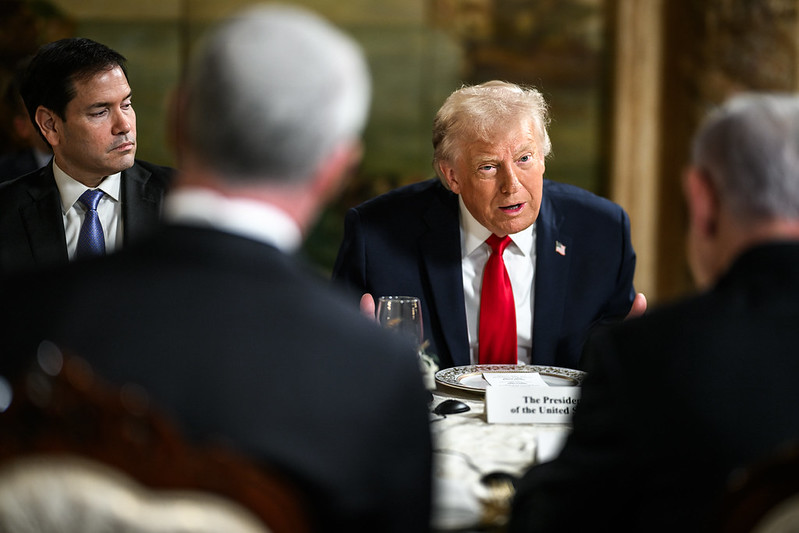
Official White House Photo by Daniel Torok.
In light of all this, investors should stop looking at tariffs as massive inflation drivers and look at them as something more similar to sales taxes on a relatively small percentage of U.S. consumption. These taxes are far from the end of the world from a raw numbers perspective. That said, there is a massive problem: uncertainty.
Unlike traditional U.S. tax and trade policy, Trump’s tariffs were implemented in a very arbitrary and inconsistent way, without the involvement of Congress or the relevant government agencies. This means they stand on shaky ground both legally and politically, and businesses have little reason to assume they will last beyond Trump’s four-year term. American companies are in a difficult situation.
Without clarity on what the future trade picture will look like, they have no clear incentive to attempt to ramp up domestic manufacturing to replace now more costly imports, nor to build production capacity in the currently favored overseas markets.
The president continues to make the situation worse, threatening several European countries with additional tariffs if they oppose his plan to annex the Danish territory of Greenland. Such military moves could also spark retaliation from European nations, particularly against the U.S. technology sector.
But there’s another issue for investors that is less connected to politics and more related to economics.
The cyclically adjusted price-to-earnings (CAPE) ratio is a market valuation tool. It’s calculated by dividing the current price of the S&P 500 by its average inflation-adjusted earnings over the last 10 years. The purpose is to smooth out the natural variance of the business cycle and produce a figure that reflects whether stocks are cheap, fairly priced, or overvalued. Right now, it stands at a whopping 40.8 — a high not seen since the dot-com bubble in the early 2000s. Simply put, based on the CAPE ratio, stocks, broadly speaking, are too high.
Spending related to the artificial intelligence (AI) megatrend seems to be propping up what would otherwise be a weak and uncertain economy. And if the torrid pace of the data center buildout pulls back in 2026, the market could react, forcing investors to face the realities of how Trump’s actions may already be hurting U.S. economic growth.
Before you buy stock in S&P 500 Index, consider this:
The Motley Fool Stock Advisor analyst team just identified what they believe are the 10 best stocks for investors to buy now… and S&P 500 Index wasn’t one of them. The 10 stocks that made the cut could produce monster returns in the coming years.
Consider when Netflix made this list on December 17, 2004… if you invested $1,000 at the time of our recommendation, you’d have $470,587!* Or when Nvidia made this list on April 15, 2005… if you invested $1,000 at the time of our recommendation, you’d have $1,091,605!*
Now, it’s worth noting Stock Advisor’s total average return is 930% — a market-crushing outperformance compared to 192% for the S&P 500. Don’t miss the latest top 10 list, available with Stock Advisor, and join an investing community built by individual investors for individual investors.
See the 10 stocks »
*Stock Advisor returns as of January 21, 2026.
Will Ebiefung has no position in any of the stocks mentioned. The Motley Fool has no position in any of the stocks mentioned. The Motley Fool has a disclosure policy.
The Stock Market Flashes a Warning as Investors Get Nervous About Trump’s Tariffs. History Suggests This Could Happen Next. was originally published by The Motley Fool










Leave a Reply