
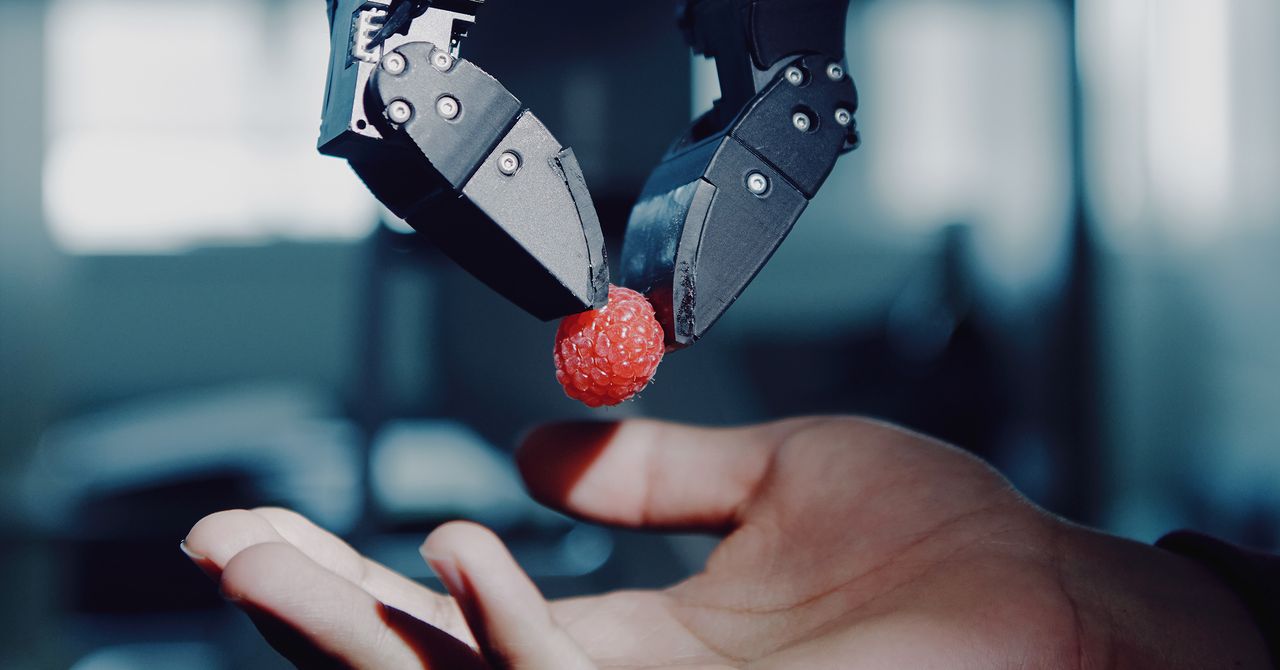
Food handling is an area of work that still relies heavily on humans. Fruit, vegetables, meat, and other foods need to be handled quickly but gently. It is also hard to automate because no two pieces of fruit, vegetables, or chicken nuggets look exactly the same.
Eka’s demos suggest that the company may be onto something big. I found myself mentally comparing their robots to GPT-1, OpenAI’s first large language model, developed four years before ChatGPT. GPT-1 was often incoherent but showed glimmers of general linguistic intelligence.
The robots I saw seem to have a similar kind of nascent physical intelligence. When I watched a video of one reaching for a set of keys in slow motion, I noticed it did something that seemed remarkably human: It touched the tips of its grippers to the table and slid them along the surface before making contact with the keys and securing them between its digits. Eka’s algorithms seem to know instinctively how to recover from a fumble. This kind of thing is difficult for other robots to learn, unless the humans training them deliberately make a wide range of mistakes.
Unlike with any other robot I can think of, it’s almost possible to imagine what the world is like for the robot. Its sensors seem to feel the weight of its arm, the inertia as it sweeps toward the keys and slows down. Once it has the keys in its grasp, it seems to sense the weight of them dangling from its claw.
I don’t know if Eka’s approach really is the route to a ChatGPT-like breakthrough in robotics. Some very smart experts believe that mixing human demonstration with simulation will yield better results than simulation alone. Maybe some combination of the two approaches will ultimately be necessary? But it does seem clear that robots will eventually need to have the kind of tactile, physical intelligence that Eka is working on if they are to obtain humanlike dexterity.
Agrawal tells me that the same general approach should work for finer manipulation. The fiddly dexterity required to build an iPhone, for instance, could be achieved by building different actuators and sensors and practicing the task in simulation.
After spending a few hours at Eka, I decide to stop by the restaurant downstairs. I watch from the counter as the staff prepare food and make coffee. A descendant of the machine upstairs may be able to do these things just as well, if not better. But given how much I enjoy chatting with the people who work there, I think I would pay extra to keep humans around. Unless, that is, my hands get automated away too.
Let us know what you think about this article. Submit a letter to the editor at [email protected].











Leave a Reply