

On the smallest scales, ordinary materials behave in ways that seem to defy the laws of physics. But these apparent contradictions reflect the minute details we’ve yet to discover in nature—as demonstrated by a new finding showing how solids can support wave-like shapes we typically see trailing behind boats on water.
In a recent Physical Review Letters study, Harvard researchers describe how it’s possible to engineer steady V-shaped wakes that ripple across the surfaces of ultrasoft, elastic materials like gels or biological tissue. Based on lab experiments, the team developed a theoretical model to explain this behavior, bridging two classical theories of fluid and solid surface-wave physics. This renewed perspective on solid physics opens new pathways for designing natural and engineered soft materials, particularly for medical purposes.
Wakes, waves
The latest findings highlight a previously overlooked link between Kelvin’s wake patterns and Raleigh waves, known to appear in fluids and solids, respectively. Both appear in very familiar contexts.
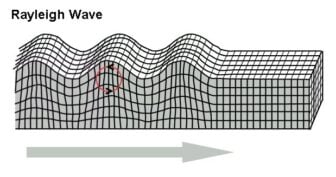
Kelvin wakes, first explained by the eponymous Scottish mathematician, are the V-shaped ripples that form behind boats or waterfowl gliding across water. Raleigh waves, on the other hand, refer to fluctuating motions across the surface of solids, such as the seismic waves produced by earthquakes.
Physicists previously assumed that the two were fundamentally different phenomena, according to a Harvard statement on the findings. However, the team behind the new study wondered if things would play out differently for soft elastic solids, which have a distinct, “delicate interplay between inertia, elasticity, gravity, and capillarity” that could potentially mimic the physical properties of both solids and liquids, according to the paper.
“I suspected that there ought to be a natural way to smoothly interpolate between the behavior of surface waves on solids and fluids,” L. Mahadevan, the study’s senior author and an applied mathematician, said in the statement, “partly inspired by watching boat wake along the Charles, where I walk almost every day.”
Testing the bridge
Mahadevan and colleagues first set up a large tank filled with an ultrasoft hydrogel, using a thin air nozzle as the pressure source. The team then recorded any noticeable changes in the hydrogel’s surface, plotting the angle of the V-shaped disturbances against other metrics like the velocity of the pressure source.
The researchers found that the angle of the wake depends on how fast the disturbance moves relative to how quickly waves travel through the material, which is shaped by its softness. The angle of the wake is narrower with faster disturbances and softer materials, reported the paper.
Coded in ripples
Importantly, this novel relationship “turns the wake into a natural diagnostic signal,” the researchers explained. By observing how waves propagate through a soft solid’s surface, researchers can infer the solid’s properties without pressing or cutting it. This has real implications for medical contexts. For instance, doctors measure the stiffness of tissue to determine whether patients have tumors, so this could inform relatively noninvasive ways to test for critical health anomalies, the team said.
Then again, the findings are inherently fascinating, as they demonstrate that, in physics, even the most solid, seemingly independent theories in physics could have unexpected connections.
“Much of our work reflects a broader scientific instinct: to search for the sublime and the arcane, hidden within the mundane,” Mahadevan said. “This is one more example of how the everyday ordinary world is full of wonders, if we only choose to see carefully.”














Leave a Reply