(Bloomberg) — The yen surged 3%, its biggest gain in almost two years, after Japan intervened in the foreign-exchange market following a “final” warning by officials to investors against selling the currency.
Most Read from Bloomberg
While the nation’s top currency official declined to comment on Friday, a person familiar with the matter said intervention had taken place. Japan’s Nikkei newspaper earlier cited a government official saying that the government bought yen and sold dollars. Several traders and strategists also said the abruptness of the move indicated action.
Economic officials in the US were notified ahead of Japan’s intervention, according to someone familiar with the matter. The effort is in line with a Group-of-Seven agreement to alert counterparts, and to only act when there’s risk of excess volatility.
The yen reached 155.57 per dollar on Thursday, the strongest since late February, before paring gains to trade around 157.10 in Asia trading on Friday morning.
Until the government stepped in, the currency had been trading close to its weakest levels in four decades, risking faster inflation by making imports — including already soaring oil — pricier.
Late Thursday in Tokyo, the nation’s top currency official, Atsushi Mimura, told speculators he was delivering a “final advisory if you want to escape” and echoed comments from Minister of Finance Satsuki Katayama that “the timing for taking bold steps is nearing.”
“This was an alarm-bell moment,” said Neil Jones, managing director of currency sales and trading at TJM Europe. “My sense is the Ministry of Finance instructed the Bank of Japan to sell the dollar versus the yen.”
Next Steps
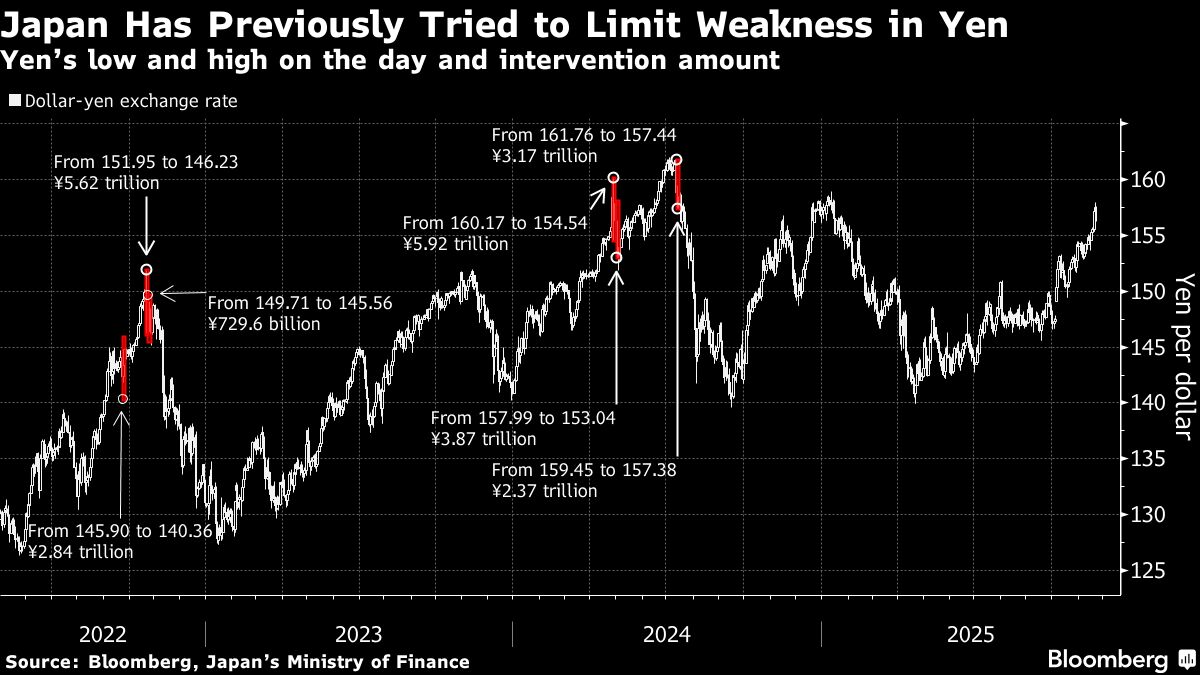
Market watchers are now turning their focus to officials’ potential next steps. Japanese authorities spent around $100 billion in total buying yen on several occasions in 2024.
“Aggressive BOJ intervention in 2022 and 2024 prompted a significant correction in dollar strength — but it required more than one round of yen purchases,” said Shaun Osborne, head of currency strategy at Scotiabank.
Chris Turner at ING said the key thing to monitor regarding intervention is whether the US joins Japan’s efforts to support the yen, a move that would be seen as sending a stronger signal to speculators.
“Taking into account high energy prices and Japan running substantially negative real interest rates, plus the dollar being in demand, Tokyo cannot expect a sustained drop in dollar-yen,” said Turner, global head of markets at ING. “The wild card, however, would be whether the US Treasury gets involved.”
The US has only intervened in currency markets on three occasions since 1995, according to the Richmond Fed’s website, most recently acting to stem the yen’s appreciation after the 2011 earthquake in Japan.
US Treasury representatives didn’t respond to a request for comment.
The Fed in February confirmed that its trading desk in New York had requested quotes on the dollar-yen rate on behalf of the US Treasury the prior month, a move that briefly boosted Japan’s currency.
Steady Rates
Before its abrupt rebound, the yen had weakened beyond 160 per dollar. That came in the wake of decisions this week by the Bank of Japan and the Federal Reserve to hold interest rates steady. The US rate advantage over Japan’s benchmark has contributed to the dollar’s strength against the yen.
Some strategists have cited BOJ Governor Kazuo Ueda’s reluctance to signal a near term rate hike as another weight on the yen, even though the decision to keep rates on hold this week was split.
What Bloomberg strategists say…
“Yen intervention feels a bit like fighting the wind. Authorities can move the currency sharply if they wish, but rate expectations will keep pushing the yen weaker against the dollar.”
—Sebastian Boyd, macro strategist. For the full analysis, click here.
Tensions in the Middle East and soaring oil prices are also hurting the yen given Japan’s heavy reliance on fuel from the region. Brent crude on Thursday surpassed $126 per barrel, the most since the aftermath of Russia’s invasion of Ukraine in 2022.
“At a time when the economy was garnering momentum, now we have this oil price shock, which is a big deal for Japan, which is an oil importer,” Sophia Drossos, a strategist and economist at Point72 Asset Management, told Bloomberg Radio on Thursday. “The currency weakness in this context is a lot more pernicious.”
While for years Japanese officials were more concerned about deflation — rather than inflation — taking hold in their sputtering economy, they’ve begun to worry more about soaring prices in the aftermath of the pandemic shock. More recently, they have begun to scrutinize speculative trading in crude oil futures, saying it had become a new factor driving currency moves.
“Our focus is on all fronts — and that hasn’t changed,” Mimura said on Thursday, while declining to comment on specific drivers of the yen’s recent weakness.
Brent Donnelly, president of Spectra Markets, said the drop in oil Thursday following the yen’s rally may have been the result of traders holding correlated positions across the two markets.
“If you’re playing for higher oil, you are probably short yen and when you are getting smoked on the yen side, you sell your oil futures,” he said.
–With assistance from Takashi Umekawa, Saleha Mohsin, Anya Andrianova, Molly Smith, Erica Yokoyama, John Cheng, Ye Xie, Daniel Flatley and Georgia Hall.
(Updates with confirmation in second paragraph from source on intervention.)
Most Read from Bloomberg Businessweek
©2026 Bloomberg L.P.












Leave a Reply