
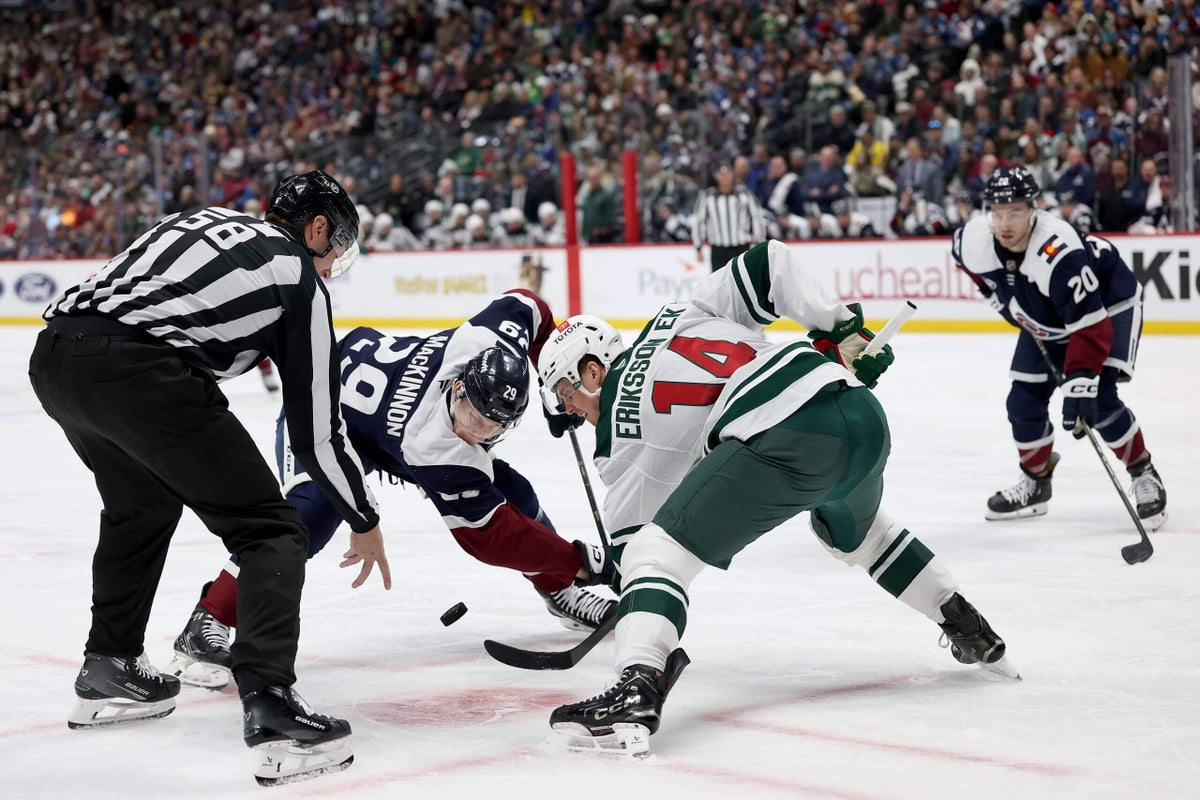
You thought the Minnesota Wild-Dallas Stars series was a heavyweight bout between Western Conference titans?
Buckle up. The upcoming second-round matchup between the Wild and the Colorado Avalanche might even top it.
The NHL playoff format, fair or not, has given us back-to-back conference final-worthy showdowns. And the Wild certainly know what they’re getting into here against the Presidents’ Trophy winners.
“They were the best team in the league,” Quinn Hughes said. “It’s going to be a really hard series.”
“You go through second place, now you’ve got to go through first place,” Marcus Foligno said. “Another big battle, and we’re mentally ready for it.”
There’s plenty of starpower here, from Hughes, Matt Boldy and Kirill Kaprizov for the Wild to Nathan MacKinnon, Cale Makar and Martin Nečas for the Avs. Colorado has a core that’s been there, done that, having won the Stanley Cup in 2022, while this is Minnesota’s first foray into the second round in a decade.
How does it all break down? What should we expect? Here’s a primer.
What’s one matchup you’re looking forward to?
Baugh: I’ll steal an obvious one. Watching Makar and Hughes go head-to-head should be exhilarating. Each had seasons worthy of Norris consideration, and both have already won the award (Hughes in 2024, Makar in 2025 and 2022). They’re probably the two best defensemen in the world. Now they’ll both be playing huge minutes in a star-studded playoff series.
Makar’s first-round numbers don’t jump off the page, but he was strong in Colorado’s four-game sweep, especially the final two games. He started to find his shot and completely worked Taylor Ward for a goal in Game 4. Hughes, meanwhile, had a massive eight points in six games against the Stars and averaged 31:40 of ice time per night. Both will presumably have their fingerprints all over this series.
Makar and the Avalanche power play will need to have a better series than they just did against the Los Angeles Kings (1-for-11). The Wild’s penalty kill struggled against a strong Dallas power play, so that could present Makar with some opportunity.
Smith: Makar-Hughes is probably the flashiest matchup, but my biggest question is how the Wild match up down the middle. The Avalanche have more depth at center, especially with the addition of Nazem Kadri, but there are few better shutdown pivots in the league than Joel Eriksson Ek, who will likely be on some Selke Trophy ballots and could be matched up against MacKinnon.
Eriksson Ek is a menace to top players, and his linemate Boldy is turning into an elite defender, too. Marcus Johansson is a very smart and savvy player on the wing. They’ll probably get a lot of the tough matchups, though we’ve seen coach John Hynes not afraid to put his top line of Ryan Hartman, Mats Zuccarello and Kaprizov out there.
Eriksson Ek did take a scary spill into the boards early in the third period of Game 6 but returned midway through the period. So we’ll see if that injury lingers. But how the Wild’s centers — Hartman, Eriksson Ek, Michael McCarron and Nico Sturm — stack up with Colorado’s side will be intriguing.
Russo: I’m really looking forward to seeing the starpower in this series: MacKinnon, Nečas and Makar against Kaprizov, Boldy and Hughes.
This is amazingly MacKinnon’s first playoff series against Minnesota since 2014, when he had two goals and 10 points in the first three home games and no points in Minnesota. In Game 7, when the Wild rallied from four one-goal deficits to win in overtime, one of the most memorable scenes in Wild history was Jared Spurgeon accepting Nino Niederreiter’s pass in the right circle and waiting for MacKinnon to slide by before scoring the overtime-forcing goal.
Since that rookie year, MacKinnon has won a Hart, a Cup and scored 396 goals and 1,079 points in 868 games. Nečas, meanwhile, is coming off a 38-goal, 100-point season. And Makar is the best defenseman in the game.
But Hughes is different, and even Makar can’t determine the pace of a game the way Hughes can. Nobody in the league has the puck on his stick as often as Hughes, and the Avs will have to find a way to neutralize his ability to spin off defenders in all three zones and make something out of nothing.
Boldy is coming off a six-goal series and is tied with Kaprizov for the second-most points in the playoffs with nine. He averaged 25 minutes a game, leads the league with 33 shots, is on a four-game point streak and scored the Game 4 season-saving overtime winner.
What’s one reason Colorado should be optimistic?
Baugh: The Avalanche were the strongest five-on-five team in the league over the course of the season, and they outplayed Dallas at even strength in their heavyweight first-round matchup last season. But the Stars won the special teams battle with their strong power play. The Avalanche had only three power-play goals in 22 attempts. It was the main reason they were a first-round out.
On paper, Colorado’s top power play unit of MacKinnon, Makar, Nečas, Kadri and Gabriel Landeskog should be one of the best in the league. The unit hasn’t found consistent success throughout the year, though it played better after the Olympic break. Perhaps the Wild’s struggling penalty kill will leave the door open. If it does, the Avalanche will be difficult to stop.
Colorado’s biggest edge against Minnesota is at center, with MacKinnon, Brock Nelson, Kadri and Jack Drury up the middle and the luxury of moving Nic Roy there, too, if it wants Kadri on the wing. Parker Kelly, who had 21 goals this year, can also play center. As good as Eriksson Ek is, no opponent can match that star power. The Wild’s top wingers, who are excellent, have to have massive series for Minnesota to win.
Russo: The Avs coaches should look at the Stars’ power play and tell their guys, “Do that!!!!”
Easier said than done, but Colorado can surely find areas to exploit after the Wild, who outscored Dallas 14-4 at five-on-five, gave up 10 power-play goals in six games.
Now, Avs fans may find it laughable to say their team should be optimistic about their power play, considering it inexplicably finished 27th during the regular season. But I’ll believe it when I see it that MacKinnon, Makar, Nečas, Kadri and Landeskog won’t score on the power play in this series.
The Wild had best stay out of the box.
What’s one reason Minnesota should be optimistic?
Smith: The confidence the Wild have should absolutely give them a chance. Their relentlessness and connectivity at five-on-five held the Stars without a goal in 250-plus minutes, which should be a recipe they try to replicate. Everyone is playing their role, including superstars playing at a high level. Hughes just had a legacy-type game. Boldy was the best player in the series. Kaprizov came on strong toward the end. And Brock Faber has looked like a franchise defenseman.
There was a business-like approach the Wild took, even after their milestone win on Thursday. Excited? Sure. Relieved? Maybe. But there was a defiant look, like, “This is just the start.”
Russo: Where the Avs were barely tested by the Kings, the Wild are already at full speed following their heavyweight battle with Dallas.
Their stars are humming, the Hughes-Faber pair dominated their matchups and Jesper Wallstedt hardly looked like a rookie.
The Wild can also use the same template they did against the Stars, and that’s to punish the Avs physically. The Wild’s physicality from their bottom six is scary to watch. Between Marcus and Nick Foligno, NHL hits leader Yakov Trenin, Sturm and the trade-deadline pickup McCarron, the Stars’ defensemen were looking over their shoulders from the start of the series to the painful finish, and the Stars’ forwards were absolutely exhausted from getting hit and hit and hit.
The Wild will try to do the same to the Avs.
Baugh: One note on Colorado not being tested much: They beat the Nashville Predators in four games in the 2022 first round — their most recent time sweeping a series — then won a tight series against the Blues in the second. It’s very possible Minnesota could win this series, but I don’t think Colorado’s lack of a Round 1 test will be a primary reason.
How’s each team’s goaltending looking?
Smith: Goaltending was one of the key question marks for the Wild heading into the playoffs — would it be Filip Gustavsson or Wallstedt? Hynes went with his gut and picked the red-hot rookie, and Wallstedt has been brilliant. “It’s freaking fun,” Wallstedt said.
Wallstedt exudes calmness in net, and it permeates through the lineup. “Ice in his veins,” as Hughes put it. Outdueling one of the league’s top goalies in Jake Oettinger will only give him more swagger. Wallstedt racked up a .924 save percentage in the series, with 4.31 goals saved above expected (score and venue adjusted), according to Evolving-Hockey. At five-on-five, he had 7.61 goals saved above expected.
And Wallstedt has had success against the Avalanche, winning two of his three starts against them this season, with a 3-2, 34-save shootout win March 8 in Colorado and another 3-2 shootout win Nov. 28 at home that snapped a 10-game Avs winning streak.
Baugh: Scott Wedgewood led the league in save percentage this season and was excellent in the first round. He had a .950 save percentage and left no doubt that he should be the Avalanche’s starting goalie heading into the second round.
If the Wild get to Wedgewood, Mackenzie Blackwood entered the year as Colorado’s presumed starter and finished the season with a .904 save percentage.
Blackwood and Wedgewood both had solid seasons in terms of their underlying numbers. Wedgewood’s 32.42 goals saved above expected (score and venue adjusted) was seventh in the league, per Evolving-Hockey, and Blackwood’s 19.08 was 23rd. Wallstedt (18.01) and Gustavsson (16.07) were 26th and 29th, respectively, but given how well Wallstedt played against Dallas, it’s hard to say either team has a huge edge in net.
What’s each team’s injury situation?
Smith: After the grueling first round, the Wild are a little banged up.
The biggest worry is shutdown left-shot defenseman Jonas Brodin. Brodin got hurt blocking a shot in Game 5, leaving the arena on crutches and a walking boot. He didn’t play in Game 6, and his availability to the start the series is unknown. The Wild would want to throw him MacKinnon, so his absence would be huge.
Eriksson Ek, as mentioned, got hurt in Game 6 but returned. Hynes called that a “gut check” moment for the group, and there’s no doubt Eriksson Ek is tough. It’s just a matter of how that will impact his game if he plays.
Zach Bogosian is walking with a limp. You can tell ankle injuries this season have taken a toll, but he should be in the lineup.
Russo: If Brodin doesn’t play to start the series or at all, the big question is if you can really go with a Bogosian-Jeff Petry third pair. Bogosian is a right-shot defenseman and would have to play his left side — not easy, especially when you’re clearly playing hurt. The Wild barely used them in Game 6, with Petry logging 7 minutes and Bogosian 11 ½ minutes and a big reason for Dallas’ power-play goal.
It may be time to unlock left-shot mobile youngster Daemon Hunt for his playoff debut.
Baugh: Rest is a weapon, and reading through the Wild’s list of banged-up players, you can see why. Colorado suffered only one injury in the first round: Josh Manson left Game 3 with an upper-body injury and missed Game 4. It’s unknown if he will be able to return by Game 1.
Nick Blankenburg filled in for Manson in Game 4, playing 12:35. He’s a serviceable depth defenseman but plays a different game than the bruising Manson. Blankenburg is 5-foot-9 and a puck mover.
Who’s one player that needs to have a big series?
Russo: Eriksson Ek. The Wild are perennially terrible on faceoffs and rode him throughout the first round. He took a league-high 149 draws and won a league-high 84 (56.4 percent).
Eriksson Ek is also Minnesota’s net-front presecnce on the first power play, first over the boards on the penalty kill and is their best two-way center. He is relentless, physical, annoying to play against and always around the puck. He sets the tone for Minnesota in the trenches, and no doubt Hynes will try his best to match him against MacKinnon.
Baugh: Colorado could use a big Brock Nelson series. Center depth on paper matters only if the bottom-nine centers produce. Nelson was solid defensively against the Kings but didn’t chip in much offense. An empty-net goal in Game 3 was his only point.
Nelson has delivered on the three-year, $7.5 million average annual value deal that Colorado gave him over the summer. He had 33 goals in 81 games. The Avs will benefit mightily if he can add supplementary scoring from the second line. If he can’t, MacKinnon’s line will have to carry a huge load. Overreliance on one line is traditionally not a recipe for postseason success.












Leave a Reply