
WASHINGTON – The Supreme Court on May 4 allowed its recent ruling limiting a key part of the Voting Rights Act to take effect early, boosting the chances that Republicans can impose a new congressional map in Louisiana before the November election.
The court customarily holds on to decisions for a month after they are reached to allow time for the losing side to request another hearing.
Voters who won the case wanted the transfer to happen without the waiting period to grant more time for new maps to be drawn.
Black voters who feared losing representation in Congress opposed that request and argued the justices should instead hold onto their April 29 ruling until after the election because voting in the primary had already begun.
The court’s response to the emergency request was unsigned, but in a concurrence, Justice Samuel Alito wrote that Louisiana should not have to use a map found to be unconstitutional. There’s still time, he suggested, for the state legislature to adopt a new map.
In dissent, Justice Ketanji Brown Jackson said the court’s decisions have “spawned chaos” in Louisiana.
On April 30, Louisiana Gov. Jeff Landry put the May primary on hold, giving the state legislature time to approve a new map that could allow Republicans to gain one or two seats.
That suspension is separately being challenged in court.
A different court must decide how to apply the Supreme Court’s ruling invalidating the existing map. Before those judges can do so, the Supreme Court must send its decision to them, which makes the ruling final.
The justices typically won’t finalize a decision until the losing side has used up the time they’re given to ask that a case be reheard. Requests for a rehearing are rarely granted.

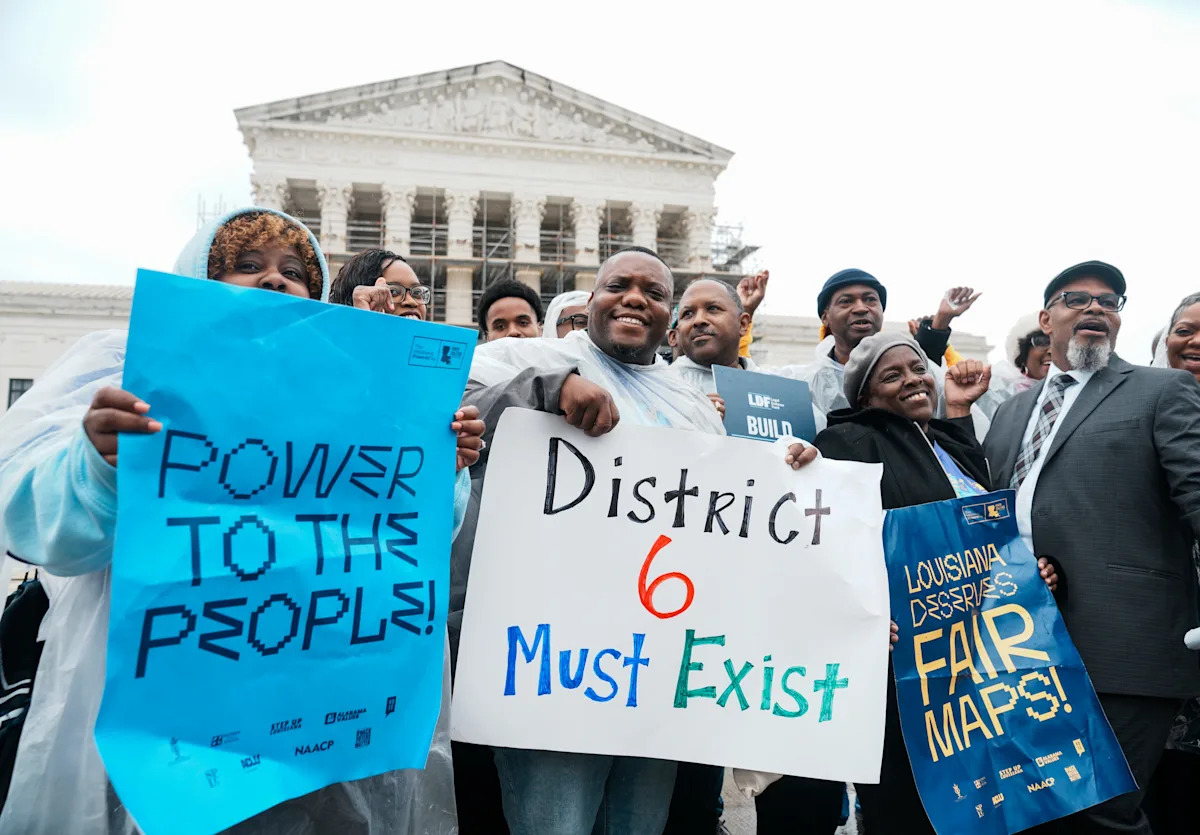
People rally outside the U.S. Supreme Court following arguments about Louisiana’s congressional districts on March 24, 2025.
In the Supreme Court’s opinion, a majority said that Black voters who lost the case “have not expressed any intent to ask this Court to reconsider its judgment.”
“And the need for prompt action by this Court is clear,” Alito wrote.
Jackson, one of the court’s three liberals, said the court looks like it’s putting a partisan thumb on the scale by curtailing the normal waiting period over the Black voters’ objections.
“To avoid the appearance of partiality here, we could, as per usual, opt to stay on the sidelines and take no position by applying our default procedures,” Jackson wrote. “But, today, the Court chooses the opposite.”
State officials told the Supreme Court it did not matter to them how quickly the justices act. The timeline won’t affect the state’s ability to produce a new map and electoral process for this year’s election, Louisiana Attorney General Elizabeth Murrill wrote.
Once that happens, she said, the lower court won’t need to get involved.
The map that an ideologically divided Supreme Court rejected 6-3 includes two majority-Black districts. A group of self-described non-Black voters sued, arguing a “racial quota” cost the state a Republican seat in a narrowly divided Congress.
More: Supreme Court weighs in on redistricting. Will it affect the national battle?
The districts had been created to protect the voting power of the state’s Black residents, who make up one-third of the state’s population.
But Justice Samuel Alito, writing for the court’s majority, called the map an “unconstitutional gerrymander” that violates the rights of the non-Black voters who challenged it.
Alito said that the Voting Rights Act’s vote dilution protections for racial minorities do not kick in when a map “fails to provide a sufficient number of majority-minority districts.” Instead, he said, there must be evidence that district boundaries were created because of “intentional discrimination.”
That decision puts at risk both of the majority-Black districts in Louisiana of being eliminated in the redrawing, as well as majority-minority districts in other states.
This article originally appeared on USA TODAY: Supreme Court issues new emergency voting rights ruling that boosts GOP











Leave a Reply