

Key takeaways:
- At the 13-year follow-up, colonoscopy reduced CRC incidence by approximately 30%, up from 20% in the 10-year results.
- Mortality reduction remains nonsignificant.
CHICAGO — Three years after NordICC trial’s much-debated 10-year results were published, follow-up data showed colonoscopy screening reduced colorectal cancer incidence by about 30% but did not reduce mortality in this patient population.
The new findings were presented at Digestive Disease Week and simultaneously published in The Lancet.

“The first publication at 10 years showed an effect of around 20% risk reduction and no effect on [mortality],” principal investigator and presenter Michael Bretthauer, MD, PhD, professor of medicine at the University of Oslo, told Healio. “Some experts said 10 years was too short and expected the effect would be larger with longer follow-up. That is why we did a new analysis 3 years down the road.”
Background
Bretthauer and colleagues enrolled 84,583 adults aged 55 to 64 years from Norway, Poland and Sweden in the NordICC trial between 2009 and 2014. Participants were randomly assigned in a 1:2 ratio to colonoscopy screening or no CRC screening.
Researchers assessed the effectiveness of colonoscopy screening on CRC incidence and mortality, with an initial analysis conducted after a decade.
Those results, published in 2022 in The New England Journal of Medicine, showed 42% of individuals invited to screening underwent colonoscopy. The intention-to-screen analysis found a 0.98% risk for CRC in the screening cohort vs. 1.2% in the no-screening cohort (RR = 0.82; 95% CI, 0.7-0.93). Mortality risk was 0.28% vs. 0.31% (RR = 0.9; 95% CI, 0.64-1.16).
When the 10-year results were published, David Lieberman, MD, professor of gastroenterology and hepatology at Oregon Health & Science University, and other experts cautioned that the data could potentially be misinterpreted by patients.
In a recent interview, Lieberman told Healio it was important for clinicians to make the distinction between the results of the per-protocol and intention-to-screen analysis clear to patients, the latter including all participants invited to a colonoscopy regardless of whether they had the procedure.
He also pointed out that CRC screening is done differently in the U.S. than this study was designed and ultimately, screening is only as successful as how many people fully participate. “I think what the 10-year follow up of the Nordic study shows is not that colonoscopy is ineffective, but that colonoscopy can be effective if it’s actually completed,” Lieberman said.
New data
After 13 years of follow-up, CRC incidence was 1.46% in the screening cohort vs. 1.8% in the no-screening cohort. The researchers reported a risk ratio of 0.81 (95% CI, 0.71-0.9) in the intention-to-screen analyses and 0.55 (95% CI, 0.33-0.81) in the per-protocol analyses.
Additionally, colonoscopy was more effective at reducing CRC incidence in the distal colon (RR = 0.79; 95% CI, 0.65-0.89) than the proximal colon (RR = 0.91; 95% CI, 0.71-1.09).
For CRC mortality, it was 0.41% in the screening cohort vs. 0.47% in the no-screening cohort, for an intention-to-screen risk ratio of 0.88 (95% CI, 0.68-1.08) and per-protocol risk ratio of 0.7 (95% CI, 0.26-1.25).
“In the analysis of only the people who underwent colonoscopy, we also did not find an effect on the death rate,” Bretthauer said.
Bretthauer and colleagues noted that CRC mortality in the no-screening cohort was 0.47%. They had expected mortality to be higher when they designed the trial, which was 0.82%.
“We have much better chemotherapy, radiation therapy and surgical therapy than we had even 5 or 10 years ago, which makes the death rate very low — which is great for patients — but it makes very hard to show that an intervention is effective,” Bretthauer said.
Interpretation
Lieberman described the lack of impact on CRC mortality as “interesting.”
“CRC mortality in the usual care group was quite a bit lower than they had originally estimated, and that may attenuate any difference between the two arms of the study,” he said. “In other words, if the colonoscopy arm was beneficial and the usual care arm had a lower-than-expected rate of colon cancer, you may not be able to detect that benefit of colonoscopy reducing mortality.”
Given these findings, Bretthauer believes it may be beneficial to recontextualize colonoscopy as a tool to reduce CRC incidence.
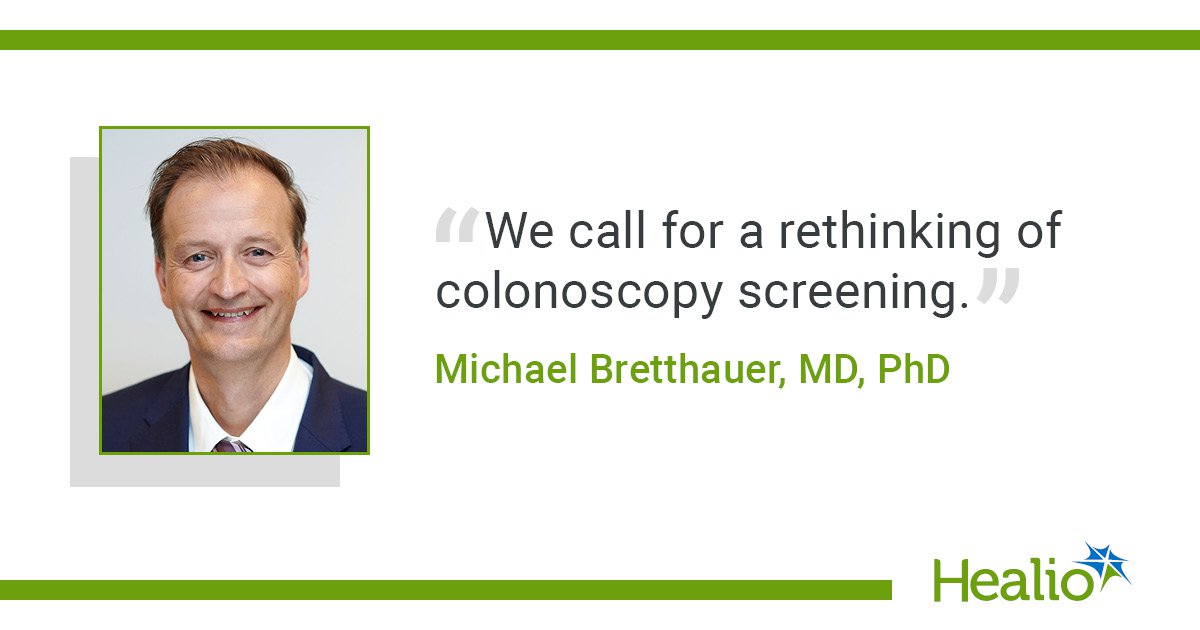
“We call for a rethinking of colonoscopy screening, where the main focus in the future should be [CRC] incidence and not [mortality],” Bretthauer said.
“I think the take-home lesson from this study is that screening works if you get it done,” Lieberman said. “Adherence and participation are key components to any successful colon cancer screening program.”
Bretthauer anticipates additional follow-up on the NordICC trial participants.
“We will do at least one additional analysis, maybe in another 3 years,” he said.
For more information:
Michael Bretthauer, MD, PhD, can be reached at michael.bretthauer@medisin.uio.no .
David Lieberman, MD, can be reached at lieberma@ohsu.edu.
Sources/Disclosures
Source:
Kaminski MF, et al. Long-term effects of colonoscopy screening on colorectal cancer incidence and mortality: Update from the NordICC randomized trial. Presented at: Digestive Disease Week; May 2-5, 2026; Chicago.
References:
Disclosures:
Bretthauer reports no relevant financial disclosures. Lieberman reports consulting for ColoWrap, Geneoscopy and Universal Diagnostics. Please see the study for all other authors’ relevant financial disclosures.

Ask a clinical question and tap into Healio AI’s knowledge base.
- PubMed, enrolling/recruiting trials, guidelines
- Clinical Guidance, Healio CME, FDA news
- Healio’s exclusive daily news coverage of clinical data
<














Leave a Reply