
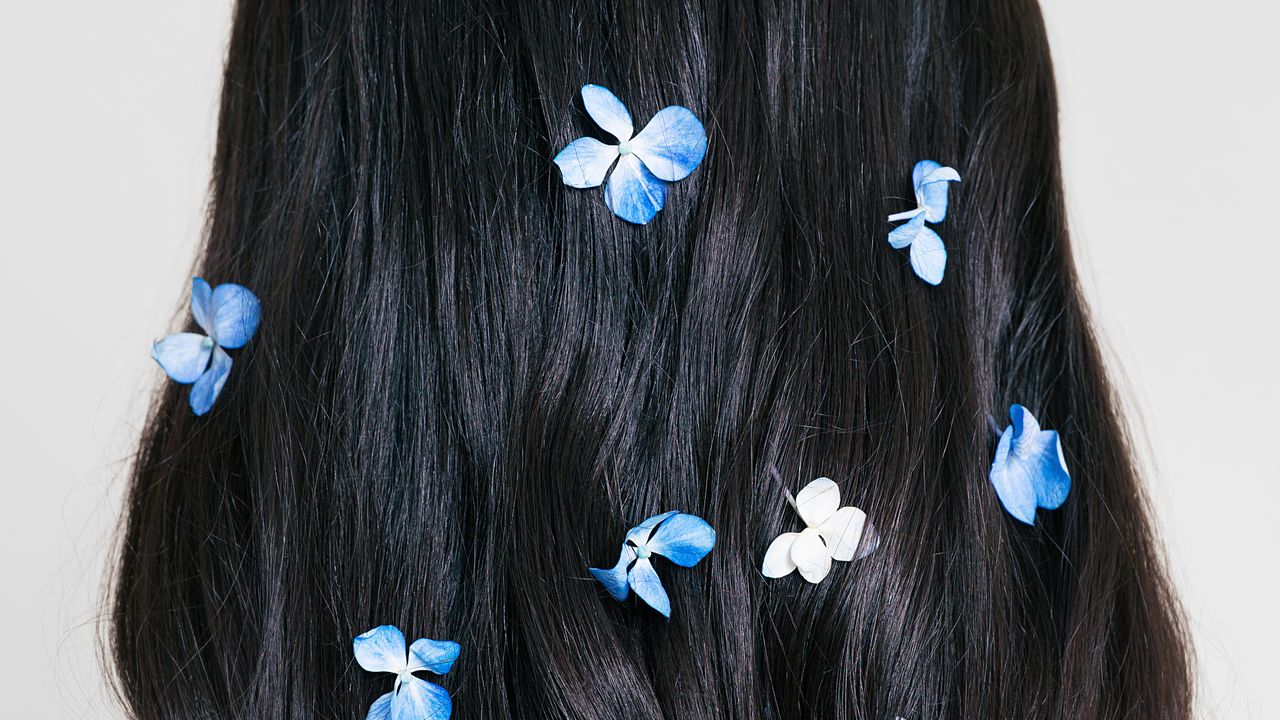
That, and scents tend to last longer on hair. (Ever smell your pillow the night after a bonfire?) “Hair is composed primarily of keratin, a fibrous protein with a complex structure that can bind and trap fragrance molecules,” says Hallie McDonald, MD, an Austin, Texas-based, board-certified dermatologist. “The cuticle, which is the outermost layer of the hair shaft, has overlapping scales that create small spaces where compounds can settle.”
And while the porous nature of hair allows fragrance to really diffuse over time, skin is biologically active. “It produces sweat and sebum and is constantly shedding cells. That contributes to more rapid fragrance evaporation and breakdown.” It also has a warmer surface temperature than hair, which speeds up evaporation.
If you really want to leave a lasting impression, your hair is a good place to start.
Can’t I just use eau de parfum in my hair?
“Why would I spend money on a hair fragrance when I could just spray my perfume onto my hair?” you may be asking. Well, that’s a bit like using Febreeze on your wrists as a perfume. Can you do it? Sure. Should you do it? Probably not.
Eau de parfum (EDP) and eau de toilette (EDT), and all the various concentrations therein, rely on alcohol as a carrier and solvent. “Fragrance itself does not inherently hurt the cuticle, but the combination of high alcohol content and repeated exposure can exacerbate dryness and brittleness,” says Dr. McDonald. “Alcohol evaporates quickly, which helps disperse scent, but it can also temporarily strip lipids and moisture from the hair shaft.” Plus, you’re not doing your scalp any favors by spraying irritating ingredients onto it, especially if you have a history of eczema, psoriasis, or seborrheic dermatitis. (Certain ingredients, like cold-pressed citrus oil, can be photosensitizing in very high concentrations, says Dr. McDonald, though it’s uncommon.)
“The fundamental difference comes down to alcohol content,” says Patty Hidalgo, vice president perfumer for IFF. “Hair mists and hair perfumes are formulated with low to no alcohol to avoid drying out or damaging the hair.” And one does not simply drop their fragrance recipe into a conditioner, shake it up, and call it a day. Not only are there regulatory differences and exposure limits, says New York-based perfumer Darryl Do, but certain formulas that are stable in alcohol might not be in an oil or a cream.
“Making a perfume smell good in alcohol is completely different from making a shampoo smell good,” adds fragrance influencer Emma, the perfumer student behind the social media account @perfumerism. “The chemical environments are completely different.”
And since we have higher expectations for our hair-care (and all) products these days, it doesn’t hurt if they also have nourishing ingredients. Dr. McDonald recommends looking for humectants like glycerin (The Signature Scent‘s hair fragrance contains glycerin and aloe) or panthenol to help retain moisture, conditioning silicones like dimethicone to smooth the cuticle, and lightweight oils for softness (Gisou‘s hair perfume is formulated with softening argan oil).
<>





Leave a Reply