
Lewiss on Lifestyle Medicine
February 02, 2026
4 min read
Key takeaways:
- The health journey starts with you.
- Calculating your BMI is a good first step.
- BMI has limitations and should be understood alongside other metrics, like waist circumference.
In 2008, Japan introduced the “Metabo Law,” short for the Metabolic Syndrome Countermeasures Promotion Act, which included “Specific Health Checkups” and “Specific Health Guidance.”
This was a public health effort to raise awareness of the connection between obesity, waist circumference (WC) and CVD. Women were advised to maintain a WC less than 90 cm, or 35.4 in, and men were advised to maintain a WC less than 85 cm, or 33.5 in.

I caught up with emergency medicine and lifestyle medicine physician Minako Abe, MD, DipABLM. Abe grew up in Japan and came to the United States for college and medical training. She practiced emergency medicine in the U.S. for 15 years. She returned to Japan and now serves as VP and chief operating officer of the Tokyo Cancer Clinic. Lifestyle medicine, including health coaching, is a mainstay of her work.
Abe shared:
“In Japan, employers are legally required to provide and pay for annual health checkups for employees (mandated under the Industrial Safety and Health Act). Typical measurements included are BMI, WC, BP and other preventive health assessments. Coverage for more comprehensive examinations varies by employer and may be fully covered, partially subsidized or self-paid. When concerning findings are identified — such as elevated BP, increased BMI or abdominal obesity via the WC — employees are offered an explanation of results and, in many cases, follow-up counseling by a physician, nurse or dietitian. This counseling generally includes basic education on diet, physical activity and lifestyle habits, and may resemble a brief lifestyle medicine-oriented intervention. Medical information from these evaluations is handled confidentially. While employers may receive limited information related to work fitness or the need for follow-up, individual health data are generally not used for punitive or work-related repercussions.”
I’ve been glad to see the American Heart Association (AHA), and the Go Red for Women “Know Your Numbers” health awareness campaigns. Four — there are many more — health numbers are highlighted because of their association with cardiovascular risk: BMI, BP, blood sugar and total cholesterol.
The BMI is body weight measured in kg divided by height in m2. User-friendly online calculators are available to help calculate your BMI, eg, the BMI calculator on MDCalc.
Once calculated, see where the BMI falls:
- underweight: less than 18.5 kg/m²;
- normal weight: 18.5 to 24.9 kg/m²;
- overweight: 25 to 29.9 kg/m²;
- class I obesity: 30 to 34.9 kg/m²;
- class II obesity: 35 to 39.9 kg/m²; and
- class III obesity: 40 kg/m² or higher.
These categories have limitations, particularly for Asian communities, for whom diabetes develops at lower BMI ranges. The adjusted table is:
- underweight: less than 18.5 kg/m²;
- normal weight: 18.5 to 22.9 kg/m²;
- overweight: 23 to 24.9 kg/m²;
- class I obesity: 25 to 29.9 kg/m²;
- class II obesity: 30 to 34.9 kg/m²; and
- class III obesity: 35 kg/m² or higher.
What is interesting and important to realize is that BMI does not account for muscle mass, bone density or body composition; it does not distinguish fat from muscle. So, interpreting this number in isolation falls short for, eg, the frail older adult with a normal BMI yet low muscle mass, or bulky person with a high BMI secondary to high muscle mass and not high body fat.
So, we need something more. Enter the WC.
Both BMI and WC are anthropometric (related to size, shape and proportion) measurements, which are noninvasive, quantitative and straightforward to measure. Unlike the BMI, the WC is a proxy for abominable fat and the adipose tissue surrounding our internal organs.
A 1997 WHO expert consultation report considered gender, age and ethnicity, and pointed to exactly this: the WC and waist-hip ratio (WHR) are better than BMI alone. A 2008 Waist Circumference and Waist-Hip Ratio Report of a WHO Expert Consultation worked on the premise that the WC and the WHR are useful in predicting noncommunicable disease risk. Women with a WC greater than or equal to 35 in and men with a WC greater than or equal to 40 in are at increased risk for CVD and diabetes. The AHA advises similar waistline guidelines.
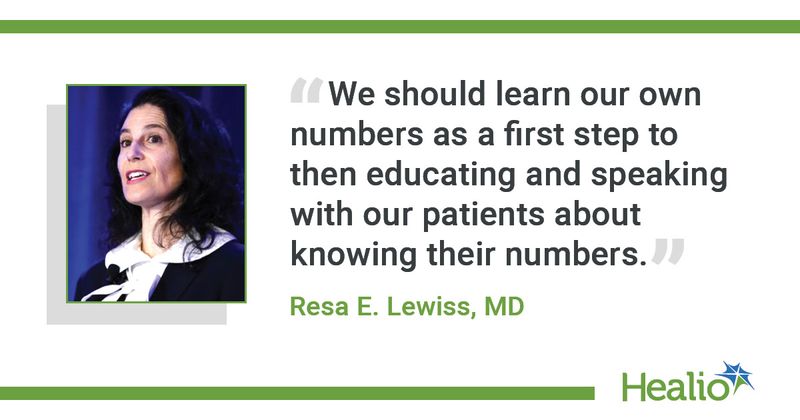
The health journey starts with you: Do you know your numbers? Start today by calculating your BMI and measuring your WC. See where you fall in the classifications. We should learn our own numbers as a first step to then educating and speaking with our patients about knowing their numbers. Then select one lifestyle behavioral change to start today.
Sources/Disclosures
Source:
Expert Submission
References:
- Araneta MRG, et al. Diabetes Care. 2015;doi:10.2337/dc14-2071.
- Calculate your BMI. https://www.nhlbi.nih.gov/calculate-your-bmi. Accessed Jan. 12, 2026.
- Clinical guidelines on the identification, evaluation and treatment of overweight and obesity in adults: The evidence report. https://www.ncbi.nlm.nih.gov/books/NBK2003/. Published September 1998. Accessed Jan. 12, 2026.
- Dr. Minako. https://www.drminako.com/copy-of-home. Accessed Jan. 12, 2026.
- Expert panel on the identification, evaluation and treatment of overweight in adults. Am J Clin Nutr. 1998;doi:10.1093/ajcn/68.4.899.
- Fukuma S, et al. JAMA Intern Med. 2020;doi:10.1001/jamainternmed.2020.4334.
- Go Red for Women. https://www.goredforwomen.org. Accessed Jan. 12, 2026.
- Hsu WC, et al. Diabetes Care. 2015;doi:10.2337/dc14-2391.
- Instructions for measuring waist circumference, according to NHANES III protocol. https://www.ncbi.nlm.nih.gov/books/NBK2004/box/A236/. Published September 1998. Accessed Jan. 12, 2026.
- Know Your Numbers. https://www.heart.org/en/health-topics/diabetes/prevention–treatment-of-diabetes/know-your-health-numbers. Accessed Jan. 12, 2026.
- Mayo Clinic BMI and waist circumference calculator. https://www.mayoclinic.org/diseases-conditions/obesity/in-depth/bmi-calculator/itt-20084938. Published Jan. 12, 2026.
- MDCalc. BMI calculator (body mass index and BSA). https://www.mdcalc.com/calc/29/body-mass-index-bmi-body-surface-area-bsa. Accessed Jan. 12, 2026.
- Obesity: Preventing and managing the global epidemic: Report of a WHO consultation. https://iris.who.int/items/933e09aa-64f9-46e9-8dbb-78d8cddf1a3d. Published Dec. 31, 2000. Accessed Jan. 12, 2026.
- Waist circumference and waist-hip ratio: Report of a WHO expert consultation. https://iris.who.int/server/api/core/bitstreams/ca408ade-05c9-4b7c-8967-6ee5b5e0ccd8/content. Published Dec. 31, 2011. Accessed Jan. 12, 2026.
Resa E. Lewiss, MD, is a lifestyle medicine and emergency medicine physician. She is an adjunct professor of emergency medicine at the Warren Alpert Medical School of Brown University. She is the host of The Visible Voices Podcast and the co-author of MicroSkills: Small Actions, Big Impact. She can be reached via her website resaelewissmd.com.
Disclosures:
Lewiss reports no relevant financial disclosures.

Ask a clinical question and tap into Healio AI’s knowledge base.
- PubMed, enrolling/recruiting trials, guidelines
- Clinical Guidance, Healio CME, FDA news
- Healio’s exclusive daily news coverage of clinical data
<











Leave a Reply