
January 16, 2026
2 min read
Key takeaways:
- A large proportion of patients surveyed did not understand terms frequently used by dermatologists.
- Up to 40% did not know squamous cell carcinomas, basal cell carcinomas and melanomas were types of cancer.
Nearly one-third of patients who responded to a survey did not understand common skin cancer terms frequently used by dermatologists, signaling a need for improved patient education during clinical encounters.
Ongoing issues such as staff shortages and increasing demands have made time constraints common in clinical practice, often requiring health care professionals to perform certain tasks quickly. However, patient education should not be one of those tasks, according to Katherine Brag, MD, associate program director of Harvard Combined Dermatology Residency and director of cutaneous oncology in the department of dermatology at Beth Israel Deaconess Medical Center, Harvard Medical School.

“It is OK to be quick in the hallway or quick on your computer when doing your notes, but it is not acceptable to be quick during patient counseling,” Brag told Healio. “Patient counseling is the crux of what we do. If we don’t do it well, patients won’t understand what you said and may have worse outcomes.”
Poor outcomes may include missing necessary procedures driven by a misunderstanding of the reasoning behind them, avoiding care due to low satisfaction or even becoming fearful of medical treatments, Brag said.
Brag and colleagues surveyed 166 patients (54.8% women; 49% aged 60 years and older) to assess their comprehension of 13 common skin cancer-related terms: topical, skin biopsy, benign, malignant, melanoma, metastatic, basal cell carcinoma, excision, pathology results, clear margins, squamous cell carcinoma, dysplastic nevus and actinic. The anonymous, voluntary survey, completed at Beth Israel Deaconess Medical Center general dermatology clinics, included multiple choice questions with one correct answer for each term.
Results showed that 82% to 95% of respondents understood the terms metastatic, melanoma, malignant, benign, skin biopsy and topical. Fifty-nine percent to 70% of respondents correctly identified squamous cell carcinoma, clear margins, pathology results, excision and basal cell carcinoma. Only 21.6% understood the term dysplastic nevus and 13.6% correctly defined actinic.
Nearly one-third of respondents did not understand terms frequently used by dermatologists such as clear margins (35.8%) and pathology results (38.5%), the authors wrote in JAMA Dermatology.
A substantial proportion of patients did not know that squamous cell carcinomas (30%), basal cell carcinomas (40%) and melanomas (20%) were types of cancer.
Compared with respondents aged 60 years and older, those aged 18 to 29 years scored lower on the survey, answering an average of 45% of the questions correctly (β = –17.88; 95% CI, –28.37 to –7.39; P < .001). Although respondents aged 60 years and older were more familiar with these terms, their average accuracy score on the survey remained below 75%.
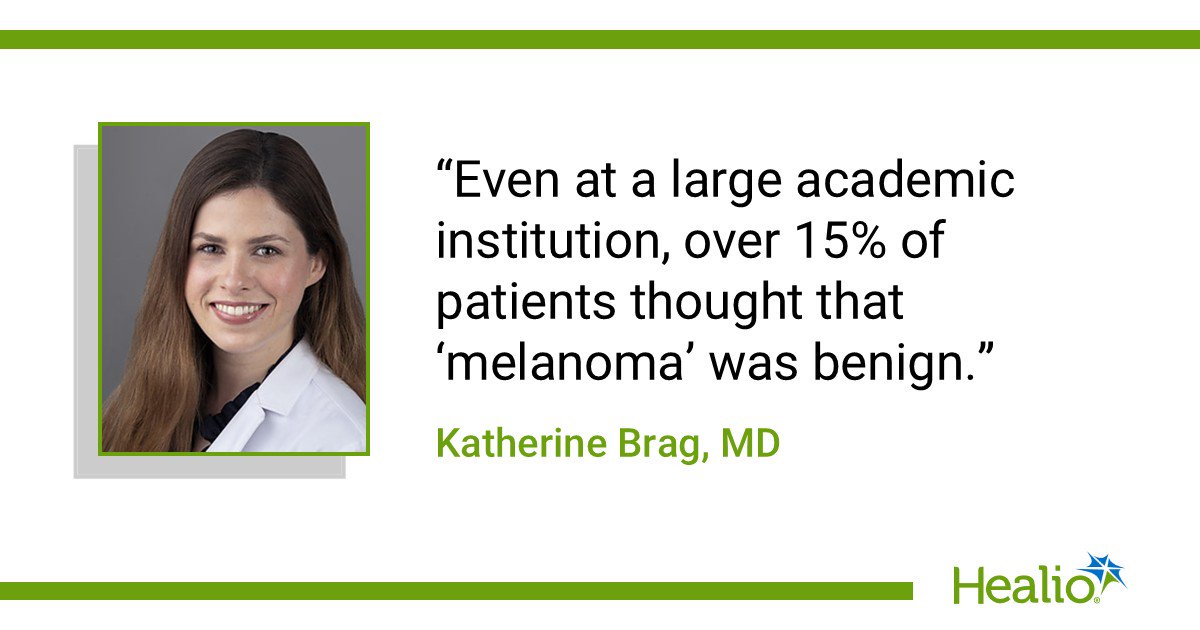
“The fact is, even at a large academic institution, over 15% of patients thought that melanoma was benign,” Brag said. “This just goes to show how important it is to educate patients during clinical encounters.”
Brag recommended dermatologists approach every visit assuming a patient may be unfamiliar with these frequently used terms.
“Be prepared to give a definition for each term and do not shy away from the scary ones like ‘malignant,’” Brag told Healio. “Patients deserve to hear the correct and accurate term. I really believe that if you do a good job counseling in the moment, it saves you time.”
For more information:
Katherine Brag, MD, can be reached at dermatology@healio.com.

Ask a clinical question and tap into Healio AI’s knowledge base.
- PubMed, enrolling/recruiting trials, guidelines
- Clinical Guidance, Healio CME, FDA news
- Healio’s exclusive daily news coverage of clinical data
<








Leave a Reply