

Key takeaways:
- Nearly three-quarters of patients reported at least 30% reduction in abdominal pain with the diet.
- The majority of patients also experienced at least 30% improvement in discomfort, distention and bloating.
CHICAGO — Patients with irritable bowel syndrome who consumed an elemental diet for 2 weeks reported significant improvement in abdominal pain, discomfort, distention and bloating, according to a presenter at Digestive Disease Week.
Notably, individuals studied met the FDA-aligned threshold of at least 30% improvement, which persisted in the 2 weeks they returned to their previous diets.

“Everybody wants to find a way to reset the gut microbiome, and this is the closest we’ve gotten so far,” Ali Rezaie, MD, MSc, medical director of the GI motility program and associate professor at Cedars-Sinai, told Healio.
Rezaie and colleagues conducted a post hoc analysis of a prospective trial to assess the impact of a 2-week exclusive palatable oral elemental diet (mBiota Elemental, GoodLFE) on abdominal-related issues in patients with IBS. The diet is an allergen-free, nutritionally complete liquid formulation.
Analysis included 22 patients (mean age, 46 years; 76% women) who met Rome IV criteria for IBS, of whom 13 (59%) had mixed-type IBS, five (23%) had constipation-predominant IBS and four (18%) had diarrhea-dominant IBS.
Patients completed a 1-week baseline screening period, transitioned to the 2-week exclusive palatable elemental diet and reintroduced their regular diet for another 2 weeks. They assessed IBS symptoms via daily electronic diaries.
Researchers defined responders as those who achieved at least a 30% reduction from baseline in the weekly average of worst daily abdominal pain, discomfort, distention or bloating at week 5.
Most patients (82%) reported a 30% or greater improvement in at least one symptom. Notably, 73% reported at least a 30% reduction in abdominal pain, a finding Rezaie called “a pleasant surprise.”
“We went in thinking it was going to come back as maybe 40% to 50% maximum,” he said. “The reason why is, that’s pretty much what we have seen in phase 2 and phase 3 trials with medications. We didn’t expect this high of a number. That’s not a usual thing we see in IBS.”
Furthermore, 64% of participants reported experiencing pain improvement of at least 40%, and 50% reported a pain improvement of at least 50%.
Nearly two-thirds (64%) reported at least 30% improvement in abdominal discomfort and distention, and 59% reported a 30% improvement in bloating.
Many questions remain, Rezaie said, and larger prospective studies are needed to determine efficacy and long-term durability of response, as well as studies that assess mechanistic factors contributing to response in this patient population.
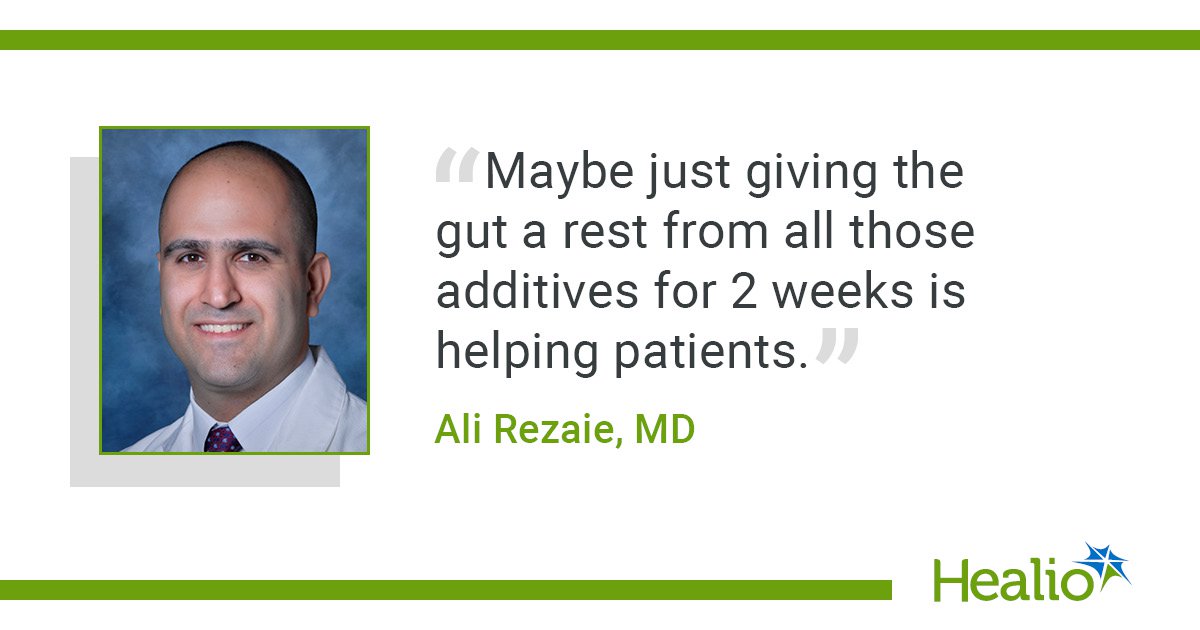
“If we knew that [the diet] would be this effective, we would have done this clinical trial much longer to see how long these effects last,” Rezaie said. “I’m also very interested in, why is it working so well? Is it the modulation of the microbiome? Is it because of known anti-inflammatory properties of elemental diet? It doesn’t have food additives, it doesn’t have sweeteners. Maybe just giving the gut a rest from all those additives for 2 weeks is helping patients.”
For more information:
Ali Rezaie, MD, MSc, can be reached at ali.rezaie@csmc.edu.
Sources/Disclosures
Source:
Rezaie A, et al. Abdominal pain response to a two-week exclusive palatable elemental diet in irritable bowel syndrome: Post hoc analysis of a prospective trial. Presented at: Digestive Disease Week; May 2-5, 2026; Chicago.
Disclosures:
Rezaie reports consulting for Alimentiv, Ardelyx, Bausch Health, Blueprint Medicines and Hobbs Medical; serving on the speakers’ bureau for Bausch Health; and having stock ownership in Alimetry and equity interest in Gemelli and GoodLFE. Please see the study for all other authors’ relevant financial disclosures.

Ask a clinical question and tap into Healio AI’s knowledge base.
- PubMed, enrolling/recruiting trials, guidelines
- Clinical Guidance, Healio CME, FDA news
- Healio’s exclusive daily news coverage of clinical data
<











Leave a Reply