

Key takeaways:
- More than 50% of U.S. physicians have signs of burnout, leading to 20% more medical errors.
- AI innovations could help improve workflow, alleviating stressors that lead to burnout.
CHICAGO — The AI tools that benefit clinicians most are not always the glamourous ones contributing to drugs, robotics and therapeutics innovations, but could also be the mundane ones that help ease physician burnout.
That is according to David Ting, MD, keynote speaker at Digestive Disease Week.

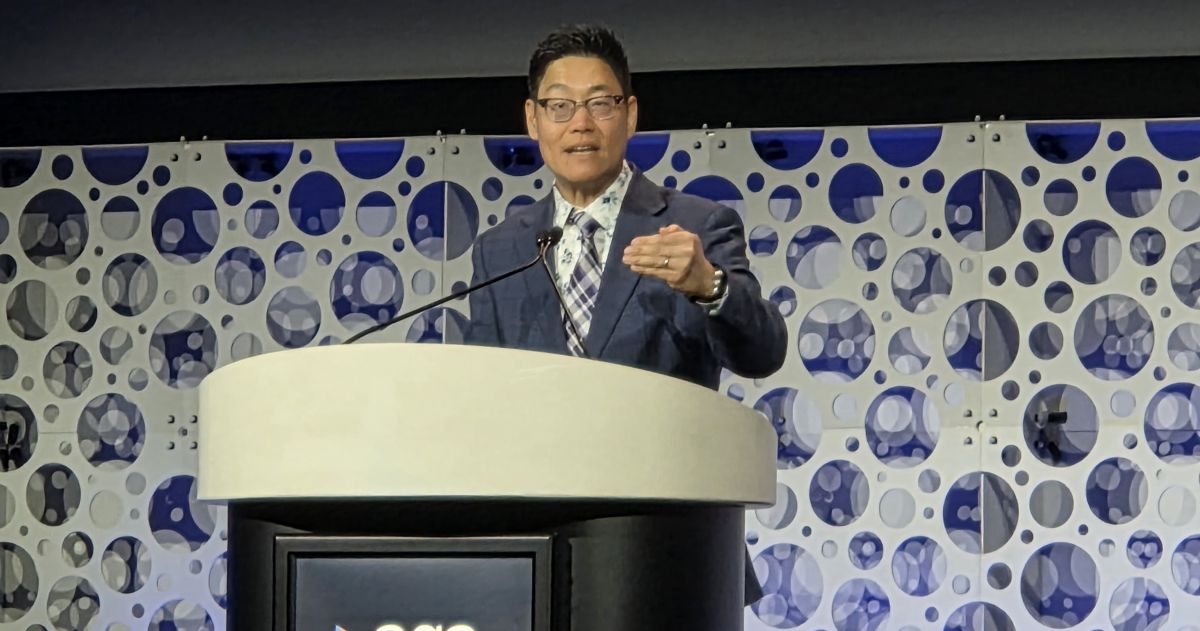
David Ting, MD, chief clinical product lead at Microsoft and primary care internist and pediatrician at Massachusetts General Hospital, was the keynote speaker at Digestive Disease Week. Image: Octavia Feliciano.
Ting, chief clinical product lead at Microsoft and primary care internist and pediatrician at Massachusetts General Hospital, told attendees he envisions a 2036 where AI products assist with the ordinary: workflow redesign, administrative burden and workplace collaboration.
AI also might one day take center stage in reshaping the clinical environment and restoring the “joy of practice,” he said.
“More than 50% of clinicians in the United States show signs of burnout,” Ting said. “When you look at how clinicians interact with technology over the course of a 10-hour shift, one study showed they were making 4,000 keyboard clicks.”
Clinicians report 20% more medical errors when burned out, he added.
Ting spotlighted “AI agents” in the models of Google Gemini, Microsoft Copilot and Anthropic’s Claude, positing them as a potential solution to the physician burnout crisis.
In his vision for the near future, “these agents were not only augmenting our clinical knowledge, but [also] helping with referral management, ordering, managing messages, collaboration across different platforms, coding support, prior authorizations and work-life balance.”
Those changes would allow clinicians to move “from 4,000 clicks per shift to conversation with our patients, colleagues and staff,” he said.
The existing and possible upcoming features of clinical AI tools like Microsoft Dragon Copilot include summarizing charts instantly, updating notes directly in the electronic health record and identifying clinical trial eligibility in real time, according to Ting.
AI could also aid physicians in ways that they might not yet have imagined. For instance, technology might help with adherence or patient follow-through. Describing a hypothetical scenario, Ting shared how AI tools could use voice biomarker analysis to identify signs of anxiety in a patient.
“The AI agent has produced a crisp summary of what I want to know from recent labs or CT scans,” Ting told the audience. “While I’m seeing the patient, a notification [alerts me] that she is exhibiting anxiety that may impact her ability to follow through on or understand my instructions.”
For this projected future to take shape, Ting believes fostering clinician and public trust in AI health care tools is essential. Additionally, gastroenterologists do not need to worry about being replaced by AI, he emphasized.
“Medicine is fundamentally about human relationships, and as much as AI could augment decision-making, robotics and some behaviors, it cannot replace the personal hand of the gastroenterologist in an exam, at a bedside or in a colonoscopy endoscopy suite,” Ting said.
Likewise, clinicians do not have to be concerned about deskilling.
“Human skills will flourish and improve because we’ve taken away some of the drudgery, some of the brain rot that caused our fellows to lose focus, that caused even us as clinicians to lose touch with the most important part of what we do, which is taking care of our patients,” he added.
Addressing other concerns, he touched on how diversity is being added to datasets to avoid training bias, and how AI hallucination and drift are already largely prompted out of systems.
Issues like AI’s environmental impact will be ongoing conversations that may require innovative solutions, Ting said, bringing up SpaceX’s proposal to launch data centers into space to capture more solar power.
Ting believes the future of gastroenterology is bright.
“In 2036, we will see the joy dividend, where GI becomes fun again, and AI gives [clinicians] time back,” he said.
Sources/Disclosures
Source:
Ting D. Gastroenterology in 2036. Presented at: Digestive Disease Week; May 2-5, 2026; Chicago.
Disclosures:
Ting reports serving as chief clinical product lead at Microsoft.

Ask a clinical question and tap into Healio AI’s knowledge base.
- PubMed, enrolling/recruiting trials, guidelines
- Clinical Guidance, Healio CME, FDA news
- Healio’s exclusive daily news coverage of clinical data
<




Leave a Reply