
April 27, 2026
1 min read

Key takeaways:
- Acupuncture decreased opioid use and pain scores on postoperative days 0 and 1 after THA.
- In a subset of patients, a greater number of patients in the acupuncture group required no opioids in the hospital.
Acupuncture performed during total hip arthroplasty as part of an enhanced recovery after surgery protocol may improve immediate postoperative pain and reduce early opioid use, according to results.
“This is something that is very, very safe,” Stephanie I. Cheng, MD, DABMA, FAAMA, from Hospital for Special Surgery, told Healio about results presented at the American Academy of Medical Acupuncture (AAMA) Annual Symposium and which was awarded first place in the AAMA annual research paper competition. “The safety profile is good. It is performed on the ear, it is away from the surgical site and you are not dealing with infection. Anything that can help us decrease opioid usage, increase patient satisfaction and decrease their length of stay is something that we should try.”

Data derived from Cheng SI, et al. The effect of intraoperative acupuncture within an enhanced recovery pathway for total hip arthroplasty: A randomized controlled trial. Presented at: American Academy of Medical Acupuncture Annual Symposium; April 23-26, 2026; Denver.
In a triple blind study, Cheng and colleagues randomly assigned 484 patients undergoing primary THA to receive either intraoperative acupuncture (n = 242) or standard of care (n = 242). Researchers assessed pain using the numerical rating scales and calculated opioid use in oral morphine equivalents.

Stephanie I. Cheng
Although trends toward decreased opioid use at postoperative day 30 were not statistically significant in the acupuncture group, Cheng said there was a significant decrease in opioid use and pain scores in the acupuncture group on postoperative days 0 and 1.
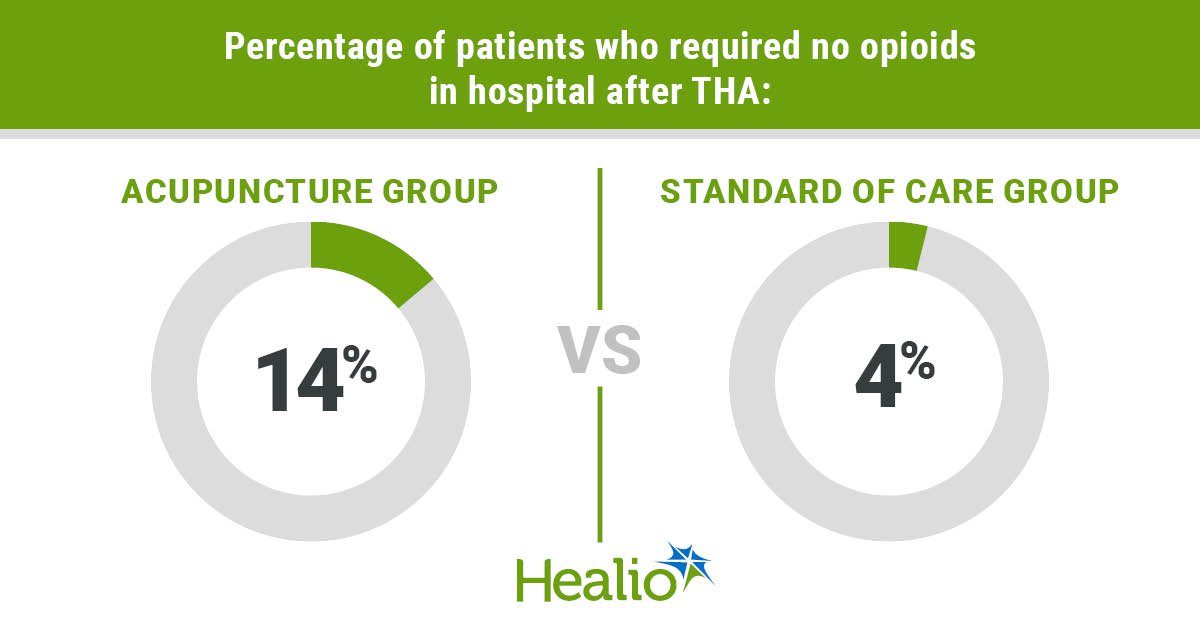
In a subset of 185 patients who underwent THA between January 2024 and March 2025, patients who received acupuncture experienced lower pain scores and lower length of stay, according to Cheng. She also said a significantly greater number of patients in the acupuncture group required no opioids in the hospital compared with the standard of care group (14% vs. 4%).
“Acupuncture allows patients to get up and moving, and get out of the hospital within that 23-hour period instead of having a multiple day hospital stay that may not get paid by insurance,” Cheng said. “The helps hospitals, doctors and the patients not incur those costs of staying an extra couple of days because their pain is not controlled.”
For more information:
Stephanie I. Cheng, MD, DABMA, FAAMA, can be contacted at mediarelations@hss.edu.
Sources/Disclosures
Source:
Cheng SI, et al. The effect of intraoperative acupuncture within an enhanced recovery pathway for total hip arthroplasty: A randomized controlled trial. Presented at: American Academy of Medical Acupuncture Annual Symposium; April 23-26, 2026; Denver.
Disclosures:
Cheng reports being on the board of the American Academy of Medical Acupuncture.

Ask a clinical question and tap into Healio AI’s knowledge base.
- PubMed, enrolling/recruiting trials, guidelines
- Clinical Guidance, Healio CME, FDA news
- Healio’s exclusive daily news coverage of clinical data
<












Leave a Reply