
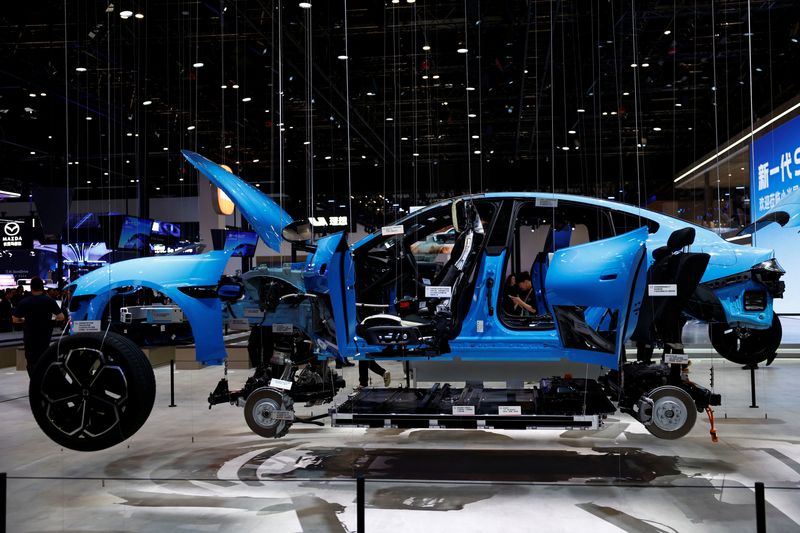
BEIJING, April 24 (Reuters) – It took China 25 years to dominate the market for electric vehicles.
Now, the country’s auto industry is hurtling toward the next disruption: Embedding artificial intelligence in cars that will make the next generation of EVs not just network-connected, but self-reasoning machines running on Chinese chips and software.
China’s most recent five-year plan released earlier this year presented a blueprint for “AI Plus,” a national project to embed AI systems into manufacturing, healthcare and almost every other corner of the economy.
Part of that aim is to break China’s dependence on high-end semiconductors – a trade chokepoint dominated by the U.S.
“There’s no longer a distinction between a technology company and a car company,” Nissan Motor China chief Stephen Ma told reporters on the sidelines of the Beijing Auto Show, which kicked off on Friday. “The AI-developed vehicle is much faster and it’s quicker in China.”
In recent days, Chinese automakers and their suppliers have flooded the zone with investment commitments and new AI systems. Some of the immediate applications seemed incremental. Analysts say the longer-term stakes are huge.
China’s automakers are now so advanced they are upending the global car industry, said Francois Roudier, secretary general of the International Organisation of Motor Vehicle Manufacturers, a federation of trade groups that represents the world’s auto industry.
“There is no transition,” Roudier told Reuters in Beijing. “It’s a revolution.”
THE CAR IS THE AGENT
Xpeng has said its updated AI model allows drivers to give the car commands – like, “park near the entrance to the shopping center” – rather than designating a spot on a map. Xpeng vehicles can use cameras to navigate even without mapping or coordinates.
Xiaomi, an appliance and phone maker that stormed into the EV business three years ago, released an updated AI model just after midnight on Thursday.
Xiaomi has said its AI-empowered HyperOS operating system in its cars would allow drivers to task the system with complicated to-do lists, making restaurant reservations, placing coffee orders and compiling notes from the road. The system could also detect when drivers seem stressed or agitated and adjust the lighting and music for their arrival at home.
“So much focus on AI in other parts of the world has been on how can we use it to improve business? That’s not what Chinese automakers are talking about,” said Dan Hearsch, global co-leader for automotive at advisory firm AlixPartners. “The AI they’re building in is going to make the car easier to drive, easier to interact with, easier to do all of the things that otherwise take effort.”










Leave a Reply