
February 04, 2026
4 min read
Key takeaways:
- AMA President Bobby Mukkamala, MD, had a grade 2 astrocytoma surgically removed from his brain.
- Mukkamala shared his experience and what he wants clinicians to learn from his journey.
Feb. 4 is World Cancer Day, a global initiative aimed at bringing awareness and encouraging action against one of the world’s leading causes of death.
According to the American Cancer Society, about 40 out of 100 men and 39 out of 100 women will develop cancer sometime during their life.

One of those people is AMA President Bobby Mukkamala, MD.
According to the AMA, a grade 2 astrocytoma — “a slow-growing tumor that only rarely spreads to other parts of the central nervous system” — was discovered in the left side of Mukkamala’s brain in November 2024.
The surgery to remove Mukkamala’s tumor was a success, and he was told he would be able to avoid chemo and radiation therapy and expect to live for another 20 years.
Healio spoke with Mukkamala to learn more about his experience with cancer, what he wants clinicians to take away from it and more.
Healio: Can you talk about your own journey as a patient with cancer?
Mukkamala: It was definitely an eye opener. Up until that point, being a head and neck surgeon, I saw patients with cancer almost on a daily basis, helping them navigate the system on their behalf. Then suddenly to realize right after my MRI scan … I thought, “Holy cow, what am I going to do?”
It was an amazing experience for me because as a physician and as the president-elect of AMA, I had a Zoom call set up with consultations with some of the top neurosurgeons in the country within a week. Three weeks later, I had an amazing operation with the Mayo Clinic and I’m alive. But I think about how it was a day of misery. Like, “Oh my gosh. How did this happen?”
Immediately starting with the first Zoom call, as soon as we got done, I thought, “people do not have that kind of access to care.”
I’m a lucky guy, and this gave me a purpose to make access to care, especially in underserved areas, one of my main focus areas. It woke me up to what needs to be done, because I knew the [to-do] list before, but having felt that list …. It really motivated me.
Healio: What lessons do you want primary care providers to take away from your experience?
Mukkamala: I can see them trying to navigate on behalf of their patients, and I don’t want them to give up. I remember going to our state legislature in Lansing, Michigan, with a patient who had stage I tonsil cancer. By the time we got prior authorization for them to get their positron emission tomography scan, they developed a lymph node and stage II cancer. So, the difficulty that the patients have and the physicians have in navigating the system to address cancer, I can totally imagine what it feels like to be a PCP doing that.
For PCPs who know the right thing to do, but they’re having trouble getting it done, it makes me even more energetic to try to help them take the best care of the patient.
What I would say to PCPs is, ‘Thank you for doing what you do.’ It’s bad enough to tell if patients have cancer, it’s worse to tell them about the delay that we might have in getting that treated.
Healio: Colorectal cancer is now the leading cause of cancer death among people aged under 50 years. When should PCPs start thinking about screening younger adults for this cancer?
Mukkamala: The U.S. Preventive Services Task Forces’ recommendation for adult screening for colorectal cancer is to start at age 45 years. That’s how we should be guided in making these decisions. And colorectal cancer is something that is on the rise from ages 20 to 49 years, so it’s even more important to let people know once they get coverage. That’s what the USPSTF is there for. It’s based on science, and then the insurance companies are obligated to cover it at that point. So, we’re fighting a battle for exactly reasons I mentioned earlier, to help PCPs better navigate that system.
Healio: Are there any other messages you want to share with clinicians and patients on World Cancer Day?
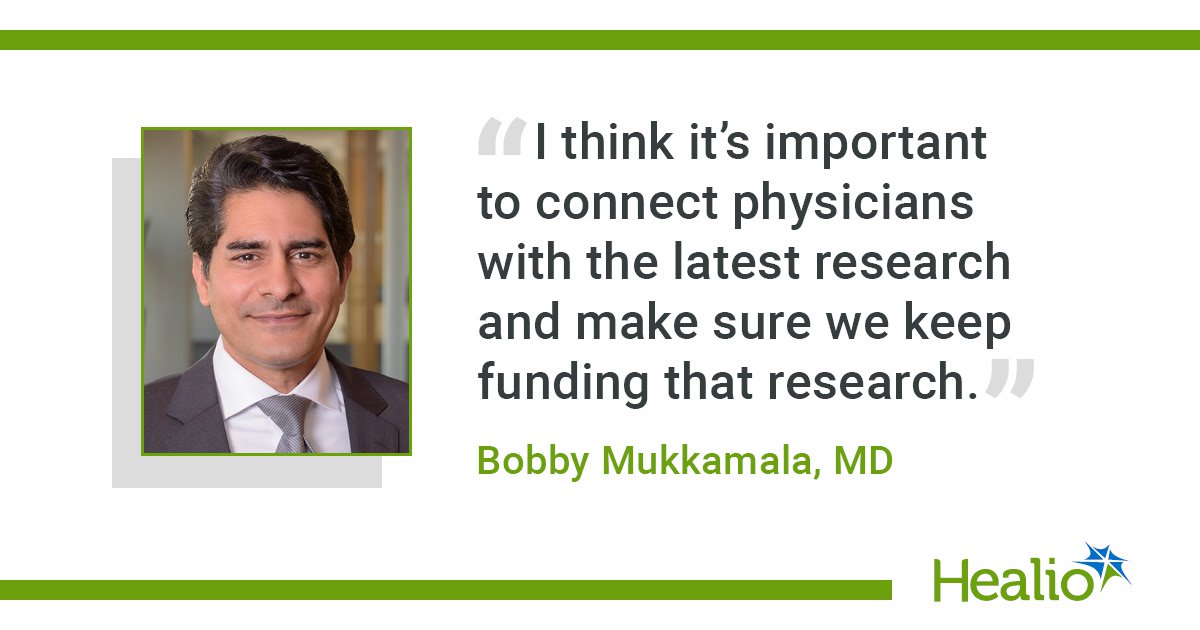
Mukkamala: I think it’s something that we need to continue to focus on in every perspective, like research to see who’s at risk. For example, with breast cancer, the BRCA 1 and 2 genetic mutations are something that we weren’t aware of when I was a medical student. So, I think it’s important to connect physicians with the latest research and make sure we keep funding that research. My treatment was very much impacted by NIH funding, and NIH funding is at risk of going down. These are the things we should advocate for.
World Cancer Day is something we should all be aware of so we can work on everything, from doing the research to getting patients access and support from their families and communities. There’s no way I would be here talking to you without that kind of support system. I think we should aim for everyone to have that.
Sources/Disclosures
Source:
Healio Interviews
References:
Disclosures:
Healio could not determine relevant financial disclosures at the time of publication.

Ask a clinical question and tap into Healio AI’s knowledge base.
- PubMed, enrolling/recruiting trials, guidelines
- Clinical Guidance, Healio CME, FDA news
- Healio’s exclusive daily news coverage of clinical data
<








Leave a Reply