
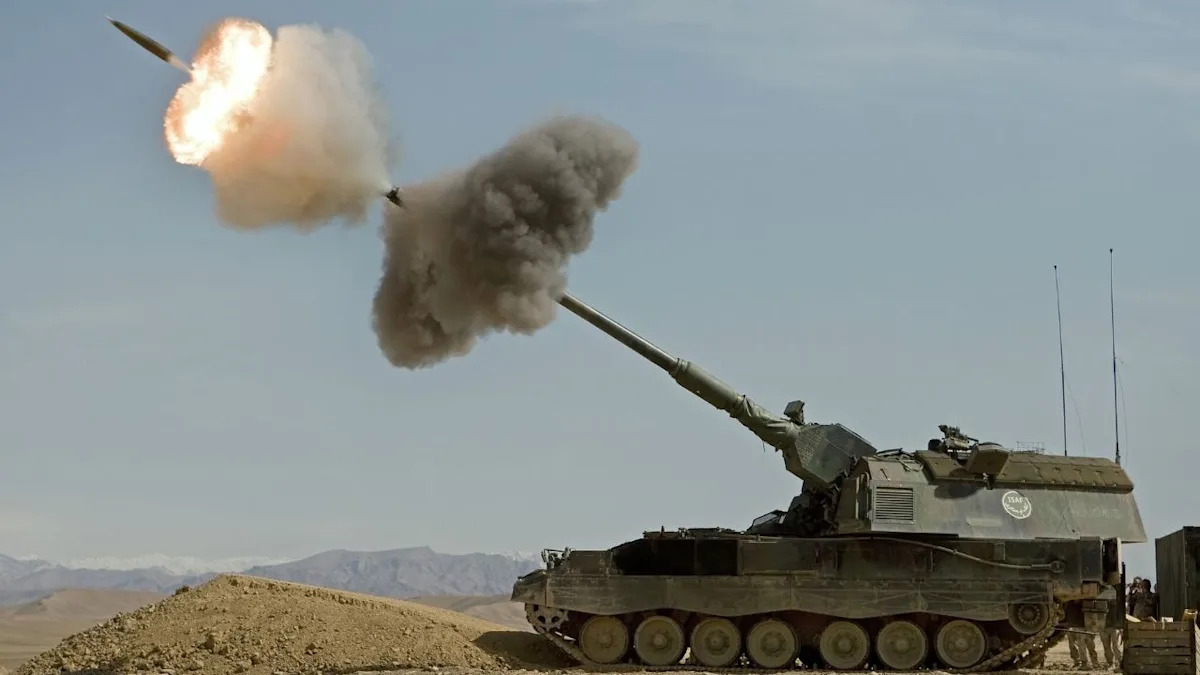
Artillery has long been hailed as the king of battle. Mounted on wheels and tracks, these mighty platforms unleash thunderous fire that can decide the fate of armies.
From the grinding slugfests of World War II to today’s precision-guided strikes, artillery vehicles have shaped every era of warfare. They may lack the glamour of tanks or fighter jets, but when their guns speak, entire battlefields listen.
Each of these machines carries a story of ingenuity and raw power. Some smashed through fortified lines in global wars, while others rewrote the rules of firepower during the Cold War or in modern high-tech conflicts. Tracing their evolution is tracing the very heartbeat of modern combat.
Wespe (Germany, WWII)

Image Credit: Bundesarchiv – CC-BY-SA 3.0/Wiki Commons.
The Wespe, meaning “Wasp,” was Germany’s attempt to give its artillery a sting that could keep up with fast-moving armies. Mounted on a Panzer chassis, it could travel with frontline units and rain shells down from behind the lines. Unlike traditional towed artillery, the Wespe didn’t have to be unhitched or set up, making it far more responsive in battle. German commanders loved its flexibility, and troops respected the cover it provided during offensives.
Of course, it wasn’t invincible, and its light armor meant it couldn’t survive much direct fire. Still, the Wespe represented the shift toward mobile artillery that would dominate warfare. It proved that the days of slow, static guns were fading fast. In many ways, it was a blueprint for the artillery vehicles that followed.
Hummel (Germany, WWII)

Image Credit: Bundesarchiv – CC BY-SA 3.0/Wiki Commons.
The Hummel, also known as the “Bumblebee” according to The National Interest, was another German creation that buzzed across battlefields with devastating effect. Larger and heavier than the Wespe, it carried a more powerful punch designed to support armored spearheads. Introduced in 1943, it provided mobile heavy artillery support that could keep pace with armored formations, especially on the Eastern Front.
Soldiers who fought under its protection often credited it with breaking tough enemy defenses. However, like many German vehicles, it was complex to build and maintain, which limited its numbers. Despite that, it proved its worth in major battles on the Eastern Front. The Hummel showed that artillery could be both mobile and fearsome at the same time. Its legacy lived on in the designs of postwar vehicles around the world.
SU-152 (Soviet Union, WWII)

Image Credit: TASS photo chronicle – Public Domain/Wiki Commons.
Nicknamed the “Beast Slayer,” the Soviet SU-152 was a formidable vehicle that struck fear into German tank crews. Originally built to blast through fortifications, it became famous for knocking out even the heaviest German armor.
The Red Army utilized it in key offensives, and it gained a reputation as a war-winning force. Troops loved its sheer destructive power, even if its size and weight made it a bit unwieldy. German reports dreaded seeing them on the horizon, knowing they could rip apart Tigers and Panthers with terrifying ease.
The SU-152 became a symbol of Soviet industrial might and battlefield determination. Its story wasn’t about elegance, but about overwhelming force. By the war’s end, it had carved out a fearsome reputation in history.
M7 Priest (United States, WWII)

Image Credit: Alf van Beem – Own work, CC0/Wiki Commons.
The M7 Priest was America’s answer to the need for fast, mobile artillery during World War II. Built initially on a modified M3 Lee chassis, and later, in the M7B1 variant, on an M4A3 Sherman chassis, it could move with frontline troops and deliver reliable fire support.
Its nickname came from its pulpit-like gun mount, which reminded soldiers of a preacher’s stand. The Priest played a key role in North Africa, Italy, and Normandy, earning the respect of Allied troops everywhere. It became a workhorse of the U.S. Army, turning up in nearly every major campaign.
Crews loved its reliability and versatility, while commanders praised its ability to keep the pressure on enemy forces. It wasn’t flashy, but it got the job done, and then some. The Priest embodied America’s pragmatic approach to wartime innovation: build it fast, use it hard, and let it win battles.
Schwerer Gustav (Germany, WWII)

Image Credit: Collection – Barrel Artillery – Public Domain/Wiki Commons.
When it comes to artillery legends, nothing tops the Schwerer Gustav. This German railway supergun was the largest-calibre rifled weapon ever used in combat and, by weight, one of the heaviest mobile artillery pieces ever built, so massive that it had to be rolled into battle on specially designed railway tracks.
Its shells were the size of small cars, designed to smash fortresses and leave craters big enough to swallow houses. Just the sight of it inspired awe, and probably a good dose of fear, for anyone on either side of the front. The logistics of moving and operating it were insane: thousands of men, weeks of preparation, and entire rail networks dedicated to setting it up. In practice, it was slow and vulnerable, but when it fired, it was pure spectacle.
Crews described the blast as earth-shaking, a sound you’d never forget. Gustav didn’t win the war for Germany, but it cemented its place in history as the most outrageous artillery weapon ever made. Even today, it stands as a symbol of how far military planners will go when chasing the notion that “bigger is better.”
FV433 Abbot (United Kingdom, Cold War)

Image Credit: AlfvanBeem – Own work, CC0/Wiki Commons.
Britain’s FV433 Abbot was a small but highly effective self-propelled gun that entered service in the 1960s. Compact and reliable, it gave British forces a mobile artillery punch during the height of the Cold War. Its size made it easy to maneuver, and it became a staple of NATO exercises across Europe.
Crews appreciated its practicality, and it earned a reputation as dependable rather than glamorous. The Abbot’s strength was its consistency; it worked when it was needed, without overcomplication. For decades, it quietly served on the front lines of deterrence, always ready to move and shoot.
Although it may not have been famous, it embodied the professionalism of the British Army. The Abbot proved that not all game-changers are flashy; sometimes, steady reliability is the real secret to power.
2S1 Gvozdika (Soviet Union, Cold War)

Image Credit: Andrew Bossi – Own work, CC BY-SA 2.5/Wiki Commons.
The 2S1 Gvozdika, or “Carnation,” became one of the most widespread artillery vehicles of the Cold War. Small, amphibious, and highly mobile, it was exported worldwide to Soviet allies.
Wherever there was a Cold War conflict, chances were the Gvozdika was there. Its ability to cross rivers and keep up with armored formations made it a favorite of Warsaw Pact militaries. While not the most powerful, it was flexible, affordable, and easy to use, a winning combination in proxy wars.
Crews admired its versatility, and commanders valued its numbers. The Gvozdika appeared in the Middle East, Africa, and Eastern Europe, becoming almost iconic due to its widespread presence. It showed that sometimes influence wasn’t about one vehicle, but about sheer global presence.
M110 Howitzer (United States, Cold War)

Image Credit: Leger Film – CC BY-SA 4.0/Wiki Commons.
The M110 was a formidable artillery vehicle, serving U.S. and NATO forces for decades. Designed to deliver devastating long-range firepower, it was a constant presence during the Cold War.
Crews described firing it as both exhilarating and intimidating, given the sheer size of its shells. It saw action in Vietnam, where it provided fire support in some of the toughest battles. Later, it served in the Middle East, proving its relevance in different terrains. Its reputation was built on raw power; when the M110 spoke, everyone listened.
Though eventually retired, it left a lasting impression on those who served with it. The M110 remains one of the most memorable American artillery vehicles of the 20th century.
M109 Paladin (United States, Cold War–Modern)

Image Credit: Sir kiss – Own work, Public Domain/Wiki Commons.
Few artillery vehicles have had a career as long and storied as the M109 family. First introduced in 1963, it has undergone numerous upgrades; ‘Paladin’ refers to the modernized variants (such as the M109A6) that kept the platform relevant into the modern era.
From Vietnam to the Gulf War to the present day, the Paladin has been at the center of American fire support. Crews love its adaptability, and commanders trust its reliability. Over the course of decades of combat, it has proven time and again that it can adapt to the changing times. The Paladin has earned its place not just as a weapon, but as a symbol of continuity.
For many soldiers, it was the sound of reassurance on the battlefield. Few vehicles embody the phrase “tried and true” better than the M109.
2S7 Pion (Soviet Union, Cold War)

Image Credit: Boevaya mashina – Own work, CC BY-SA 4.0/Wiki Commons.
The Soviet 2S7 Pion was a formidable Cold War artillery piece, designed to shatter fortified positions and strike fear into its opponents. Its massive firepower made it one of the most powerful self-propelled guns ever built.
When it rolled into position, it was clear something serious was about to happen. Troops respected its ability to deliver devastating blows from long range. Though not produced in massive numbers, it became a psychological weapon as much as a physical one.
For NATO forces, the Pion was a reminder of the Soviet Union’s commitment to overwhelming firepower. It was a giant in every sense, symbolizing the scale of Cold War competition. Even today, its reputation echoes in military circles.
PzH 2000 (Germany)

Image Credit: OR-4 Martin Glinker – Public Domain/Wiki Commons.
Fast-forward to the modern era, and Germany’s PzH 2000 stands out as one of the most advanced artillery vehicles in the world. Sleek, efficient, and deadly, it redefined what mobile fire support could do.
Used by several NATO countries, it saw combat service in Afghanistan with Dutch forces in 2006 and was widely noted for accuracy and reliability there. Crews rave about its accuracy and effectiveness in fast-moving operations. Unlike the lumbering beasts of World War II, the PzH 2000 demonstrates that modern artillery can be both agile and powerful.
It represents the cutting edge of what self-propelled guns can achieve today. Its role is as much about deterrence as it is about destruction. In a way, it’s the culmination of decades of artillery evolution.
K9 Thunder (South Korea)

Image Credit: Republic of Korea Armed Forces – CC BY-SA 2.0/Wiki Commons.
South Korea’s K9 Thunder has quickly risen to become one of the most respected artillery vehicles on the planet. Designed with the Korean Peninsula in mind, it has since spread globally through exports.
Its reputation for reliability and effectiveness has made it a favorite in Europe, Asia, and beyond. Crews describe it as tough, dependable, and surprisingly easy to operate. In training and in combat, it has been proven that modern artillery can be both rugged and refined.
The K9 shows how smaller nations can set new standards in military technology. It’s not just a Korean success story, but a global one. Wherever it goes, the K9 Thunder commands attention.
Archer (Sweden)

Image Credit: Ibaril – Own work, CC BY-SA 3.0/Wiki Commons.
The Swedish Archer system looks like something out of a sci-fi movie, but it’s very real. Mounted on a truck, it can fire and then disappear before the enemy even knows what hit them. Crews love its speed and survivability, especially in a world where counter-fire is a constant threat.
Archer embodies the new philosophy of “shoot and scoot,” prioritizing mobility over brute force. It has become a model for modern artillery tactics, where being seen means being targeted. By blending mobility with precision, it has set a new bar for efficiency. Archer isn’t just another gun; it’s a revolution in thinking.
Sweden may be a small country, but with Archer, it’s punching far above its weight.
CAESAR (France)

Image Credit: Mikki Sprenkle – Public Domain/Wiki Commons.
France’s CAESAR system takes the simplicity of a truck and turns it into a battlefield game-changer. Lightweight, mobile, and fast, it can roll down a highway one minute and deliver deadly fire the next.
It has been deployed operationally in Afghanistan (from 2009), Mali, and Iraq (including Mosul), among other theaters, where its mobility proved invaluable. Crews appreciate how quickly it can get in and out of position, minimizing risk. CAESAR reflects the trend toward making artillery more flexible for modern wars. In an age of drones and instant detection, being able to move quickly is a matter of survival.
Its success has inspired imitators and competitors worldwide. CAESAR demonstrates that in today’s battles, speed is just as important as power.
HIMARS (United States)

Image Credit: DVIDSHUB – Flickr, CC BY 2.0/Wiki Commons.
In today’s conflicts, few artillery systems have garnered as much attention as the American HIMARS. Mounted on a truck, it looks unassuming at first glance, but its precision strikes have changed the way modern wars are fought.
HIMARS has proven itself in Iraq, Afghanistan, and most recently in Ukraine, where it became a symbol of high-tech firepower against old-school defenses. What makes it remarkable isn’t just its accuracy, but its ability to fire and vanish before enemies can react. Crews love how quickly it can move, calling it one of the most flexible systems ever fielded. For opponents, its arrival on the battlefield is a nightmare, striking from far away with pinpoint precision.
HIMARS represents the future of artillery: fast, mobile, and devastatingly smart. It’s a long way from the lumbering giants of World War II, but it carries the same truth: artillery still rules the battlefield.
When the Guns Changed History

Image Credit: Teddy Wade – Public Domain/Wiki Commons.
From the smoking fields of World War II to the deserts and cities of today’s conflicts, artillery vehicles have proven time and again that they can decide battles. They’ve evolved from lumbering steel beasts that shook the ground with every shot to nimble systems that strike with precision and disappear before the enemy can respond. What hasn’t changed is their role as the backbone of firepower, the unseen hammer behind so many victories.
These 15 machines show that artillery is more than big guns. It’s a story of innovation, adaptation, and the eternal race to strike harder, faster, and smarter than the other side. Whether it was the fearsome roar of the SU-152, the earth-shaking blasts of the Schwerer Gustav, or the pinpoint strikes of HIMARS, each system left its fingerprints on history. And as long as wars are fought, artillery, in whatever form it takes, will remain the king of battle.












Leave a Reply