
All products and listings featured on Matador Network are independently selected by our writers and editors. Matador Network may receive compensation if you make a purchase through these links.
Aegina
- Travel time: As little as 40 minutes on a fast ferry (Flying Dolphins or Blue Star Ferries); around an hour on conventional ferries, which are cheaper and a more relaxed crossing.
- Ferry frequency: One of the most frequently served island routes in Greece. Ferries run from 6 AM, with up to 20 daily crossings in summer and regular year-round service. Book your return ticket in advance on summer weekends — this is a popular Athenian escape, and boats fill up.
- Best for: History travelers who want ancient ruins without the Acropolis crowds.
- Is it a day trip or stay overnight?: A day covers the main sights comfortably. Those who stay will find LaLiBay Resort and Spa hard to leave. It sits on the north side of the island, adults-only and right on the water, with a spa and a restaurant that takes seasonal Greek cooking seriously.
- Don’t miss: The Temple of Aphaia at golden hour, if you can time it, and a bag of pistachios from the port vendors for the ferry home.
Aegina — pronounced egg-ee-nah — is the closest island to Athens, reachable in as little as 40 minutes from Piraeus on a fast ferry. The port town is easy to navigate on foot, and the vendors lining the dock give you your first indication of what the island does best. Aegina’s pistachios have a reputation well beyond Greece, and the stalls sell them in enough forms — butters, ice cream, fresh pastries, loose bags still warm from the roaster — to carry you through the return journey.
From the port, the island’s two main historical sites tug you in opposite directions. Head north on foot, and within five minutes, you reach Kolona — the ruins of an ancient Temple of Apollo and a long, sandy beach that stays surprisingly quiet even in summer. Head east by scooter, taxi, or local bus, and after about 25 minutes, you arrive at the Temple of Aphaia, . Built around 500 BCE on a pine-covered hill above the northeast coast, it sits at one point of what’s sometimes called Greece’s sacred triangle, aligned with the Parthenon in Athens and the Temple of Poseidon at Cape Sounion. Twenty-five of the original 32 Doric columns still stand. Scooters are available to rent at the port, and the ride out through the island’s pistachio groves is part of the trip.
Agistri
- Travel time: The fastest crossing from Piraeus takes around 55 minutes with Aegean Flying Dolphins; conventional ferries run up to 1 hour 35 minutes. Agistri has two ports — Skala and Myli — and most services arrive into Skala, the island’s main town.
- Ferry frequency: Ferries run year-round, with up to 10 daily crossings in summer. Agistri also connects directly from Aegina in around 25 minutes, so it’s easy to pair the two islands in a single day.
- Best for: Travelers who want a crowd-free beach day without going far from Athens.
- Day trip or stay overnight?: You can spend a day in Agistri and be back in time for dinner in Athens, and it’s also a popular overnight stop for Greeks who camp along the shoreline. Those who prefer a bed will find the Oasis Beach Hotel in Skala hard to fault — right on the water, with sea-view rooms, a pool, and a terrace restaurant looking out over the gulf.
- Don’t miss: The ride through the pine forest to Dragonera, and the quieter coves beyond the organized section of the beach.
Agistri sits right next to Aegina — just 10 minutes by ferry between the two islands — but it takes about an hour to reach directly from Piraeus, and it feels further from Athens than the numbers suggest. International visitors are rare here. Most of the people you’ll share the beach with are Athenians, and you’ll eat at family tavernas. The port has bicycle and scooter rentals, and the island is small enough to cover in a day either way.
The beach to aim for is Dragonera, on the western side of the island, reached through dense pine forest that presses right down to the shore, the branches almost touching the water. Dragonera is split into two sections: the larger, more organized side has sunbeds, umbrellas, and a bar; follow the coastline in the other direction and the beach breaks into small coves at the base of the cliffs, where the water runs clear over black pebbles.
Hydra
- Travel time: Around 1 hour 10 minutes from Piraeus on a high-speed ferry. The route stops at Poros on the way, so ferries that continue to Spetses also pass through — making Hydra a natural stop on a wider Saronic itinerary.
- Ferry frequency: Multiple daily departures year-round, with up to 10 crossings a day in summer. Note that you cannot bring a car to Hydra — all ferries on this route carry foot passengers only.
- Best for: Travelers who want a Greek island experience without the infrastructure of a resort town.
- Day trip or stay overnight?: Hydra is one of the islands that genuinely earns an overnight. The harbor empties considerably once the afternoon ferries leave, and the town takes on a different character after dark. Leto Hotel is a five-star property right in the port — a long-established address with a spa, concierge, and an on-site art gallery. For something with more history, Hydrea is a restored 1803 sea captain’s mansion overlooking the harbor, recognized multiple times as Greece’s best historic hotel.
- Don’t miss: The coastal path west to Kamini, the Leonard Cohen bench, and the almond sweets — amygdalota — sold in the harbor town.
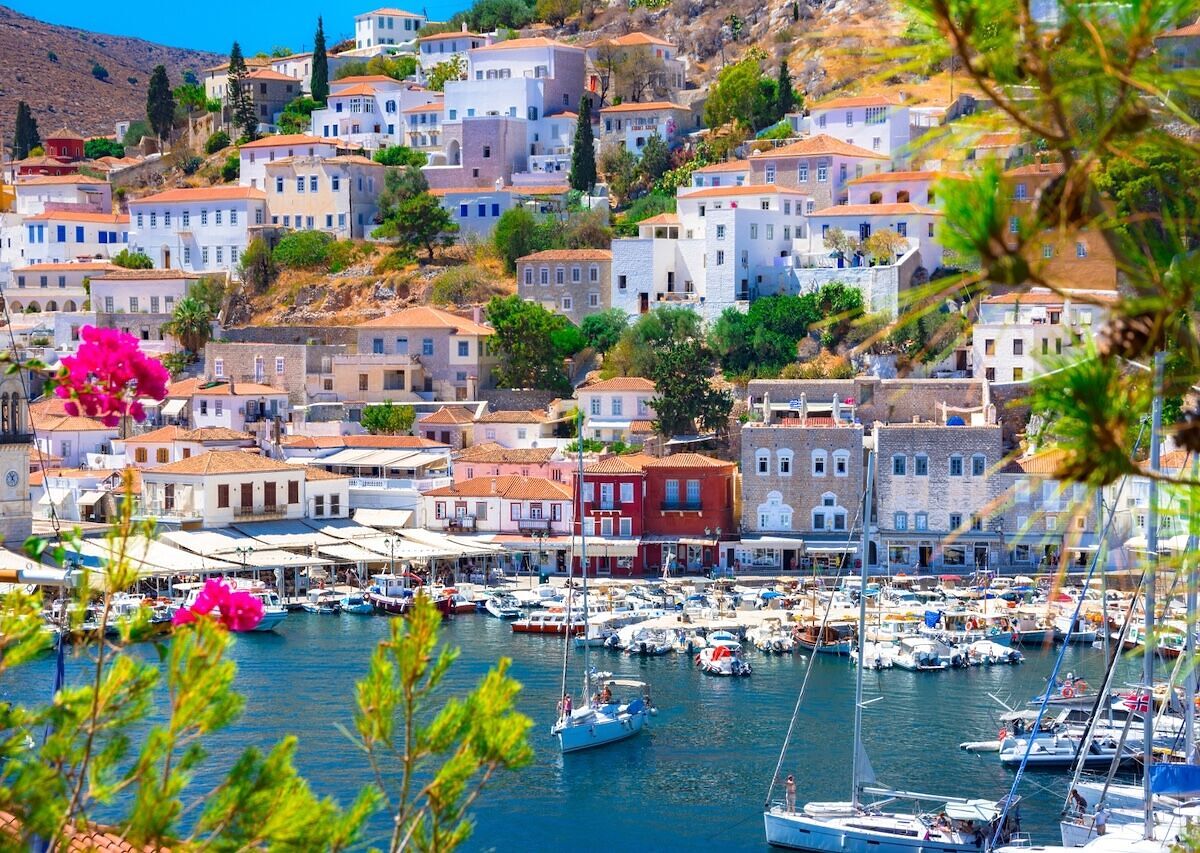
In about an hour and 10 minutes, a high-speed ferry from Piraeus brings you to Hydra. Hydra famously does not permit any motor vehicles, and that’s just as well — the roads don’t take you very far. Most of the island is mountainous, the highest point rising to around 590 meters at the center, and if you wanted to reach the far beaches on the southwestern tip, you’d need a water taxi or a long hike.
No matter, because all the activity concentrates near the crescent-shaped harbor, framed by neoclassical stone mansions built by wealthy shipowners in the 18th and 19th centuries. After lunch at one of the waterfront restaurants, check out the boutiques in town — you’ll find jewelry makers working in small studios where you can ask for a custom piece.
A 15-minute walk west along the coastal path leads to Kamini, a small fishing harbor where the tavernas sit close enough to the water that you can watch the boats come in while you eat. Leonard Cohen lived on Hydra through much of the 1960s, and the bench dedicated to him sits along this stretch of coast.
Poros
- Travel time: Around 55 minutes to 1 hour from Piraeus on a fast ferry; up to 2 hours 30 minutes on conventional ferries. Multiple operators run the route year-round.
- Ferry frequency: Several daily departures in summer, with reduced but consistent service through winter. Poros also connects easily to Hydra and Spetses, making it a natural stop on a wider island-hopping itinerary.
- Best for: Travelers who want history, a harbor town with real character, and easy access to the Peloponnese.
- Day trip or stay overnight?: If you want to stay, the Sirene Blue Resort is right on Monastiri Beach, about 3 km from the port. It’s a good spot to wake up to the sea rather than the harbor.
- Don’t miss: The view from the clock tower at sunset and the ruins of the Sanctuary of Poseidon.
Don’t confuse Poros with Paros — a fancy island in the Cyclades that takes considerably longer to reach. Poros is around an hour from Piraeus on a fast ferry, and it sits so close to the Peloponnese that the strait separating the island from the mainland is only 200 meters wide. You can see the peaks of the Peloponnese clearly from the harbor, and the sense of being almost on the mainland gives Poros a different feeling from the other islands on this list.
The clock tower above the harbor is the natural first stop: built in 1927 on the hill of Sferia, it’s the island’s most recognizable landmark and visible from almost anywhere in town. The climb takes around 15 minutes from the waterfront, and the view at the top takes in the bay, the strait, and the lemon groves of the opposite shore. Sunset is the best time to go.
On the northern side of the island sit the ruins of the ancient Sanctuary of Poseidon, built around 520 BCE, where the Athenian orator Demosthenes is said to have taken poison in 322 BCE rather than surrender to Macedonian forces. If you’d rather skip the history and get straight to the water, the beaches at Monastiri and Russian Bay are both worth the trip.
Spetses
- Travel time: Around 2 hours 30 minutes from Piraeus on a fast ferry. Travelers driving from Athens can also reach Porto Heli on the Peloponnese in about 2 hours 30 minutes and take a 15-minute water taxi across — a useful alternative in summer.
- Ferry frequency: Several daily departures in summer, with services also connecting from Hydra and Poros for island-hopping. Book return tickets in advance for summer weekends.
- Best for: Travelers who want the full Greek island atmosphere — beaches, history, good food — and don’t mind the longer crossing.
- Day trip or stay overnight?: Worth an overnight if you can manage it, and the Poseidonion is the obvious place to do it.
- Don’t miss: Agioi Anargyri Beach, Bekiri Cave, and the harborfront at dusk when the horse-drawn carriages are out.
Spetses is the farthest island on this list — around two and a half hours from Piraeus — but it’s still manageable as a day trip if you leave early. Like Hydra, the island restricts private cars within the town boundary, which keeps the harbor walkable and quiet even at the height of summer. Horse-drawn carriages wait at the dock, scooters and bicycles are available to rent at the port, and water taxis run to the beaches that are too far to walk.
The best of those beaches is Agioi Anargyri, a long sandy stretch on the western side of the island with sunbeds and a beach bar. From there, a path over the rocks leads to Bekiri Cave — a sea cave with a small hidden beach inside, accessible either by swimming in through the entrance or on foot via a short cliff path. It’s a tight squeeze either way, but inside there’s a small hidden beach surrounded by rock, completely cut off from the sea outside. Spetses has long been a weekend retreat for Athenians, and you can see it in the neoclassical architecture, the harbourfront, and the Poseidonion Grand Hotel, a Belle Époque seafront property that has been the island’s landmark address since 1914. Two pools, a spa, and On the Verandah, its award-winning fine-dining restaurant drawing on produce from the hotel’s own organic farm make it the best place to stay on the island. 










Leave a Reply