
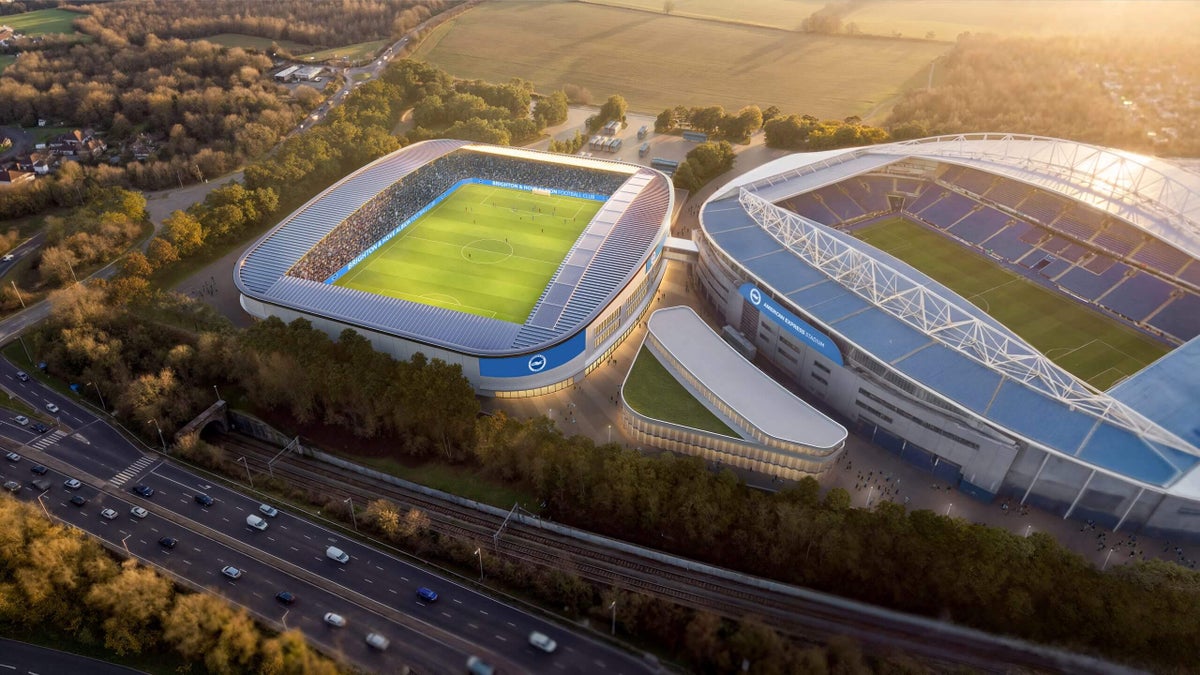
There were a few sleepless nights for Brighton & Hove Albion CEO Paul Barber following a board meeting a couple of weeks ago.
The club’s executive team had made a three-hour, 60-slide presentation to owner and chairman Tony Bloom on April 16 about the construction of the first purpose-built women’s stadium in the United Kingdom and Europe.
Bloom wanted some time to think about the proposal. Last week, he gave the green light to the project called ‘Built For Her’.
The club owner will fund the 10,000-minimum-capacity stadium, which will cost around £75million to £80million ($101m to $108m) and be built by 2030 at the latest. However, the club is open to government funding. “I see it as part of the football club as a whole,” Bloom told media on Tuesday.
It is a statement of intent, a signal to the Women’s Super League (WSL) and the rest of the world that Brighton continue to push boundaries in the women’s game.
“It shows the culture of a football club,” said former Chelsea great and now Brighton player Fran Kirby, who believes the new stadium will be a “big attraction” to retaining and recruiting talent. “We’re not just sitting still, happy with where our women’s team is at. All I’ve ever cared about is playing for teams that care about women’s football.”
The women’s stadium — the third globally, following NWSL sides’ Kansas City Current and Denver Summit’s planned venue for 2028 — will be next to the Amex Express Stadium, where the club’s men’s Premier League side play, and be specifically designed for women’s players and their fans, a different demographic to the men’s game with different needs and behaviours, from merchandise activity to food consumption.
The stadium will be physically joined to the Amex via a bridge and the club hope to be successful with the planning application because they already have proof of concept with the Amex. Such a close connection to the Amex was key as the club can share resources, such as the ticket office, club store, car parking and Falmer train station.
Brighton, who will visit the aforementioned American teams’ sites, are looking at everything through a women’s football lens: whether the pitch surface can prevent certain injuries to female players; dressing room setups to cater, for example, for the split of male physios and female athletes; sufficient female toilet facilities, types of food and drink to serve match-goers and buggy parks for families.

“We’ve always felt that to show real commitment and respect for the game, we need to give the women’s team an opportunity to have their own stage,” said Barber. “The best way to do that was to build our own stadium. They (fans) have the right and deserve to see their women’s and men’s teams play in their city.”
The club researched potential sites around seven years ago and looked again in 2023, but land is not cheap in the south east of England. Brighton did not own Bennett’s Field for many years and had leased it as a car park. The land was sold to property developers for student accommodation but the universities decided they no longer needed it and so Brighton bought it last year.

An aerial view of the proposed stadium (Brighton & Hove Albion)
WSL clubs have had to navigate the conundrum of outgrowing their smaller shared grounds and filling much larger club stadiums.
Arsenal, Chelsea, Leicester and Aston Villa have made their main club’s stadium their women’s home ground, with mixed success. However, Brighton, who attract around 2,000 to 3,000 fans on a matchday, believe a middle ground is more suitable.
Is a minimum 10,000-capacity stadium, which has some flexibility to increase but not much, ambitious enough, though? “It’s about the right size for some time to come,” said Barber, who has learned that staging top-class football matches in stadiums that are too big can be “detrimental”.
“It can give a sense to the crowd that not everyone cares as much as they do, therefore it’s not such a big event,” he said. “If you’re right-sizing a stadium, it’s full, noisy and atmospheric, everyone feels that this is a major event that they want to be at, which women’s football is, should be and will be even bigger in the future.”
Brighton also have the option to switch their biggest women’s games to the Amex, due to reach a 33,000 capacity once the latest works have finished, and are hoping to play more of their WSL games there in the near future to start to drive audience behaviour.
But given the pace at which the women’s game is growing, it is hard to forecast the next 10 years. What happens if the women’s team outgrow their new stadium by 2035? “We’ll cross that bridge when we come to it,” said Barber.
He believes any learnings from the new women’s stadium may be applied to modify the Amex, while the under-21 men’s team and under-19 women’s team could use the new arena, too.
“Everyone wants to be a Champions League team,” said women’s managing director Zoe Johnson. “You have to have your unique selling point. Having world-class infrastructure is very much a part of our vision.”
“This isn’t just about building a football stadium,” added Barber. “This is historical for our sport and country.”














Leave a Reply