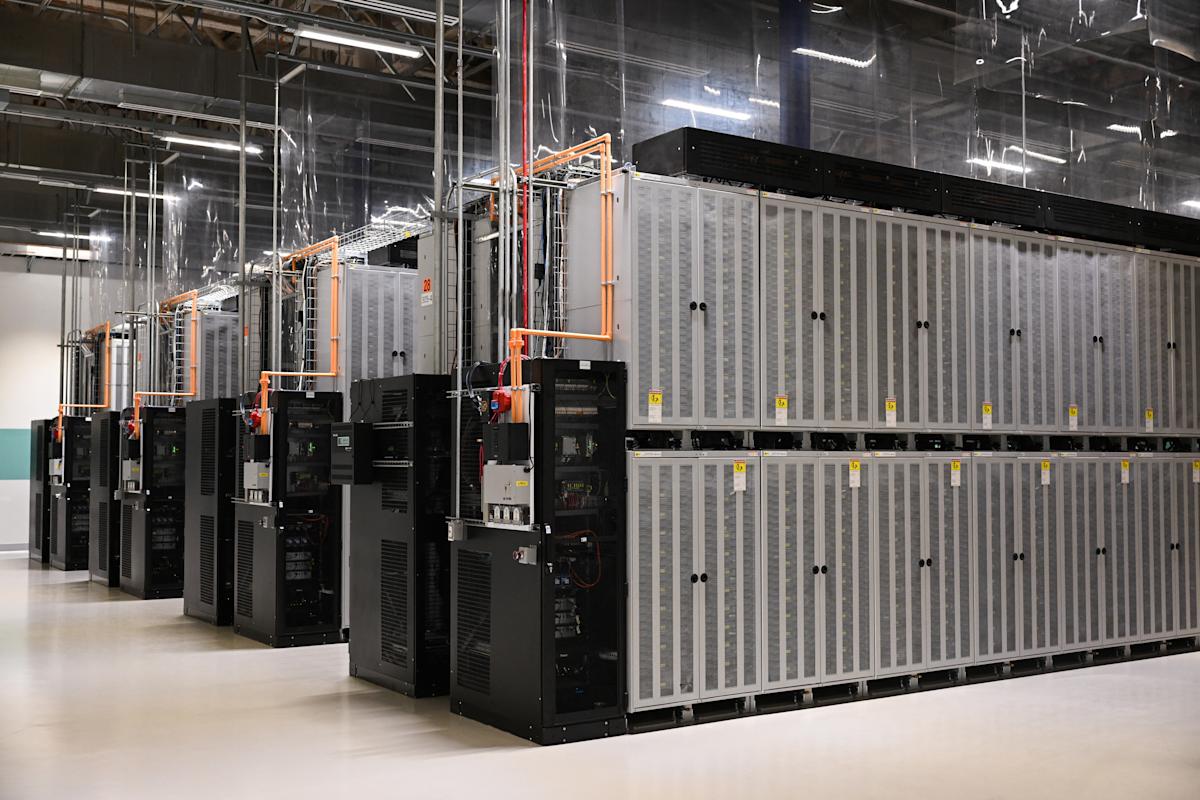
(Bloomberg) — Around the world, a wave of mega installations batteries are lining up to be connected to the grid this year — from solar hubs in Texas to grasslands in Inner Mongolia and the site of a former coal plant north of Sydney.
Most Read from Bloomberg
Invest in Gold
Powered by Money.com – Yahoo may earn commission from the links above.
Falling costs and soaring energy demand from data centers had already set the stage for rapid growth. The war in the Middle East has helped accelerate the trend by lifting demand for alternatives to expensive fossil fuels, setting 2026 up to be the year batteries become influential in the global energy system. BloombergNEF analysts had already expected installations to jump by about a third this year, led by expansion in Europe, the Middle East, Africa and Latin America. That momentum could build further if fuel disruptions persist.
Signs of the ramp up are already emerging. A Chinese battery manufacturer has forecast a sharp rise in first quarter profit as global demand picks up. In Vietnam, a developer is seeking approval to replace a planned LNG-to-power project with renewables paired with storage, citing the surge in fuel costs linked to the war.
“We’ve now crossed into a point where anytime anyone is looking at investing in the power system, batteries are one of the most attractive options,” said Brent Wanner, head of the power sector unit at the International Energy Agency. “Battery storage systems will continue to grow for the foreseeable future.”
In markets flooded with solar and wind — technologies that have been built out significantly since the last energy crisis in 2022 — battery operators can buy electricity when it’s cheap and sell it when demand peaks. Where grids once relied on coal and gas when renewable output dipped, storage technology is now becoming cheap and fast enough to make a difference in how the grid functions. Average costs have dropped by around 75% from 2018 to 2025, according to BNEF, and are expected to tumble another 25% through 2035.
Battery projects are also increasingly being built in fleets big enough to make a real difference in how the grid operates. In Inner Mongolia, three massive sites were recently switched on with a combined capacity of 7.4 gigawatt-hours, enough to rival several large power plants for short periods. In Scotland, two huge neighboring battery farms at the site of a former coal mine will start up this year.
Australia — the world’s largest battery market on a per capita basis — offers a glimpse of how the boom is reshaping energy systems. Shortly after a massive project known as the Waratah Super Battery was partially switched on in New South Wales last year, batteries discharged more power onto the main grid during the evening peak than gas-fired plants. The site is expected to become fully operational in 2026. Storage is also helping delay an expected gas crunch as domestic fields deplete, underscoring its role in the nation’s energy security.
For investors, one big reason that projects have become more appealing is the rapid decline in costs. Waratah, for instance, would cost about 20% less to build now than when it began construction four years ago, according to Nick Carter, chief executive officer of Waratah’s owner Akaysha Energy Pty Ltd. “If you had the same project today, the economics would be materially better,” he said, even as Waratah’s strong returns have left him with “no regrets.”
At the center of the world’s energy storage boom is China’s role in producing the hardware. Years of investment in its electric vehicle supply chain have created a glut of batteries, driving prices down and flooding global markets with cheaper equipment.
The country now accounts for the vast majority of global manufacturing capacity, as well as around half of existing grid-scale battery installations. That’s in part because of a 2021 mandate requiring renewable projects to include energy storage, which has since been retired.
The pattern mirrors the solar industry’s post-2021 cycle, when surging demand triggered a wave of investment that led to oversupply, collapsing prices and, ultimately, mass adoption, according to consultancy Trivium China. What’s striking is that the decline in battery prices is happening even as costs for most other clean energy technologies have risen.
That means the calculus for projects is changing quickly. In mid-2024, Australia’s AGL Energy Ltd. began construction of a large battery in New South Wales. Six months later, it approved another project in the same state at roughly half the cost per megawatt-hour, according to CEO Damien Nicks.
Soaring demand
With power systems under strain across much of the world, the wave of cheaper batteries is coming at a pivotal moment.
In the US, the speed of construction is an important factor. Data centers from Texas to Tennessee are turning to solar paired with batteries because traditional power plants can’t be built quickly enough, as turbine shortages and grid bottlenecks slow timelines. Near Memphis, Tennessee, Elon Musk’s artificial intelligence business xAI has installed rows of Tesla Inc. Megapack batteries at its Colossus supercomputing facility to manage outages and surging electricity needs.
Batteries are expected to account for more than a quarter of the record generating capacity the US is set to add in 2026, according to the Energy Information Administration.
“A lot of people still view the battery story as a clean energy technology,” said Jeff Monday, chief growth officer at storage provider Fluence Energy Inc. “We’ve seen an evolution — battery tech is now seen as building grid resilience.”
The dynamic is also spawning a new class of technologies outside of lithium-ion, which are designed to stretch storage from hours to days. Companies like Form Energy Inc. are pitching batteries that can keep data centers running through prolonged shortages, effectively substituting for supply from the grid. Unlike lithium-ion cells, Form’s technology relies on the rusting of iron to store and release energy for up to 100 hours, 25 times longer than most grid-connected batteries.
In Europe, the challenge is different. A rapid expansion of wind and solar is straining grids that were not designed for huge variations in supply, increasing price swings and forcing operators to turn off when generation outpaces demand. Germany alone is expected to lose €3.7 billion ($4.4 billion) to curtailed renewable output this year. Storage is now set to surge across the continent, with capacity forecast to grow around fivefold by the end of the decade, according to a report earlier this year by think tank Aurora Energy Research.
Energy price swings unleashed by the Iran war increase arbitrage revenues and strengthen the case for cutting reliance on imported fossil fuels, according to BNEF. In Europe, it sees batteries that are already online or nearing completion as likely to benefit most, with capacity seen rising from about 50 gigawatts in 2025 to 75 gigawatts by year-end.
“In the face of rising gas prices with the war in Iran and general market fluctuations, storage can serve as a hedge for the power price volatility that is becoming more frequent,” said Allison Feeney, an energy storage analyst at research firm Wood Mackenzie. “It’s going to revolutionize the way our grid operates, once we reach high penetration levels.”
The technology is also gaining momentum elsewhere. India has supercharged its auctions for energy storage projects as it races to balance a grid receiving more variable renewable power. Brazil is preparing its first tender for grid-scale batteries. In Egypt, Africa’s largest hybrid solar and battery installation was partially switched on earlier this year and is expected to become fully operational this summer. The takeoff, however, is not without constraints.
Much of the industry still depends on China’s supply chain, creating vulnerabilities as geopolitical tensions rise and US trade tariffs enter into force. While the US now has the production capacity to supply 100% of its energy-storage systems domestically, according to a March report by the US Energy Storage Coalition, Chinese equipment is still cheaper than American-made components.
Deploying batteries at scale also requires navigating the same bottlenecks facing the broader power sector. Grid connection delays, permitting hurdles and evolving market rules can slow projects, even as demand surges.
“For installers in Europe, the hardware is only maybe 50% of the cost, but then there are also the grid connection and installation costs,” said Eva Zimmermann, a senior research associate at Aurora. Higher interest rates as a result of war-related price disruptions could also complicate the economics of capital-intensive projects.
Yet even with those constraints, few expect the battery boom will slow. In the US, demand for storage outweighs policy headwinds, driven by rising electricity needs, the growth of data centers and the need to stabilize renewable power.
Developers are continuing to push into new markets, from Europe to Texas, betting that the same forces reshaping Australia will play out elsewhere. Akaysha’s Carter, who cut his teeth in oil and gas before making the jump to renewables, sees the current momentum extending well beyond this decade.
“Power demand is going up, data centers are coming online, more renewables are getting built, coal is exiting,” he said. “So when you combine all those things, the need for storage is going up.”
—With assistance from Ocean Hou, Eva Brendel, Will Mathis and Rachel Morison.










Leave a Reply