
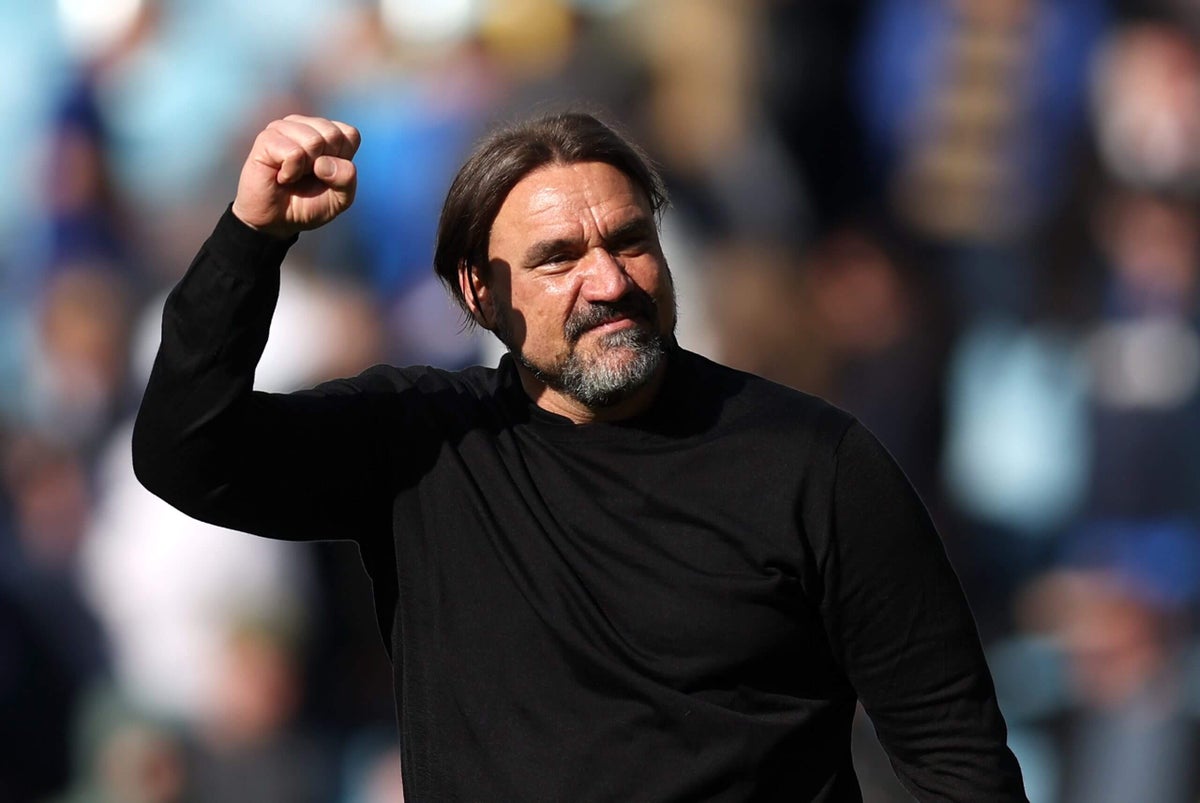
As he walked around Elland Road late last November after another defeat, Daniel Farke got both barrels from some Leeds United fans.
“You don’t know what you’re doing,” was an audible accusation from the Don Revie Stand after a fifth defeat in six Premier League matches, which took the team into the relegation zone and behind the point-per-match average Farke had set as the club’s target for Premier League survival.
It was not just that November 23 defeat to Aston Villa that led to the most pronounced fan dissent of Farke’s tenure. There was an accumulation of factors. He had, again, failed to influence a match with timely substitutes or tactical tweaks, and there was fan anxiety after dire back-to-back defeats by Brighton & Hove Albion and Nottingham Forest. There was a sense Leeds were sliding.
That Manchester City, Chelsea and Liverpool were looming across seven days left most supporters convinced the situation would become more desperate by mid-December. Farke’s position was considered by United’s board, but it was felt there was still enough credit in the bank to justify giving him more time.
Since then, the turnaround has been quite remarkable. In the 20 league fixtures since the Villa loss, Leeds have lost four. Only Bournemouth (11) have played out more stalemates than United (10) in that time, but a 28-point return is firmly mid-table form, better than Chelsea and Newcastle United, among others.
When you then include the FA Cup run — four victories and a first semi-final in 39 years — it’s hard to ignore what Farke has achieved in West Yorkshire. That cup quarter-final win at West Ham, combined with the end of a 45-year wait for a league victory at Old Trafford and Saturday’s 3-0 win against Wolverhampton Wanderers, which put Leeds on 39 points, made it quite the fortnight for the German.
No club has been relegated from the Premier League after amassing 39 or more points after 33 matches in a 38-game campaign. With five games to spare, Leeds are beyond the aforementioned point-per-match (38) target Farke had set in August.

Victory over Wolverhampton Wanderers put Leeds United on 39 points (Darren Staples/AFP via Getty Images)
Last July, if you had offered Leeds fans 39 points after 33 matches, an eight-point buffer to the relegation zone, an Old Trafford win, and an FA Cup semi-final trip to Wembley, most of them would have snapped your hand off.
Last season, the top flight’s three newly promoted clubs collected 25, 22 and 12 points apiece and quickly returned to the Championship. The promoted trio of the 2023-24 season amassed 26, 24 and 16 points, again their seasons finishing in relegation. That’s the scale of the trend Farke and Leeds have bucked.
Does Farke get enough credit? Are his doubters ready to accept him?
In the modern era, it seems unlikely any manager or head coach will be treasured as much as Marcelo Bielsa is in Leeds. The Argentine’s philosophy in life and football, as well as being the man to end the club’s top-flight exile, awakened a lasting love.
Farke is crafting his own history. His teams have not had the panache, artistry or guile of Bielsa’s, but they do put points on the board and are hard to beat.
There was the 190 Championship points accumulated over two seasons and the title in his second term. Yes, the club’s wage bill in those seasons was enormous and the 2023-24 season was a failure, but Farke has to take some credit for holding off 100-point Burnley to create those generational memories during the city centre title parade last year.
This first season back in the Premier League was never going to be easy or perfect. The 12 goals conceded after the 85th minute (not including the cup brace in added time at West Ham) have been one of the defining stories of the year for Leeds.
Then there has been the sometimes blunt attacking play. It was only four matches ago that United’s dire scoring record was coming under the spotlight after the goalless draw against Brentford. They were goalless in four and had one open-play strike in the previous six, which had come from a Chelsea mix-up.
Yet, these are the ups and downs of a season for a newly promoted club. At times, it’s been functional and pragmatic with five at the back, but it’s been what’s necessary to hopefully keep Leeds in the division.

Dominic Calvert-Lewin celebrates scoring Leeds’ third goal on Saturday (Matt McNulty/Getty Images)
Ironically, Saturday’s clash with bottom-placed Wolverhampton Wanderers felt more like the games Farke managed with Leeds in the Championship, as favourites looking to dominate possession and territory.
“I’m always switched on to what is necessary,” he told reporters. “My brand of football normally suits teams who can dominate possession, who like to attack, but this season is different.
“I have to make sure a team that is just promoted has to survive. It’s also, for me, a bit of a different challenge because my last seasons here in England, I quite often won the Championship title.
“Right now, I have to steady the ship for a team that is fighting against relegation and also accept we can’t always be so dominant. We still try as much as possible to stick to our DNA, to play our football, otherwise, we wouldn’t deserve so much praise for performances, like away at Old Trafford.
“To deliver these types of performances, these types of results during the crunch time period of the season, when everyone in the last decades was questioning our ability to deliver in crunch-time periods, makes me proud. I haven’t done anything special or anything different; it’s just a different scenario from the last season.”
Farke wants to build a new, durable identity with a winning mentality at Elland Road. He will need time to do it.
His contract expires in June 2027. The board and Farke’s representatives have been keen to focus on maintaining the club’s Premier League status. Any discussions on a new deal have been pushed back until the campaign ends.
His future was debated after a 100-point title-winning campaign last season. It was debated again in November as the club’s hierarchy felt the walls closing in. If Farke now keeps the club up, will there be much of a debate at the end of next month over whether he should stay?
Five months on from being told by some fans that he did not know what he was doing, Farke heard his name sung on several occasions on Saturday afternoon. These milestones, these memories — this sniff of another top-flight season — can only bode well for Farke.




Leave a Reply