
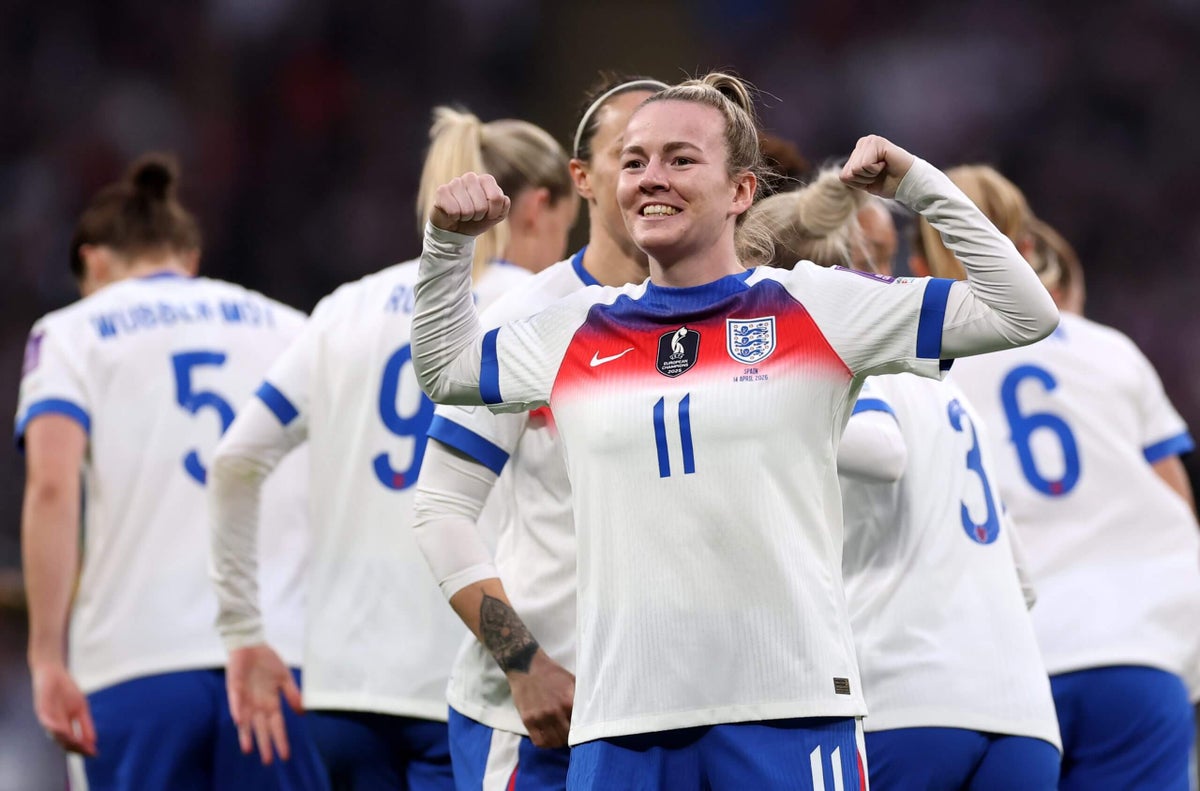
Fine margins separated European champions England and world champions Spain on Tuesday at Wembley.
Three minutes into the match, Alex Greenwood aimed an outswinging left-footed corner towards Lucy Bronze and Alessia Russo at the far post. Somehow, Russo, surrounded by four Spanish players, scooped the ball goalwards for Lauren Hemp to flick over the line. The opener, and eventual winner — the Lionesses’ fastest ever goal at the venue — put England in a commanding position as they top their Nations League group with only first place qualifying automatically for the 2027 World Cup in Brazil.
Sarina Wiegman’s side kept the ball well, were defensively organised, sharp on the counter attack and worked hard to regain possession quickly to disrupt Spain’s rhythm. When you make few mistakes and your opponent is profligate in front of goal, small details like set pieces can be decisive.

England’s Lauren Hemp scored the lone goal of Tuesday’s match against Spain. (Naomi Baker/Getty Images)
Given Spain’s technical superiority, dead-ball scenarios should be an area England exploit but the Lionesses’ conversion rate from such situations has been particularly poor. Despite conquering Europe twice and making the 2023 World Cup final, England failed to convert their set-play chances in those tournaments, scoring just three goals from free-kicks and only four from 107 corners (a corner conversion rate of four per cent).
What’s more, as the table below shows, their expected goals (xG, a measurement of the quality of chances created) value from corners throughout those three tournaments has been low: 0.08 and 0.03 at both Euros and 0.05 at the World Cup.
England goals from corners
| Tournament | Corners won | Goals scored | xG per corner |
|---|---|---|---|
|
Euro 2022 |
33 |
3 |
0.08 |
|
World Cup 2023 |
39 |
0 |
0.05 |
|
Euro 2025 |
35 |
1 |
0.03 |
Wiegman knows set pieces are an area which England can significantly improve upon. The Dutchwoman, who now leads coaching in this area, tries to decipher where her team can harm an opponent.
“Spain is pretty well organised,” she said after England’s 1-0 win. “They have some great headers of the ball in defensive and attacking corners. We were really sharp. It shows really nicely what you train.”
When asked to expand on how her team specifically train, Wiegman was reluctant to give away any details. There were a few insights, however: England review their offensive and defensive set pieces with video footage; players often gather in small groups, which provides better feedback, or as a whole team, to discuss their plans and make any tweaks that are needed.
It is clear, however, that England have varied their approach in a bid to improve their success rate. At the 2023 World Cup and 2025 Euros, just seven per cent and 12 per cent of their deliveries respectively were short corners but in the 43 corners taken in seven matches since last summer’s European campaign, the rate has increased significantly to 40 per cent.


Against Ukraine last month specifically, full-backs Maya Le Tissier and Poppy Pattinson played corners short to Jess Park, who worked the ball into the box from a closer distance. The advantage of taking short corners is to drag the opposition out of the penalty box, creating space in a congested area and forcing defenders to make a decision as to which player or zone to mark. England have yet to see the fruits of their labour, though.
In the next game against Iceland, however, Georgia Stanway, a good driver of the ball but rarely a corner taker, was put on duty and aimed long, nearly always for Lucy Bronze at the far post. The strategy was to beat the goalkeeper and the two or three strong defenders at the front. Although Stanway found her team-mate, England failed to score.
In the past, the tall imposing centre-back Millie Bright, who retired last year, was used as a last-minute Plan B from set pieces with mixed results — she scored two goals in three years from 2022 to 2025 — but, bar perhaps Bronze and Russo, England lack a true threat from dead balls. Indeed in 2025 Keira Walsh was England’s top scorer from set pieces, with two. Short corners may make more sense as England can maintain possession and work a passing sequence rather than hoping a delivery is met with a low-percentage chance.

England forward Lauren James shakes off challenges from Spain (Richard Heathcote/Getty Images)
The only other corner England had against Spain was played short by Stanway to Lauren James. Although the Chelsea player’s delivery was ineffective, the hosts eventually worked the ball into the box but no clear chance came of it.
Spain had opportunities themselves from their seven corners and should have equalised in added time had it not been for Hannah Hampton acrobatically palming away Edna Imade’s header. England, however, were resolute in defending corners, a reflection of their performance at the last three major tournaments where they did not concede a single goal from 81 corners faced.
The reigning world champions, who hit the woodwork twice, had 21 shots compared to England’s nine, double the number of touches inside the opposition’s box (41), should have been more clinical in front of goal. But the manner in which the Lionesses ended Spain’s 17-match unbeaten run showed that when two teams go toe to toe, set plays can prove to be the difference. It is an area England need to continue improving.











Leave a Reply