
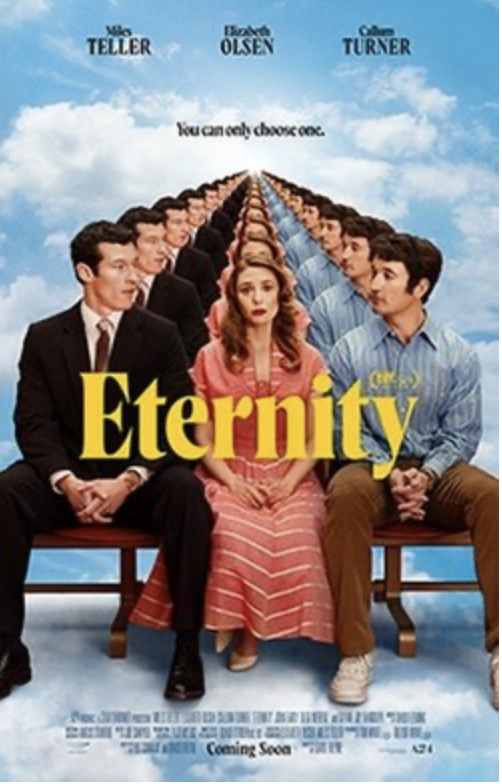
 Note: Proceed at your own risk if you don’t want spoilers!
Once a week my husband and I have a home date night where we watch a show or film, and our film-buff son is often our source of recommendations. While my husband will watch a wide range of media from horror to war as he keeps up with our son’s passion, I have to be more selective due my highly sensitive temperament; I still occasionally have nightmares about the 5 minutes of Poltergeist I watched in 7th grade and the two episodes of Stranger Things I watched several years ago! Our son knows this about me, so when he recommends a film he thinks he’ll love, he’s usually right. As such, last week when he recommended Eternity (a client also recommended it), we were excited to settle in.
The film follows a couple, Larry and Joan, who had been married for 65 years as they make their way to the afterlife where they have to choose where, and with whom, they’re going to spend eternity. The husband dies first, and is certain his beloved wife will soon join him, as she’s dying from terminal cancer. He’s also certain that she’ll follow him into whatever eternity he chooses. An interesting and important element is that when you die you spend eternity at the age you were the happiest. “A lot of kids, not a lot of teens,” says the Afterlife Coordinator. It’s always a bonus when a film about death makes you laugh :).
The Dilemma
The glitch is that the wife’s first husband, a handsome fellow named Luke who died in war shortly after they married, has been waiting 65 years for her. So when she arrives in the afterlife she has to choose: will she spend eternity with “the one who got away” (first husband) or the one with whom she shared a life, had children and grandchildren, and also argued, got irritated, and carried the stresses of daily living together (second husband).
Here’s where it gets interesting: Luke, the first husband, has occupied a position of fantasy her entire life. He was a war hero, and they never had a chance to experience real life together; their honeymoon ended while still in the honeymoon stage. Stripped of the possibility of day-to-day living, he could remain a perfectly encased memory in the glass castle of an unblemished fantasy. He never fell from grace, which means they never argued or even lived enough life together to know if they were truly compatible.
Larry, on the other hand, is a real, flesh-and-blood, human husband, full of quirks and irritations (he loves to complain) as well as the goodness of a lifelong marriage: showing up for each other through the ups-and-downs of life, raising children together, figuring out how to navigate inevitable stressors. For most of the film, Luke is shot is glowing light, leaving the viewer to see him through Joan’s eyes as the untouched fantasy, while Larry is, well, Larry: handsome, yes, but also slightly annoying and humanly imperfect.
Who will she choose: The fantasy who never was or the husband who always was? The embodiment of infatuation or the embodiment of real love?
Who would you choose?
If you’re familiar with my work, you know who I would choose.
Real Love Versus Infatuation
I’m sure you can imagine how thrilled I was to finally come across a film that depicted the truth about love versus infatuation that I’ve been writing about for decades, like:
Finally, a film that shatters the fantasy of the perfect lover and extolls the blessing of a solid, lifelong partner! A film that acknowledges what I wrote in this post:
Love is a verb. This is one of the great truths about love that our culture fails to teach, one that, even when we understand the principle, we need to remember it and practice it over and over again. I think of marriage or any long-term, committed relationship with a willing, open partner as an opportunity to practice loving – the active form of the verb – day after day and year after year until it becomes second nature.
And this, from one of the most gorgeous and wise blog post comments I’ve ever received (you can read the full response here):
I never felt like 10,000 volts went through me when I met my husband, but I sensed something so much bigger, the night we met—28 years ago almost to the day—I thought to myself as we talked, “This man has a soul.”
And given our temperaments—we are both passionate, noisy people—the relationship has never lacked for all the things that come with passion. Relationship anxiety for me. Career anxiety for him. Fights. Deep affection. And profound love, the profoundest I have ever known. Like breathing it is, that vital.
For Joan, the shattering of the fantasy doesn’t happen easily. She spends much of the film tortured by the decision, and it’s only when Larry realizes that Joan has long hair, which means her happiest time on earth was with Luke, that he lets go of the fight for her love and surrenders her to Luke.
Beyond Happily Ever After
Joan and Luke go off into the proverbial sunset of eternity. And it’s there that the fantasy starts to breakdown and Joan realizes that she’s made a terrible mistake. She also realizes that the myth of happiness doesn’t tell the whole story. Here’s the dialogue when she finds the courage to tell Luke that she’s made a mistake:
Luke: “Joanie, we were happiest together.”
Joan: “Of course we were. It was young love. It was love without the burden of a mortgage or job or kids. It was the kind of love you feel before knowing loss. It was everything. But love isn’t just about happy moments. It’s bickering in the car and supporting someone when they need it and it’s growing together and looking after each other.”
This poignant exchange elucidates one of the key pitfalls our culture typically falls into about love: we think love is happiness. We think we’re “supposed” to be with the person who “makes us happy.” The entire premise of the liminal stage of the afterlife in the film is based on going back to the time in life when you were happiest.
One of the most common spikes for people struggling with the relationship anxiety is perseverating on the ex: Was I happier with that person? Did we have more spark, chemistry, fun? When I probe for more details and ask the diagnostic question, “If you were so happy, why did you leave?” the response is always: “We weren’t well-matched for a lifetime together.”
Happiness, like all emotions, is fleeting, and it’s not a solid foundation for a lifelong relationship. We’re not here to just have fun and be happy; that’s the child-like mindset that pervades much of romantic love culture. Kids want to have fun, and they’ll take enormous risks to have that fun. But then we grow up (hopefully), and we realize that building a solid marriage partner relies on much more than fun. It’s about shared value and vision, friendship, and the commitment to supportive each other and growing together through all of the losses and joys that life has to offer.













Leave a Reply