Nvidia (NVDA) is officially moving beyond the “Hardware Wave” of the AI revolution. While the market remains fixated on Blackwell shipment counts, a more significant transition is quietly unfolding in the company’s margin profile: the shift to Vera Rubin and rise of Nvidia Inference Microservices (NIMs).
In 2026, I suspect the real catalyst for Nvidia’s next leg up isn’t just the number of Blackwell GPUs it can ship, but how effectively the company can monetize the “operating system” of the agentic AI era and transition to Vera Rubin. Agentic AI shifts the story from selling “shovels” to “automated miners,” creating a recurring-revenue moat that could de-risk the stock even if hardware cycles eventually cool.
The transition isn’t guaranteed, and uncertainty is evident in Nvidia’s stock price, which has mainly flatlined since the fall despite a 37% return in 2025. Shares are up only 2% over the past three months and are essentially unchanged year to date, ahead of their fourth-quarter 2025 earnings, scheduled for February 25, 2026.
To kickstart Nvidia’s share price, investors are going to want to see three things in the upcoming February earnings report:
A frictionless Blackwell ramp-up
An improved Vera Rubin timeline
Growing sales from high-margin AI NIMs and blueprints
One defining narrative for Nvidia’s upcoming earnings report is the execution of its “Blackwell Transition.” As the company moves from its record-breaking Hopper (H100/H200) architecture to the Blackwell (B100/B200/B300) platform, investors will focus on the pace of its silicon ramp and easing silicon bottlenecks.
In late 2025, CEO Jensen Huang noted Blackwell demand was “insane,” and in 2026, the question shifts from record-setting orders to the supply chain’s ability to fulfill them.
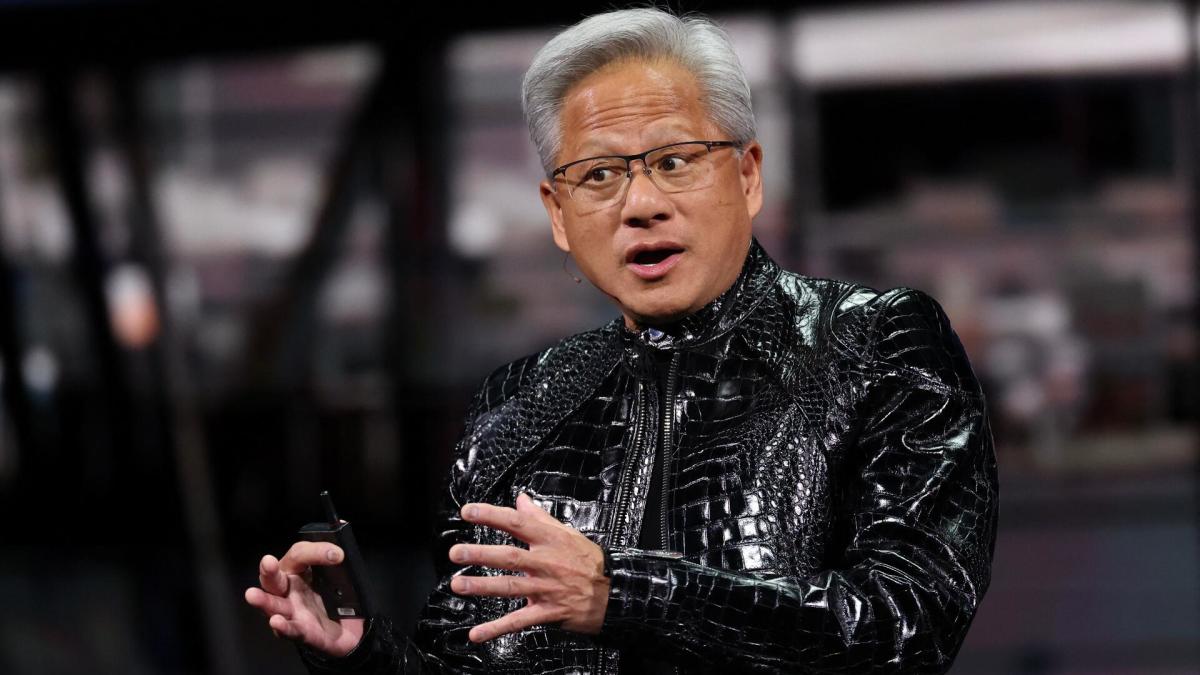
Nvidia CEO Jensen Huang seeks to boost sales with Blackwell, Vera Rubin, and agentic AI in 2026.PATRICK T. FALLON / GETTY IMAGES ·PATRICK T. FALLON / GETTY IMAGES
There’s growing optimism that Nvidia has successfully navigated the packaging bottlenecks (specifically CoWoS-L capacity) that threatened to delay high-volume shipments and bottlenecked results in 2025.
As of January 2026, NVIDIA has reportedly booked over 50% (and potentially up to 800,000-850,000 wafers) of Taiwan Semiconductor’s total advanced packaging output for the year. With TSMC aggressively expanding to 120,000-130,000 wafers per month by late 2026 (up from about 75,000 exiting 2025), Nvidia’s supply constraints may be behind it.
At CES 2026, CEO Jensen Huang reaffirmed that while the Blackwell architecture remains the primary driver of current data center revenue, its successor, the Rubin (R100) architecture, is firmly on track for a late 2026 launch.
Currently in the critical sampling stage, Rubin features next-generation HBM4 memory, positioning Nvidia to maintain its lead in the “Agentic AI” era by offering a leap in power efficiency and inference throughput over the B200 series.
More Nvidia:
Analysts now expect Nvidia to provide a “clean” shipment schedule during the Q4 call, confirming that Blackwell is reaching full-scale volume maturity by the end of the April quarter.
This represents a critical “Information Gain” pivot for the stock; if CEO Jensen Huang confirms that the Blackwell Ultra (B300) mid-cycle refresh is already on track for H2 2026, it effectively dismantles the “demand air pocket” theories championed by bears.
By bridging the gap between current B200 shipments and the upcoming B300 launch, Nvidia can prove that the AI hardware cycle is not peaking, but rather accelerating into a new phase of high-margin upgrades.
Furthermore, the transition is not just about new chips; it’s about the GB200 NVL72 racks. These liquid-cooled systems represent a massive jump in Average Selling Price (ASP) compared to individual GPUs.
A B200 GPU can cost $30,000 to $40,000, while a GB200 NVL72 rack can cost $2 million to $3 million.
If Huang or CFO Colette Kress indicates that the rack-scale systems are making up a larger percentage of Nvidia’s backlog, it may signal significant margin expansion that the market has not yet fully priced in.
Nvidia’s Q4 revenue will undoubtedly be massive, but the “next move” for its stock isn’t about past performance. In 2026, investors are no longer satisfied with “beats and raises”; they want evidence that the transition from Hopper (H100) to Blackwell (B200/GB200) to Vera Rubin is happening without a “demand air pocket.”
“Vera Rubin is now in full production, on track for 2H26,” wrote Bank of America in a research note shared with TheStreet. “We continue to highlight NVDA’s continued dominance in AI compute, networking, system, and ecosystem.”
The “CoWoS-L” Bottleneck: Much of the Blackwell ramp hinges on TSMC’s advanced packaging capacity. Any commentary from Jensen Huang suggesting packaging yields are improving could be a green light for the stock.
Gross Margin Compression: There’s a lingering fear that the initial Blackwell ramp will temporarily squeeze gross margins below 75% due to the complexity of the liquid-cooled NVL72 racks. If Nvidia’s margin guidance remains stable despite ramp-up costs, it could lead Wall Street analysts to conclude they’re too light on their earnings estimates.
The “Hopper Tail”: If sovereign nations and smaller CSPs (Cloud Service Providers) continue buying Hopper 200 while Big Tech waits for Blackwell, Nvidia’s “Earnings Floor” may be higher than the market realizes, especially if Huang says China H200 demand outstrips supply.
“Management noted ongoing upward pressure to its input costs, including HBM memory and many other components,” wrote Goldman Sachs in a research note shared with TheStreet. “However, in 2026, Nvidia believes it can hold gross margins in the mid-70% range as higher pricing and other cost reductions offset these increased input costs.”
“Sovereign AI could represent a market of $600 billion by 2030,” McKinsey recently said.
For the first time in a while, hardware is only half the story. As we move into 2026, the “Information Gain” that may drive the stock’s P/E multiple is AI software monetization. Analysts are specifically looking for growth in Nvidia Inference Microservices (NIMs) and “AI Blueprints.”
These aren’t just developer tools; they are the “operating system” for the Agentic AI revolution.
Related: Fund manager pulls plug on popular semiconductor stock
The shift is profound: Nvidia is moving from selling “shovels” (GPUs) to selling “automated miners” (Agents). During the Q4 call, the market will be hyper-focused on how many enterprise customers are moving from the “experimental” phase of AI into “production-grade” autonomous agents.
If Nvidia can demonstrate that its software revenue is becoming a predictable, recurring stream, it helps de-risk the stock from the cyclical nature of hardware sales.
NVIDIA AI Enterprise, its software suite, can cost $4,500 per GPU per year.
In addition, the introduction of “Digital Workers” powered by Nvidia’s NIMs provides a new value proposition for the Fortune 500. By providing the full stack — from the Blackwell silicon to the software frameworks that enable agents to “reason” and “act” — Nvidia is building a moat that competitors like AMD and Intel are still years away from replicating.
Watch for management to highlight “Software ARR” (Annual Recurring Revenue) as a hidden engine that could drive the next leg of the NVDA bull run.
What do you think?
Is the market underestimating the Blackwell ramp, or is the AI pivot already priced into Nvidia’s $3 trillion valuation? Join the conversation in the comments below.
Todd Campbell owns shares in Nvidia.
Related: Nvidia CEO sends biblical-scale reality check on AI
This story was originally published by TheStreet on Jan 18, 2026, where it first appeared in the Investing section. Add TheStreet as a Preferred Source by clicking here.











Leave a Reply