

Ireland’s historic relationship with alcohol, romanticised in folklore and lubricated by commerce, has produced a crisis hidden in plain sight, writes Terence Cosgrave
There are ghosts in Ireland that no census records, no parish registers and no tribunal reports have ever fully counted. They move through our schools and prisons, our psychiatric wards and addiction clinics, our hostels and courtrooms. They are children who became adults carrying invisible wounds before they ever drew breath – injuries inflicted not deliberately, but by ignorance, by culture, by denial, and by a national intoxication so deeply woven into Irish life that to question it is often treated as an act of heresy.
Foetal Alcohol Spectrum Disorder – FASD – sounds, at first hearing, like one of those sterile clinical phrases manufactured by bureaucrats and medical committees. Yet behind those initials lie lives of bewilderment and quiet catastrophe. A child unable to regulate emotion. A teenager labelled as ‘difficult’. A prisoner described as violent or impulsive. A homeless man who cannot understand why every attempt at stability collapses around him. A young woman in psychiatric care who has spent her life being punished for a disability nobody recognised.

Terence Cosgrave and pup
And Ireland, of all countries, now stands accused by its own clinicians and health advocates of sleepwalking through what one expert described as a ‘silent epidemic’.
At the recent FASD Ireland conference in Ennis – a gathering that brought together doctors, legal scholars, educators, social workers and people living with the condition – there emerged not merely a warning, but an indictment. The testimony was stark – Ireland’s historic relationship with alcohol, romanticised in folklore and lubricated by commerce, has produced a crisis hidden in plain sight.
One can already hear the muttering defensiveness that always accompanies such discussions in Ireland. Ah sure, haven’t we always had drink? Isn’t it part of the culture? Isn’t this all terribly judgemental? The Irish genius for transforming national pathology into sentimental identity has long protected alcohol from scrutiny. The pub is not merely a business in Ireland – it is mythology. Guinness advertisements are treated with greater reverence than public health campaigns. The cheerful poison of ‘the craic’ floats through politics, sport, funerals, weddings and baptisms alike.
But our brains do not care for mythology.
Dr Julian K Davies, one of the world’s leading FASD clinicians, told the conference with devastating simplicity that ‘FASD is a complex developmental brain injury’. Not a behavioural problem. Not bad parenting. Not moral weakness. A brain injury. A child’s neurological architecture altered before birth because alcohol -a substance Ireland markets with near religious fervour – crossed the placenta and interfered with development.
And the cruelty of FASD lies partly in its invisibility. Dr Davies noted that only one-in-ten people with Foetal Alcohol Syndrome display the recognisable facial features associated with the condition. Ninety percent don’t. Which means the majority pass through life misunderstood, misdiagnosed or entirely undiagnosed.
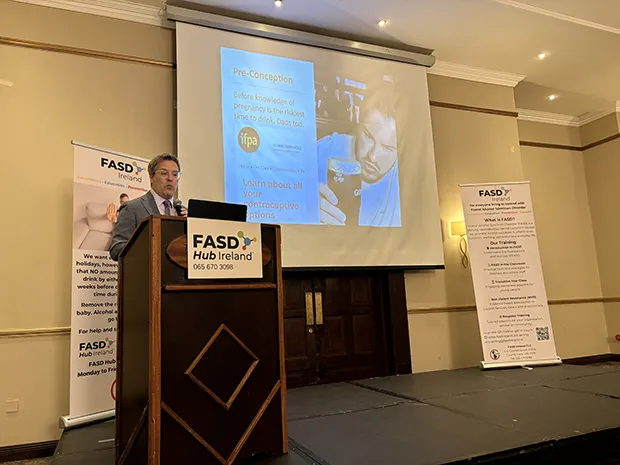
Dr Julian K Davies, Clinical Professor of Paediatrics at the University of Washington, Seattle, speaking at the FASD Conference
The Irish State has perfected the art of institutional blindness. We saw it with industrial schools. We saw it with Magdalene laundries. We saw it with child abuse inquiries where thousands of testimonies accumulated only after decades of official silence. Ireland excels at waiting until suffering becomes too politically embarrassing to ignore.
Now FASD joins the queue.
The figures presented at the conference are alarming enough to shatter complacency. Internationally, prevalence estimates stand at roughly eight in every 1,000 people. Yet in Ireland, estimates suggest rates may reach as high as 7.4 per cent of the population. If accurate, this would place Ireland among the most affected countries in the world. If true, as they say on the Internet, we’re off the scale.
Imagine it. In classrooms across the country there are children struggling – not because they are lazy or defiant, but because their brains process memory, communication, impulse control and emotional regulation differently. In Garda stations there are suspects who may confess falsely because of suggestibility and confusion. In addiction centres there are adults self-medicating neurological injuries they do not even know they possess.
And yet the national conversation around alcohol remains astonishingly primitive.
The drinks industry, naturally, prefers euphemism. ‘Drink responsibly’, they tell us, while spending fortunes linking alcohol to beauty, masculinity, celebration and belonging. The burden is shifted onto the individual consumer while the machinery of addiction hums profitably in the background. Ireland taxes alcohol, advertises alcohol, normalises alcohol and then expresses surprise when alcohol harms the unborn.
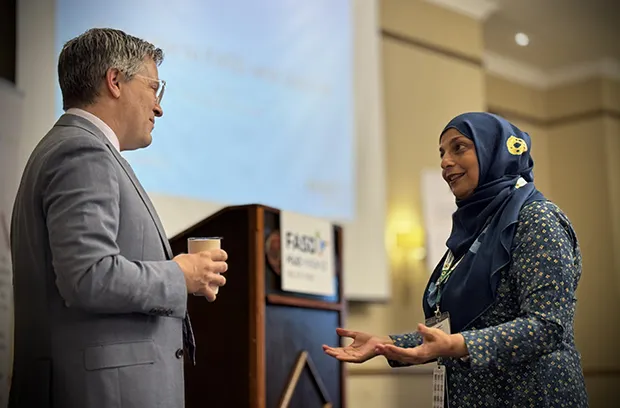
Dr Julian K Davies and Professor Farhana Sharif, Consultant Paediatrician and leading advocate for FASD diagnosis in Ireland
But what emerged from Ennis was not simply anger. It was also a plea for compassion. Again and again speakers urged a movement away from shame and stigma towards understanding and support. This matters profoundly because Ireland’s history of moral panic around pregnancy and motherhood has often driven vulnerable women further from healthcare rather than closer to it.
FASD Ireland criticised current public health messaging for precisely this reason. One recent HSE campaign apparently depicts a heavily pregnant woman being scrutinised and implicitly judged by those around her. The symbolism is revealing. Once more the woman becomes the battlefield upon which public morality is fought.
Yet the conference raised another uncomfortable truth rarely discussed publicly: paternal alcohol use may also contribute to risk prior to conception. Davies advised that ‘out of an abundance of caution’ fathers should avoid alcohol in the 90 days before conception. This transforms FASD from being solely a women’s issue into something much broader — a societal and familial responsibility. And perhaps that is precisely what unsettles Ireland most.
Because if FASD is truly widespread, then this is not a marginal problem concerning a few unfortunate families. It becomes a mirror held up to the nation itself. It is, as they say, part of what we are.
One of the most haunting remarks from the conference came when Davies observed: “If you’ve told a child a thousand times and the child has still not learned, then it’s not the child who is the slow learner.”
The sentence cuts far beyond education. It is Ireland that has failed to learn.
We have known for years about prenatal alcohol exposure. We have known for years that no safe amount of alcohol during pregnancy has been established. Yet diagnostic pathways remain fragmented. Services remain inadequate. Awareness among teachers, doctors, judges and social workers remains patchy. Families often endure years of confusion before obtaining answers.
And what happens meanwhile to the child misread by society?
They are punished in school for behaviours rooted in disability. They are excluded socially because they cannot navigate cues others absorb naturally. They encounter a justice system built around assumptions of rational cognition and personal responsibility. By adulthood many have accumulated trauma upon trauma.
The conference explored precisely this intersection between FASD and the law. People with the condition may struggle with impulse control, adaptive functioning and confabulation – the unconscious filling in of memory gaps. They are disproportionately vulnerable during police interviews, court proceedings and incarceration. One wonders how many Irish prisoners carry undiagnosed neurological injuries mistaken for criminality.
Yet despite the bleakness there was something deeply humane in the language emerging from Ennis. The emphasis was repeatedly placed not merely on deficits but on belonging. Davies concluded by saying that if individuals with FASD are ‘connected, supported, know that they are loved, know that they belong’ then ‘that is a win’.
Belonging. It is an extraordinary word to arise from a medical conference.
Because ultimately FASD is not simply about alcohol or diagnosis or neurology. It is about whether society chooses punishment or understanding. Whether difference is treated as danger or humanity. Whether invisible disability is recognised before lives unravel beyond repair.
FASD Ireland has now called for a National Clinical Lead, a National Clinic and coordinated lifelong supports. These are not extravagant demands. They are the minimum architecture of a civilised response.
But one suspects resistance will come not only from bureaucratic inertia but from cultural discomfort. Ireland does not easily interrogate its relationship with drink because alcohol oils too many wheels — economic, social and emotional. It softens loneliness, masks trauma and fills silence. To challenge drinking culture is, in some circles, treated almost as an assault on Irish identity itself.
Yet nations are not measured by how fiercely they defend comforting myths. They are measured by whether they protect the vulnerable when evidence demands change.
For decades Ireland ignored the suffering inside church-run institutions because the truth threatened our national self-image. The danger today is subtler, but no less serious. FASD forces Ireland to confront the possibility that preventable neurological injury has become woven into the fabric of everyday life.
And unlike political scandals or economic crises, this damage unfolds quietly over generations. A child struggling in school. A teenager expelled. An adult homeless. A prisoner bewildered by his own actions. Each case treated individually while the collective pattern remains obscured.
This is how national tragedies endure: not through conspiracy but through normalisation.
The Ennis conference represented something important because it pierced that silence. It declared publicly that FASD exists in Ireland at a scale the State can no longer afford to ignore. And perhaps most importantly, it reframed those living with FASD – not as problems to be managed – but as human beings entitled to dignity, support and understanding.
The old Ireland specialised in concealment. The new Ireland, if it wishes to deserve the name, must learn recognition.
Recognition that alcohol is not harmless simply because it is culturally beloved. Recognition that disability can be invisible. Recognition that prevention requires honesty rather than shame. Recognition that people living with FASD are not failures of character, but citizens carrying neurological injuries acquired before birth.
The ghosts are already among us. The only remaining question is whether Ireland continues pretending not to see them. 
<


Leave a Reply