
On the eve of every game, zone maps, videos, spray charts and usage patterns are sent to a group chat with all 13 position players on the Houston Astros roster. Most of the material is devoted to the next day’s starting pitcher, equal parts a plan of attack and prospectus on his probabilities or preferences. For a team trying to reestablish its offensive identity, this is something new.
Putting the data points into practice begins the next day when the team gathers at the ballpark. If it’s the first day of a series, all of Houston’s hitters gather for an advance meeting run by first-year hitting coach Victor Rodríguez. Rodríguez said his preference is to meet every ensuing day — just as he’s done during every stop of his 13-year coaching career — but the players are dictating the plan.
“They’re athletes because they don’t like meetings,” said Anthony Iapoce, one of Rodríguez’s assistants who is averse to even saying the word meeting. Mitch Moreland called them rallies during Iapoce’s first year on a major-league coaching staff, so he’s stuck with that slang.
“Who really likes getting together all the time,” Iapoce asked. “Baseball is such an individualized sport. You don’t want to disrupt their day, especially veteran guys. They have their whole day planned from the night before until they get to the field until they’re ready to play.”
For some, that routine includes sitting at their locker, staring at an iPad and studying the slew of information still sitting in the group chat. Afterward, they’ll trickle into the batting cages and debrief with Rodríguez, Iapoce or Dan Hennigan, the offensive coordinator compiling all of the data this team is devouring.
“The approach that’s being taken is, ‘Look, we’re giving this information to everybody,’” center fielder Jake Meyers said. “Figure out what information you need to be successful. They don’t care however much that is — they’re giving it to you and it’s your job to figure out the best place you can be when you step into the box.”
The early returns are remarkable — and keeping the Astros afloat amid an avalanche of injuries. They have averaged 5.27 runs across the season’s first 26 games, a stretch in which Houston has the American League’s highest OPS, on-base percentage, slugging percentage and batting average.
Only three teams entered Friday with more runs scored than the 137 Houston has totaled. Only two teams have a higher slugging percentage than the Astros, who spent the winter seeking a revival of an offense that had grown stale.
“We didn’t come here to reinvent the wheel or try to do something different,” Rodríguez said. “We knew who they were, we knew their careers and how much success they had. It was more of a reminder of, ‘This is what you do and this is what you have done.’ That, I think, has been the more important part.”
Rodríguez, Iapoce and Hennigan are part of what first baseman Christian Walker called “a three-headed monster.” They are here after Houston parted ways with longtime hitting coaches Alex Cintrón and Troy Snitker, two men still revered within corners of Houston’s clubhouse. That makes this conversation a complicated one.
Such early offensive success breeds an outside explanation that Cintrón and Snitker were somehow preventing the lineup from reaching its full potential. Players scoff at such a notion, but still must acknowledge the about-face from their entire lineup.
“In previous years, we’ve always put in the work and we’ve always had great plans going into games,” shortstop Jeremy Peña said. “But this year, it feels like the energy is different with the team. I feel like we have a certain kind of swagger to us as an offense and as a team. We’re really buying into it.”
Same position players, better production
Injuries forced Peña to miss significant time in the second half of last season. Same for All-Star third baseman Isaac Paredes. Yordan Alvarez appeared in 48 games while dealing with a sprained ankle and a hand fracture that the organization misdiagnosed. It is impossible to overlook that attrition when comparing the two offenses.
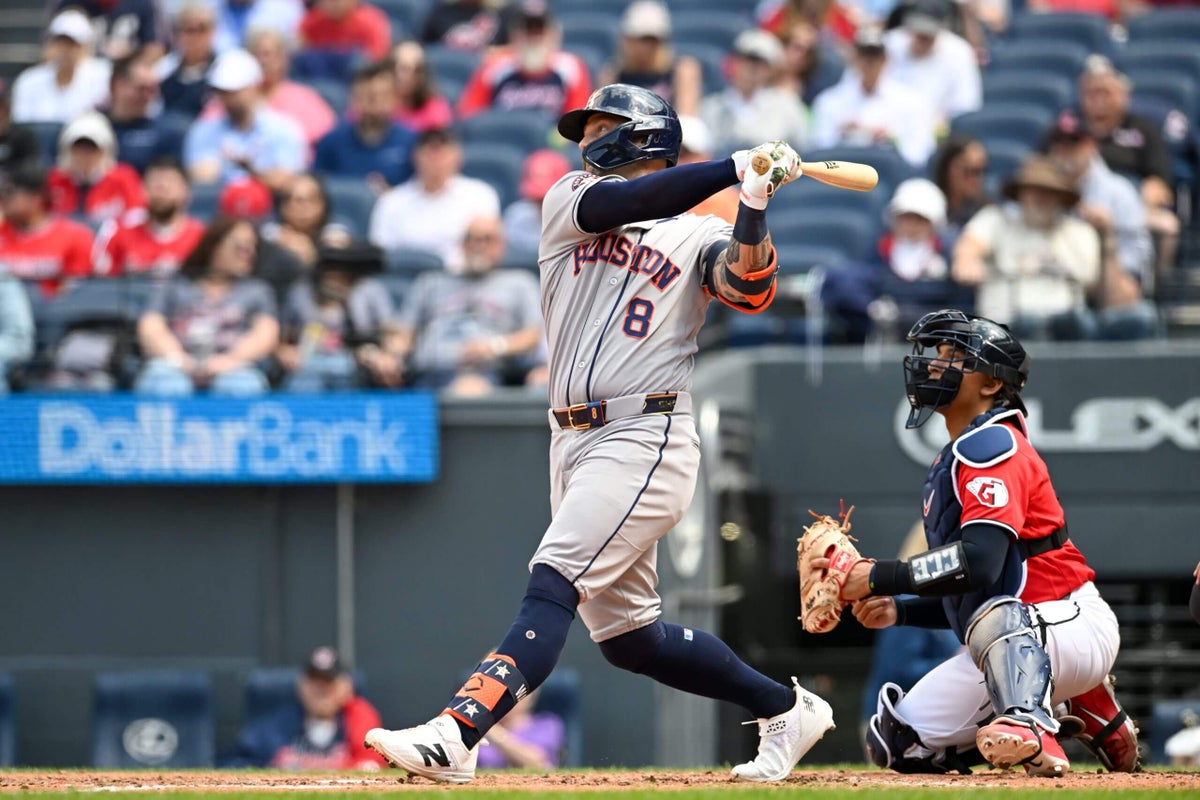
Alvarez has already hit 11 home runs in his first 118 plate appearances. His 1.245 OPS and 245 OPS+ are the best in baseball. Having and keeping him at full efficacy means more than overhauling any coaching staff ever could. Ditto for Walker, who underwhelmed last season, slashing .264/.358/.505 across his first 106 plate appearances of this one.
Still, team officials believed new voices would be a benefit. That both manager Joe Espada and general manager Dana Brown are in the final year of their contracts can’t be overstated, either. Both are operating with obvious urgency to correct what failed the club last season. Scoring 4.23 runs per game, seeing the third-fewest pitches per plate appearance in baseball and swinging at an almost 50 percent clip all contributed to that.
Returning all nine everyday position players from last year’s lineup prompted wonder what — if anything — would change.
“I think people have that backwards about veteran players,” Iapoce said. “Veteran players are in the league because they want to be coached and want to learn.”
Since last season, the Astros have increased their walk rate by 4.3 percent, lowered their swing rate by 3.4 percent and are seeing 3.92 pitches per plate appearance. They saw 3.76 last season. The arrival of ABS has inflated walk rates and shrunk strike zones across the sport, but Houston is still deploying the distinct approach that it abandoned for most of last season.
“I wouldn’t necessarily say the message is different, I would just say that, as a team, we’re really buying into the plan,” Peña said. “We’re passing the baton to the next guy. It feels like we trust every single person in the lineup. You don’t need to be a hero. Get on base, pass the at-bat to the next guy and good things happen.”
That’s been Houston’s supposed mantra since Peña arrived in the major leagues in 2022. It is impossible to know how much of its resurgence can be credited to new coaching or new methods — especially when it hasn’t been emphasized by the new staff.
“I don’t think at any point we’ve said, ‘Hey, let’s avoid chase,’” Hennigan said.
Added Rodríguez: “The walks, seeing pitches is the result of a good approach. We don’t preach: ‘Hey, take pitches, take walks.’ No. All the work we do is about hitting.”
Cintrón and Snitker shared hitting coach responsibilities beginning in 2020. After their dismissal, team officials sought a more defined hierarchy within its offensive infrastructure. Rodríguez is the team’s head hitting coach and Iapoce is his assistant.
Hennigan is something of a hybrid. He is a 35-year-old biomechanics guru whom at least one other team courted this winter for a major-league coaching job. The Astros ponied up to keep Hennigan, put him in charge of game planning and gave him two titles: offensive coordinator and director of hitting. He is the man who sends the pregame data inside Houston’s group chat.
“Similar info (to last season), just different ways of wording it,” Walker said. “Slightly different visuals, but it’s the same info.
“The info is good. It’s efficient. We’re not getting overloaded. We talked a lot during spring (training) about ‘What do you need to see before a game?’ I think what we’re getting is just a blend of all this information.”
In November, Hennigan intimated he would not be in uniform or in the dugout during major-league games. Input from both Espada and players has altered that plan. Hennigan has traveled on the team’s first two road trips and been inside the dugout during games “constantly talking” with both Rodríguez and Iapoce.
On most nights, Rodríguez can be seen straddling the top step of the dugout studying an iPad. He has “the final say” on everything, Hennigan said, and can “figure out that perfect, quick little simplification of something.”
“A lot of my conversations with him have been him reminding me how good I am, which is great to hear as a hitter sometimes,” Walker said. “This game feels really hard at times and for a guy to just be like, ‘Man, I watched you for six years across the field in the other dugout, just do this and this.’”
How much information is too much?
Somewhere behind Rodríguez is Iapoce, a man whose nickname “Coach Poce” already adorns a set of navy blue T-shirts seen throughout the Astros clubhouse. Iapoce is in charge of in-game morale and preparing hitters for possible matchups against relievers.
“They’ve got over 50 years of experience and this is my first year in the big leagues,” Hennigan said. “For them to lack any ego whatsoever and allow me to be running my mouth as much as I do, it’s just a really cool environment.”
They’ve done so since spring training, when Espada allowed all three coaches to conduct listening sessions and meetings before workouts. From those conversations, Hennigan started to select all the data he would send to Houston’s group chat before a game. Advance scouting coordinator Ricardo Lizarraga is a key contributor, too.
“I had it for the first time last year in Toronto and to have that here and have somebody like Dan who is so keyed in on that stuff, it’s been awesome,” outfielder Joey Loperfido said. “I think it’s the way the game is going. With the way guys are throwing the ball these days and the way pitchers and getting better and better, you as a hitter have to be more informed and that much more diligent.”

Yordan Alvarez’s league-leading 1.245 OPS has been a bright spot during Houston’s rough start to the season. (Troy Taormina / Imagn Images)
Not all of Houston’s hitters need or desire all of this information. “Alvarez,” Rodríguez asked rhetorically, “you think he’s going to look at that?” Peña calls himself a “traditional type” who prefers “simple stuff” because “going off the percentages is a dangerous game.”
Others study every piece of data provided. There is no one method to prepare for a major-league game, but the hope is that this will cover every conceivable way.
“Pick what you want,” right fielder Cam Smith said, “but we’ve got everything we need.”
Smith first scans a pitcher’s usage pattern with runners in scoring position. He likes watching some of the videos sent inside the group chat to get a better gauge of what type of velocity he will face. Loperfido looks at both pitch shapes and a pitcher’s release height before scanning heat maps to find out where the majority of these offerings will land.
“I’m just trying to come up with a window that I can kind of set my sights on to know I can cover a few pitches, to put myself in a good spot to be a swing in the zone,” Loperfido said.
Walker will study damage heat maps and some notes on pitch shapes, but acknowledged he is someone who can overload himself with too much information.
“Some guys want simple, just words. Some guys like visual cues of like, ‘Hey, this is where this pitch needs to start,’ and then you just layer it over some video,” Walker said. “It’s hard to narrow it down and boil to one thing, but at the very least, we’re all speaking the same language.
“We’re sharing the info during the game, which is helpful, and I think we trust the guys in charge.”






Leave a Reply