
February 06, 2026
4 min read

Key takeaways:
- Asundexian reduced risk for secondary stroke without raising bleeding risk vs. placebo.
- Benefits of the factor XIa inhibitor on top of DAPT were consistent across all subgroups.
For patients with noncardioembolic ischemic stroke or high-risk transient ischemic attack, asundexian, a factor XIa inhibitor, reduced risk for secondary stroke with no excess risk for any bleeding vs. placebo, a speaker reported.
This is the first time an antiplatelet therapy reduced risk for stroke without increasing bleeding risk in this population, and the results were consistent regardless of age, sex, race and medical history, including atherosclerosis, according to a presentation.

The positive results of the placebo-controlled, double-blind, event-driven phase 3 OCEANIC-STROKE trial of asundexian (Bayer) were presented at the International Stroke Conference.
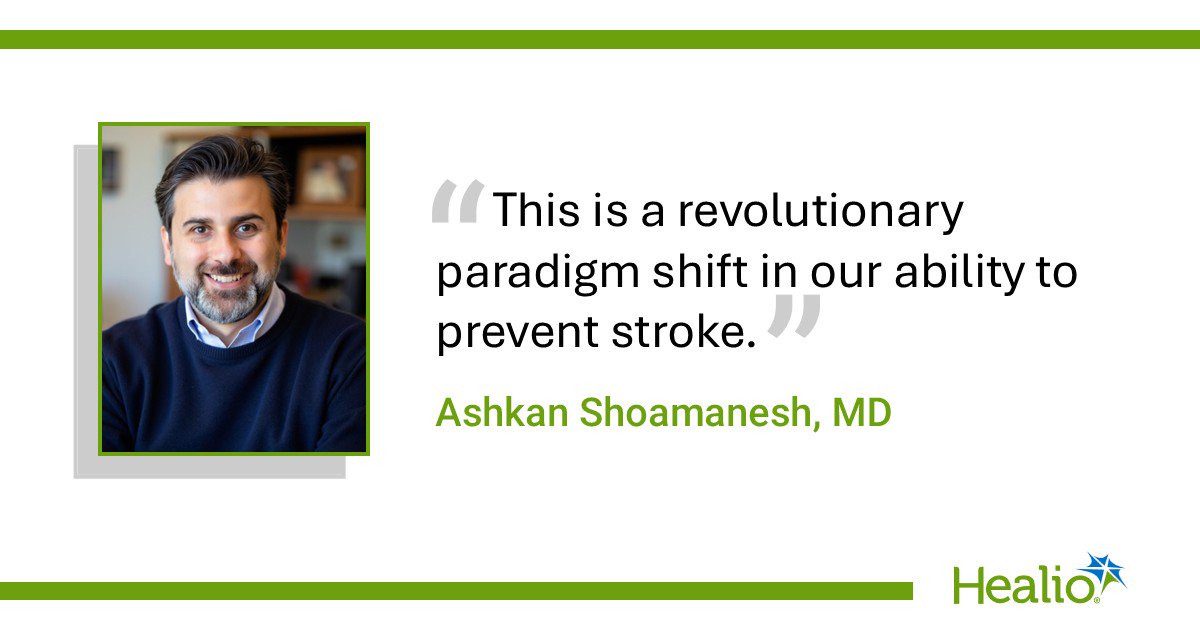
“What makes me believe this is a revolutionary paradigm shift in our ability to prevent stroke is the safety results that came with this improved efficacy, because we saw these benefits without any excess in our primary safety endpoint,” Ashkan Shoamanesh, MD, stroke neurologist at McMaster University in Hamilton, Ontario, Canada, senior scientist at the affiliated Population Health Research Institute and co-principal investigator of OCEANIC-STROKE study, told Healio. “But not only that, we actually saw absolutely no significant increase in any of our safety endpoints.
“This is the first case in history where an anticlotting drug is able to prevent a clotting event without having some offsetting harm from bleeding,” Shoamanesh said. “In one particular subtype of patient where many trials in the past have failed, embolic strokes of undetermined source, we also saw a robust reduction in stroke. We’re thrilled about these results, given the impact it’s going to have for ability to prevent strokes for our patients.”
Prior data on asundexian
In February 2022, asundexian received fast track designation from the FDA for its application for approval for secondary stroke prevention.
OCEANIC-STROKE was preceded by the phase 2 PACIFIC-STROKE trial, which evaluated the efficacy and safety of three doses of daily asundexian (10 mg, 20 mg and 50 mg once daily), on top of dual antiplatelet therapy in patients enrolled within 48 hours of noncardioembolic stroke symptom onset.
As Healio previously reported, asundexian on top of DAPT reduced factor XIa activity after stroke, with no excess bleeding risk.
“Factor XI lives in the contact pathway, and as opposed to other anticlotting medications, which inhibit not only bad clots that form strokes or heart attacks, for instance, they also will block the clots that prevent bleeding after vessel injury,” Shoamanesh told Healio. “By inhibiting factor XI, which is strategically placed in the cascade that leads to clots, you can actually inhibit the clots that lead to strokes without inhibiting the clots that lead to normal repair of vessels if they get injured. In effect, you could prevent stroke without compromising bleeding.”
The OCEANIC-STROKE trial
For the OCEANIC-STROKE study, researchers randomly assigned 12,327 patients within 72 hours of acute noncardioembolic ischemic stroke or high-risk TIA to once-daily asundexian 50 mg or placebo, both on top of antiplatelet therapy. Participants were enrolled at 702 sites across 37 countries (mean age, 68 years; 33% women; 66% white; 28% Asian).
All participants had a history of atherosclerosis, evidence of atherosclerosis in intra- or extracranial vessels or a visualized nonlacunar infarct and were excluded if they had a history of nontraumatic intracranial bleeding, sources of stroke requiring anticoagulation and active nontrivial bleeding, according to the study design.
The primary efficacy endpoint was ischemic stroke, and the primary safety endpoint was International Society on Thrombosis and Haemostasis (ISTH) major bleeding.
During 31 months of follow-up after index stroke, participants assigned asundexian experienced lower risk for secondary ischemic stroke compared with those assigned placebo (HR = 0.74; 95% CI, 0.65-0.84; P < .001).
The researchers also reported lower risk for key secondary outcomes with asundexian compared with placebo, including ischemic and hemorrhagic strokes (HR = 0.74; 95% CI, 0.65-0.84; P < .001), a composite of CV death, MI or stroke (HR = 0.83; 95% CI, 0.74-0.92; P < .001) and a composite of all-cause death, MI or stroke (HR = 0.85; 95% CI, 0.77-0.95; P = .003).
Although not statistically significant, there were numerically fewer ischemic strokes within 90 days and disabling/fatal strokes in the asundexian group than in the placebo group.
Risk for the primary safety outcome of ISTH major bleeding was not significantly different between the asundexian and placebo groups (HR = 1.1; 95% CI, 0.85-1.44).
Results were similar for all secondary safety events including ISTH major or clinically relevant nonmajor bleeding, clinically relevant nonmajor bleeding alone, symptomatic intracranial hemorrhage, hemorrhagic stroke, fatal bleeding and minor bleeding, according to the presentation.
“I thought it was too good to be true to see a drug that can actually prevent clotting to this extent and provide such a strong reduction on the efficacy side, without having at least some excess and minor bleeding,” Shoamanesh told Healio.
Moreover, the efficacy of asundexian for the prevention of secondary stroke was similar across all subgroups, regardless of age, sex, race, region and history of hypertension, diabetes, stroke or/TIA prior to index event and atherosclerosis.
“Based on phase 2, there was a suggestion that patients who had atherosclerotic disease would have greater benefit from asundexian compared with other stroke subtypes, and we did not see that. We found consistency across the board,” Shoamanesh told Healio. “This whole narrative we had that it was atherosclerosis that was going to drive benefit and stroke prevention is no longer the case. People with atherosclerosis do benefit, but they benefit similarly to all the other stroke subtypes that were eligible for the study.
“We’re excited about these paradigm-shifting results,” Shoamanesh said. “It is historical, given the lack of excess bleeding with clotting medication, and importantly, it is going to provide a new treatment for up to 5.5 million patients per year who have a noncardioembolic ischemic stroke around the globe.”
For more information:
Ashkan Shoamanesh, MD, can be reached at ashkan.shoamanesh@phri.ca.
Sources/Disclosures
Source:
Sharma M, et al. LB9. Presented at: International Stroke Conference; Feb. 4-6, 2026; New Orleans.
Disclosures:
The study was funded by Bayer. Shoamanesh reports serving as principal investigator on clinical trials and on advisory boards for Bayer.

Ask a clinical question and tap into Healio AI’s knowledge base.
- PubMed, enrolling/recruiting trials, guidelines
- Clinical Guidance, Healio CME, FDA news
- Healio’s exclusive daily news coverage of clinical data
<











Leave a Reply