
(NewsNation) — Federal officials say there is a growing chance the climate phenomenon known as El Niño will develop this summer, with some forecasts suggesting a historically strong one is on its way.
El Niño is a warming of the ocean’s surface in the central and eastern tropical Pacific Ocean, according to the United States Geological Survey. It occurs once every two to seven years and affects weather patterns worldwide.
The National Oceanic and Atmospheric Administration gives a roughly 60% chance El Niño will emerge between May and July of this year, with that probability rising to 90% between Aug. and Oct.
Missouri Gov. Kehoe declares ‘State of Emergency’ ahead of severe weather
NOAA announced earlier this month that La Niña, the opposite weather phenomenon characterized by cooler-than-average sea surface temperatures, has officially ended.
Could a ‘super El Niño’ be coming?
The “super El Niño” circumstance occurs when temperatures rise at least 2.0°C above normal, according to Matthew Sittel, assistant state climatologist at Kansas State University.
While this level of El Niño is rare, with only four since 1950, NOAA says there’s approximately a 50% chance this year’s could develop into a “strong” or “very strong” one. The last super El Niño occurred during 2015 and lasted into 2016.
Dam failure fears grow across Michigan as water levels surge
Federal officials note that a stronger El Niño doesn’t necessarily equate to more extreme weather.
“Stronger events do not always mean bigger weather and climate impacts,” according to NOAA. “Stronger events make it more likely that certain impacts could occur.”
How will El Niño affect the U.S. in 2026?
The impacts of El Niño are typically felt in the United States during the cool months, between Oct. and May, according to NOAA.
Monster typhoon bears down on US-controlled islands in the Pacific Ocean
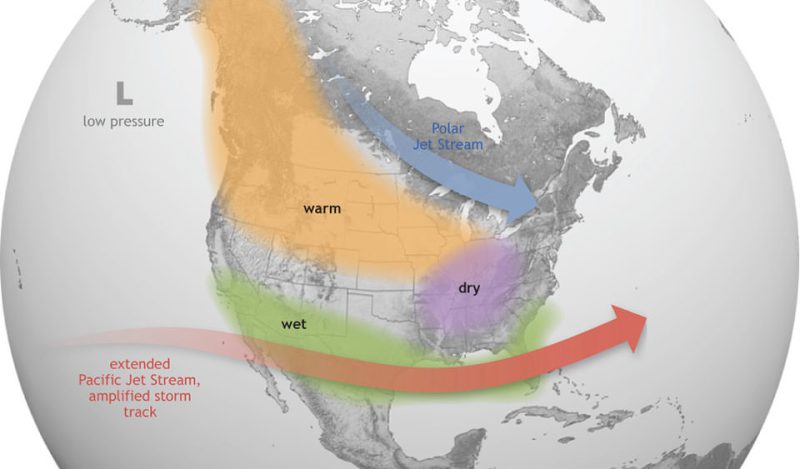
The super El Niño prediction means the traditional weather impacts of the phenomenon, such as warm, dry winter weather in the northern half of the country, and a wetter, colder winter for the southern states, are likely to occur, Nexstar’s Alix Martichoux reports.
However, if El Niño starts in the summer, as forecasters currently expect, it could also dramatically increase temperatures and contribute to heat waves before winter arrives, Martichoux added. This comes on the heels of a record-breaking spring, during which many states have set all-time heat records.
A strong El Niño could also lead to a milder hurricane season in the Atlantic. Andy Hazelton, associate scientist at the University of Miami CIMAS, predicted it might be “the quietest season since 2015.”
Nexstar’s Alix Martichoux and Jeremy Tanner contributed to this report.
Copyright 2026 Nexstar Media, Inc. All rights reserved. This material may not be published, broadcast, rewritten, or redistributed.
For the latest news, weather, sports, and streaming video, head to NewsNation.











Leave a Reply