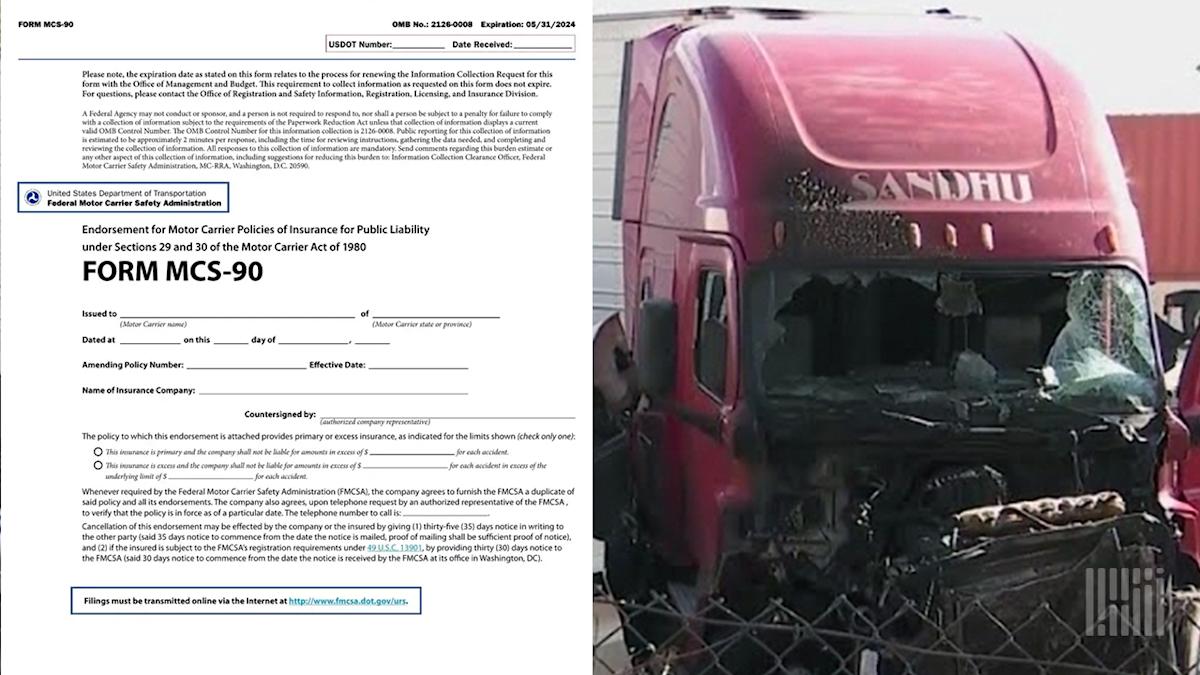
No federal or state law requires an insurance company to evaluate a motor carrier’s safety fitness before binding a commercial trucking policy. Every for-hire interstate carrier must carry minimum liability coverage to operate, but the process by which that coverage is obtained varies enormously, from rigorous actuarial underwriting with safety audits and ongoing loss control monitoring to instant-issue digital platforms where coverage binds without a single question about the carrier’s crash history. The $750,000 federal minimum, set in 1980, was intended to create a safety quality barrier. It has not functioned as one for decades, and now there is data at national scale to confirm it.
The working paper under peer review preparation, available at theteaintel.com, links FMCSA insurance filing records to carrier-level safety performance data for 314,078 interstate for-hire motor carriers using the agency’s February 2026 data release. The findings are built on a four-way insurance classification that separates the market into underwritten programs, which conduct prospective risk assessment; non-underwritten programs, which issue coverage without safety evaluation; Risk Retention Groups, which operate under federal preemption through the Liability Risk Retention Act with no state guaranty fund protection; and group captive programs.
The results support what the insurance market’s structural incentives would predict, but the magnitude of the differences is larger than expected, and the Risk Retention Group finding was not anticipated.
What the data shows across the main comparison
Within-cohort comparisons, which control for fleet size because larger carriers are both more likely to qualify for underwriting and independently safer, find that non-underwritten carriers exhibit significantly higher composite risk scores than underwritten peers of comparable size in five of six fleet size categories. The differences range from less than a quarter point among solo owner-operators to more than four points in the medium-fleet cohort of carriers with 20 to 99 power units, with most results significant at p < 0.001. Non-underwritten carriers also show dirty inspection rates, defined as the proportion of inspections generating violations across more than one BASIC category, that are 7.93 percentage points above the underwritten average across the full study population.
That dirty inspection rate measure is worth explaining because it does not appear in existing carrier safety research. An inspection that generates a single lighting violation tells you something different from an inspection that generates lighting violations, a brake adjustment issue, and a driver hours-of-service problem simultaneously. The multi-BASIC violation inspection is a signal of systemic safety neglect, of a carrier where the problems are not isolated but organizational. The underwritten versus non-underwritten gap on that measure is as consistent as the composite score gap, and it holds across fleet size cohorts.
The temporal analysis adds a predictive dimension. Using driver out-of-service rates split across two consecutive 12-month periods, carrier performance in the first period predicts performance in the second period significantly across all insurance categories at p < 0.001. But the persistence differential is meaningful: underwritten carriers show a 6.6 percentage-point second-period OOS gap between high and low performers in the first period, consistent with mean reversion driven by loss-control interventions. Non-underwritten carriers show a 9.7 percentage-point gap, suggesting the absence of the ongoing monitoring mechanism that produces that reversion. Insurance type contains predictive information about future safety outcomes beyond what current safety metrics alone capture.
The Risk Retention Group finding
The RRG result was not pre-specified. It emerged from the four-way classification structure and it is the most striking finding in the dataset. RRG carriers score 4.6 to 11.6 points above underwritten peers, depending on fleet size, with all differences significant at p < 0.001 or p < 0.01. Their overall dirty inspection rate is 50.71%, more than 15 percentage points above the underwritten average. Their driver out-of-service rates are the highest of any insurance category in both measurement periods, and the gap between their period-one and period-two OOS rates shows virtually no improvement, consistent with the absence of the monitoring and intervention mechanisms that characterize underwritten programs.
The Liability Risk Retention Act of 1986 authorized Risk Retention Groups to operate across all 50 states while being regulated only by their domiciliary state and explicitly exempts RRG policies from state guaranty fund coverage. The LRRA’s design assumption was that RRG members, bearing each other’s losses, would have strong mutual incentives to monitor peer safety performance. The trucking RRG market appears to have evolved into something closer to an adverse selection pool, attracting carriers who cannot obtain voluntary market coverage due to loss history or safety record, and progressively concentrating the carriers the voluntary market has screened out.
The systemic risk dimension compounds the individual safety finding. The carriers with the worst safety profiles in this dataset are simultaneously the least protected in the event of insurer insolvency. When an RRG fails, its policyholders have no recourse to state guaranty funds. A carrier in an insolvent RRG that causes a serious crash leaves a victim with a judgment and no collectible insurance. That combination, elevated individual safety risk and elevated insolvency exposure, exists uniquely in the RRG segment and has not been documented systematically prior to this analysis.
What the policy implications are and are not
Raising the federal minimum insurance dollar amount is necessary. The $750,000 threshold set in 1980 has lost more than 70% of its purchasing power to inflation and covers only a fraction of what a serious commercial trucking crash costs in 2026. The argument for raising it is not complicated.
But raising the dollar amount does not solve the underlying problem if coverage can still be bound without anyone evaluating the carrier’s safety fitness. The more direct intervention is a federal minimum underwriting standard that requires a prospective risk assessment before a commercial trucking policy is issued. That standard does not exist today. Creating it would not eliminate non-underwritten coverage from the market. It would require that whoever issues the policy has reviewed the carrier and priced the risk with knowledge of the carrier’s actual safety record.
The companion intervention is closing the RRG oversight gap created by the LRRA. A targeted amendment requiring trucking-sector RRGs to maintain minimum risk-adjusted capital buffers, submit to periodic solvency reviews with results disclosed to FMCSA, and maintain coverage that meets the same minimum underwriting standard as admitted market carriers would preserve the LRRA’s mutual insurer rationale while closing the adverse selection dynamic this data describes.
For carriers, the practical takeaway is immediate. Insurance type is now a data-backed signal of safety quality. Shippers and brokers building carrier qualification standards around actual risk can use it as a screening component. Carriers that want to signal they are not the RRG population in this dataset have a clear first step: get into an underwritten or captive program, build the safety infrastructure that makes staying there possible, and recognize that the qualification criteria the best freight networks are applying are not moving in a more permissive direction. The full methodology, insurer classification lookup table and computational code for this analysis are documented at theteaintel.com. A companion piece on raising the federal insurance minimum and what that reform would actually entail runs below.
The post New data puts a number on the insurance-safety gap in trucking appeared first on FreightWaves.











Leave a Reply