
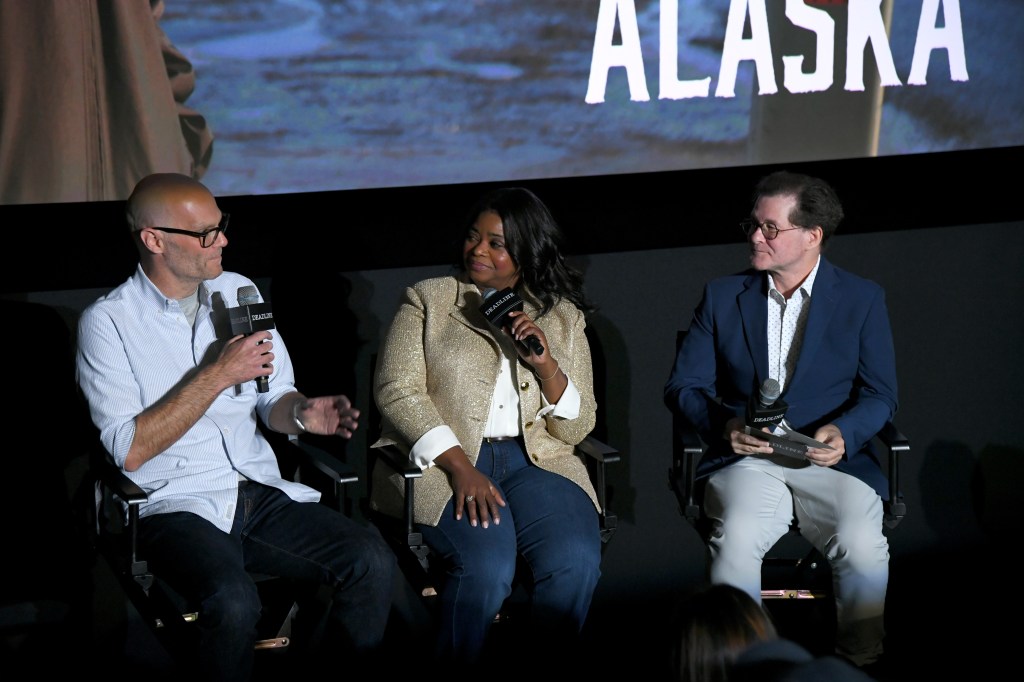
When Octavia Spencer, the narrator and executive producer of Investigation Discovery’s three-part docuseries Lost Women of Alaska, decided to get involved in telling the story of indigenous women living on societal fringes who were targeted and murdered by serial killer Brian Steven Smith, she had a key goal in mind: “Restoring the dignity of these women in solidarity with these women and their families.”
“I can’t imagine having a family member disappear and not knowing what happened to them,” Spencer said during the show’s panel at Deadline’s Contenders Television: Documentary event. “So we want to provide closure – in some cases, justice. … There’s a number that’s really stuck out for me that there were over 1,300 missing indigenous women. 1,300. But that’s an alarming number that the very opening line is, “Alaska is a serial killer’s playground.”
Executive producer Matt Robins says the story takes a deep look at how the South Africa-born Smith believed he’d never be caught, until a woman saw depraved, disturbing videos he’d shot of his victims and alerted police.
“It really is the story of a group of women that are essentially being taken from the streets by a predator who is emboldened and empowered by the fact that he believes those crimes will not be investigated,” said Robins. “And so on one level, you can watch a documentary series as a classic sort of mystery-oriented true-crime event where you are following the mystery of who is taking the women and who’s responsible for this and will they be caught? I think that the more important level, the second layer to this series has always been the way our society tends to fail women — and in this case, indigenous women, women who happen to be sex workers, the unhoused. This is a guy who knows that he can prey on these streets and target these women because he genuinely believes he’ll get away with it.”
He explained: “When this story first came to us, it came to us through a fantastic producer called Christina Douglas, who hails from an indigenous background. The story is very personal to her. The stat that she gave me when she first talked to us about the case was that Alaskan native women are 10 times more likely to be the victims of murder than white women in Alaska. So there is a real crisis at play in that part of the world. And it was very, very empowering and fascinating for us to be able to get in there and tell the story the way we did.”
Talking about the underlying cultural failures at play in the murders chronicled her and in the preceding series, 2023’s Lost Women of Highway 20, Spencer said: “I think there is systemic racism, [and] I think on a broader scale, misogyny. The fact that we have enough material to title a series Lost Women and have multiple seasons about different lost women is indicative and I think emblematic of a broader problem within society. So I think there’s a lot that goes to it, misogyny. And with regard to the indigenous women, ‘They’re not missed; they don’t have families,’ is what the perception is.”
Spencer said there will “absolutely” be more stories to tell under the Lost Women banner. “Sadly, there are so many missing women within our society, and across the world,” she explained. “It’s prevalent, quite prevalent in our society. And sadly, there is a series that we’ve created called Lost Women, and sadly there are so many voices that need to be restored. And we are happy to do the job.”





Leave a Reply