
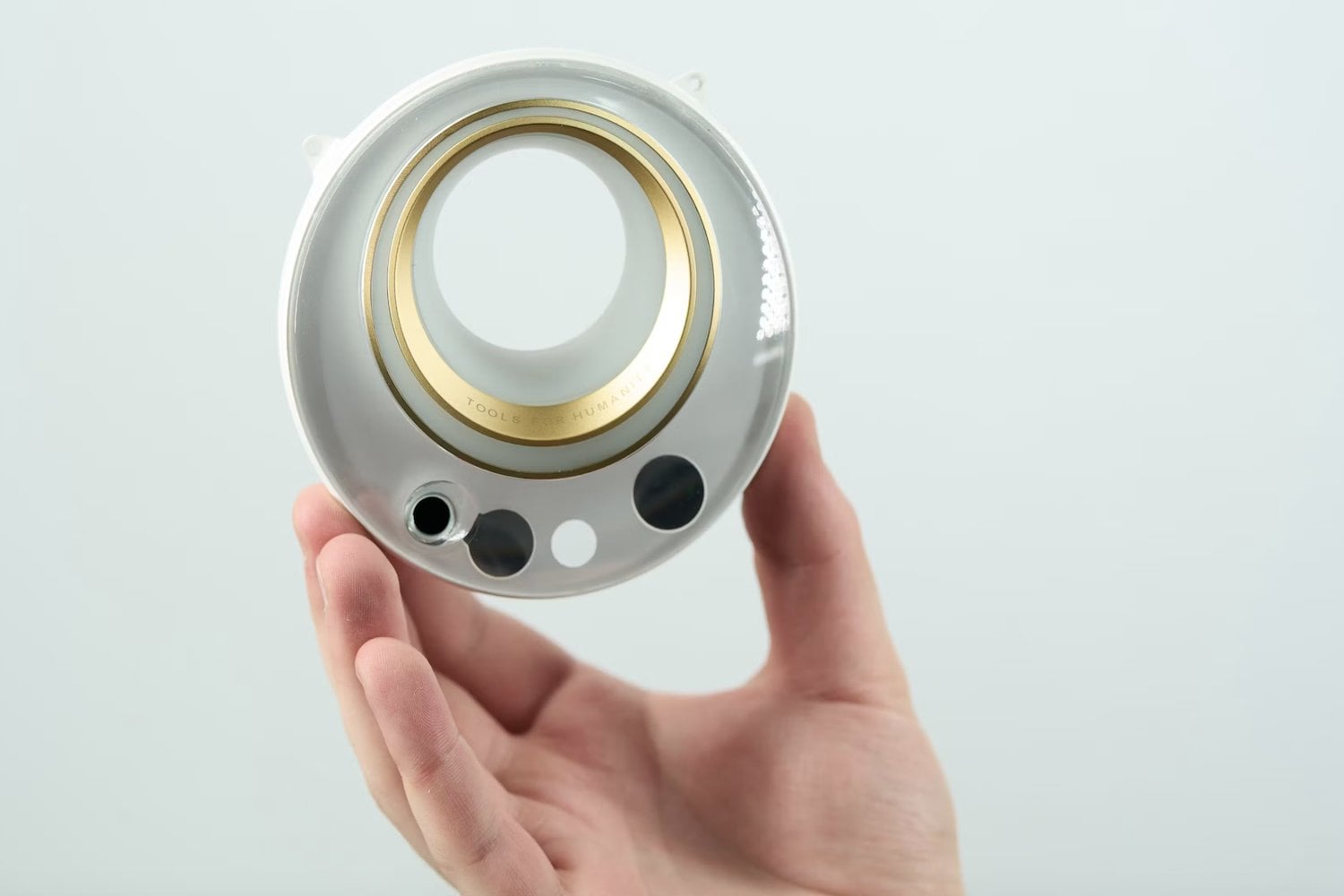

No one wants to talk to a bot, but how far are you willing to go to prove that you’re human? Sam Altman is banking on people being willing to surrender scans of their eyes in order to authenticate themselves, and he’s amassing some powerful sources to push more people to go along with the scheme. On Friday, both Tinder and Zoom announced partnerships with Altman’s World, the company behind the creepy, eyeball-scanning orb that is meant to prove users are human.
World has already been working with Tinder and ran a pilot of the verification process in Japan. It was apparently enough of a success that Tinder will roll out the authentication method globally. According to a press release, users will be required to undergo World’s verification method, which requires having their eyeballs scanned at a physical location with a proprietary device to prove they are human. Once they do so, they’ll get a badge on their profile to signal that they are a verified human. Tinder will also tempt people to partake by offering five free “boosts”—a feature that temporarily makes a person’s profile appear first for other users.
Zoom will also be getting in on the proof-of-humanhood plan, but will be taking a different approach. Per a press release, the video conferencing platform will start to integrate World ID Deep Face, a technology that cross-references an image of a user taken at the time they verify their identity at a World Orb device to ensure they are who they claim, performs a real-time face check of the person from their own device, and scans the live video frame that other participants see on screen. If all three methods produce a match, the person gets a “Verified Human” badge.
World doesn’t plan to stop there, either. The company is pitching itself as a potential solution to ticket scalping, and announced that it has built software called Concert Kit that ticketers can use to ensure only real people and not scalper bots are purchasing tickets. Once again, it requires people to offer a biometric scan to get authenticated.
Basically, every version of World’s approach to verification requires people to go along with invasive biometric scans, and while that might be the best way to ensure a person is who they claim to be, it’s also a pretty major uphill battle to sell people on submitting themselves to scans like this. The power of World’s partners will certainly make things trickier. Zoom is still a big deal across many workplaces, and Tinder remains one of the largest dating platforms in the world. We’re one step from these types of scans being mandatory, with the potential penalty of getting cut off from essential services for failure to comply.
It’s not clear World has anywhere near the infrastructure needed to support this scheme at scale at this point. Last year, the company claimed it planned to deploy 7,500 Orbs in the United States, but never followed up on that figure. The company reportedly has about 18 million verified users thus far, but many of them are people in developing nations who signed up because of the promise of Worldcoin, a cryptocurrency that has seemingly fallen out of World’s plans. The scheme to get users to trade their biometrics for digital coins was criticized for being exploitative and deceptive.
Even with that, World has had trouble getting buy-in from the general public, and rightfully so. Trusting your biometrics to any third party seems like a mistake (just look at how well third-party verification services have handled the sensitive data entrusted to them for age-assurance checks), but especially one run by a guy who frankly doesn’t seem to think much of humanity.






Leave a Reply