
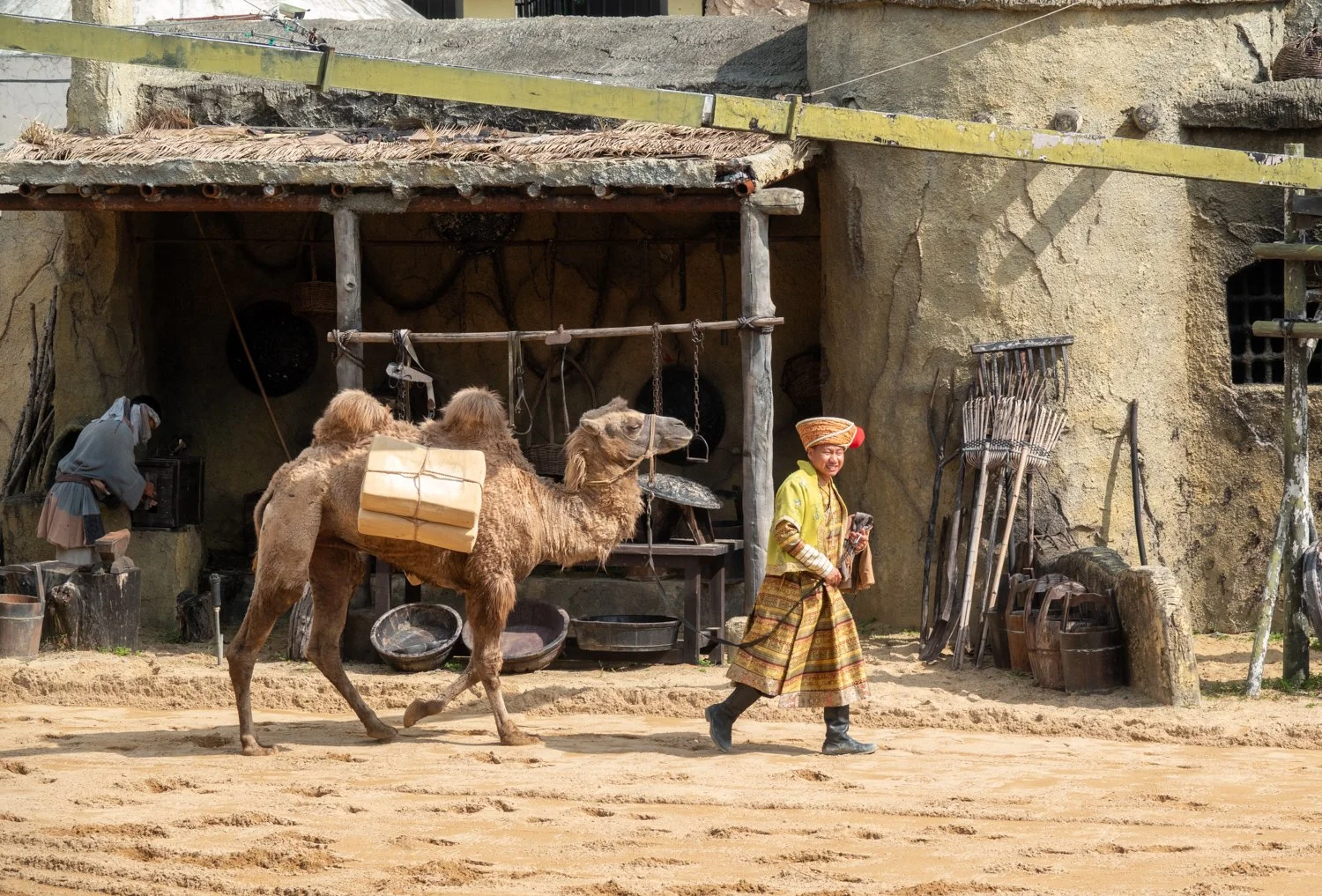

The Silk Road is an historically important area of China, as it represented the first connection that China had with the Western world. It is featured prominently in ancient literature and folklore. For example, probably the most well-known story that all Chinese children learn is the Journey to the West (西遊記), a fanciful account of a real-life 19 year journey in the 7th century AD by the Buddhist monk Xuanzang to India and back to find and retrieve Buddhist scriptures. Many of the stories in the Journey to the West take place on the Silk Road. So the famous characters in the story, the Monkey King (Sun Wukong), Piggy (Zhu Bajie), Buddhist monk (Tang Sanzang) are celebrated at many sites in this area. Part of the mythology of the journey is the ruggedness of the environment, traversing the intimidating Gobi and Taklamakan deserts, along with the likelihood of meeting bandits and raiders.
In addition to the characters in Journey to the West, another common sight is to see young women dressed in traditional hanfu (汉服) style and posing in front of ancient temples or landmarks.
Along the many miles of desert, there are a number of sites of great interest and historical importance (Mogao Caves, Jiayuguan, etc.). Inevitably, these sites are crowded with Chinese tourist buses. wind turbine and solar farms. Between these few attractions are endless miles of vast desert punctuated with solar and wind farms. The government is also building additional sites to attract the tourist trade.













Leave a Reply