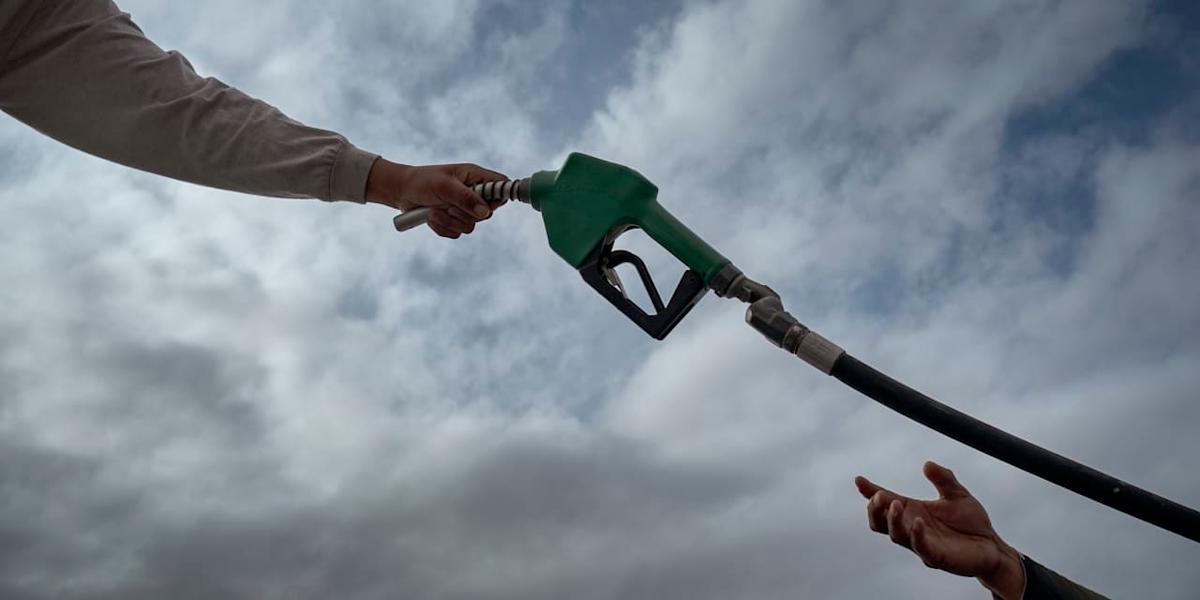
Traders are grabbing oil at much higher prices – Ezra Acayan/Getty Images
Hopes the Middle East conflagration will be brief have been dashed as the U.S.-Israel war with Iran goes into a second week.
Oil prices right now are by far the dominant determinant of market sentiment — and the prospect of energy supplies from the region being severely constrained has pushed crude to multi-year highs and whacked investors’ risk appetite.
This makes sense. Surging oil prices are a tax on consumers — via the gas pumps, for example. Meanwhile, through higher production and transport costs, they bolster inflationary pressures more generally.
When inflation rises but growth is constrained the economy can be blighted by stagflation, and that’s a possibility that is currently being addressed by even the usually more upbeat market observers, such as Ed Yardeni.
In a bulletin sent out late Sunday, the founder and president of Yardeni Research noted the spike in oil futures was accompanied by rising Treasury yields, a higher dollar, and lower gold prices.
This oil shock won’t end until ships can sail freely through the Strait of Hormuz, according to Yardeni. “Until then, the financial markets are likely to become increasingly concerned about a 1970s-style stagflation scenario; back then, the period of stagflation included two recessions,” he says.
Yardeni notes that on the Polymarket prediction site the prospect of a U.S. recession in 2026 has jumped in recent days. From 22% at the start of last week it is now 34%. (Polymarket has a data partnershp with Dow Jones, the publisher of MarketWatch.)
– Source: Yardeni Research
Already by last week Yardeni was predicting trouble ahead and a 10% to 15% correction in the S&P 500 because of the Middle East war.
The latest surge in energy costs makes him even more wary. “Now we can’t rule out a bear market and even a recession. It all depends on how long the Strait will be closed, obviously,” he says. A bear market is considered to be a 20% fall in stocks from the recent highs.
The S&P 500 and Nasdaq 100 already look “precarious” to Yardeni, as it seems likely they may soon fall below their 200-day moving average — a long-term trend gauge that usually acts as technical support.
And in the stagflation scenario, hiding out in bonds may not work either. Yardeni notes that 10-year Treasury yields, which move inversely to prices, have been “remarkably subdued” and stuck between 4.00% and 4.25% over the past year.
“Soaring oil prices are likely to disturb that calm, sending the yield higher,” he says.
Source: Yardeni Research –
In response to developments in the Persian Gulf, Yardeni is raising his odds of a 2026 recession from 20% to 35%, while also slashing the odds of an economic boom and stock market melt-up scenario from 20% to just 5%.
“We are sticking with our Roaring 2020s scenario and counting on the resilience of the economy, but the risks of a ‘Stagflating 1970s Redux’ scenario are increasing every day that the Strait remains impassable,” says Yardeni.
Nevertheless, he is preparing for when sentiment becomes too depressed. “As we’ve noted before, geopolitical crises tend to create buying opportunities in the stock market. Bearish sentiment is likely to soar in the coming days, which should work as a contrarian buy signal.” he says.
U.S. stock-indices SPX DJIA COMP are lower at the opening bell on Wall Street as benchmark Treasury yields BX:TMUBMUSD10Y rise. The dollar index DXY is higher while gold futures GC00 are trading around $5,105 an ounce.
U.S. oil futures CL.1 surged to nearly $120 a barrel on fears of supply constraints caused by war in the Persian Gulf. Prices later fell back toward $100 on reports developed nations may coordinate a release of oil stockpiles.
Key asset performance
Last
5d
1m
YTD
1y
S&P 500
6740.02
-2.02%
-2.77%
-1.54%
16.81%
Nasdaq Composite
22,387.68
-1.24%
-2.79%
-3.68%
23.03%
10-year Treasury
4.173
13.30
-3.90
0.10
-4.30
Gold
5114.9
-4.14%
0.60%
18.07%
76.79%
Oil
99.6
40.22%
54.61%
73.49%
51.12%
Data: MarketWatch. Treasury yields change expressed in basis points
Take control of your news. Make MarketWatch your preferred source on Google.
Mojtaba Khamenei, son of the slain Ayatollah Ali Khamenei, has been chosen as Iran’s new supreme leader, a move seen as maintaining Tehran’s hardline regime.
Live Nation Entertainment LYV is nearing a Department of Justice settlement that avoids a sale of its Ticketmaster business, according to Bloomberg, and its shares are jumping.
UniQure stock QURE is surging by nearly a third after the Federal Drug Administration said an official who oversaw vaccines and biotech treatments will step down from the agency.
Hims & Hers Health HIMS soared on a report it’s going to announce a partnership with Novo Nordisk NVO.
Hewlett Packard Enterprise HPE will announce earnings after Monday’s closing bell.
Earnings highlights this week include Oracle ORCL on Tuesday and Adobe ADBE on Thursday.
The Federal Reserve is in its blackout period ahead of its two-day monetary policy meeting starting on Mar. 18. The key consumer price index is due on Wednesday.
AI needs management consultants after all.
Kharg Island: Iran’s oil lifeline that Donald Trump has left untouched.
Anthropic has done a report on what it thinks will be the labor market impacts of AI.
Source: MarketWatch –
U.S. wheat futures on the Chicago Board of Trade W00 have jumped to their highest since June 2024 — topping $6.30 per bushel — as food staples become another victim of the Middle East war. Soybean S00 and corn C00 futures have also risen sharply in recent days as traders worry that supplies from the region of chemicals crucial for making agricultural fertilizers are being restricted.
Here were the most active stock-market tickers on MarketWatch as of 6 a.m. Eastern.









Leave a Reply