
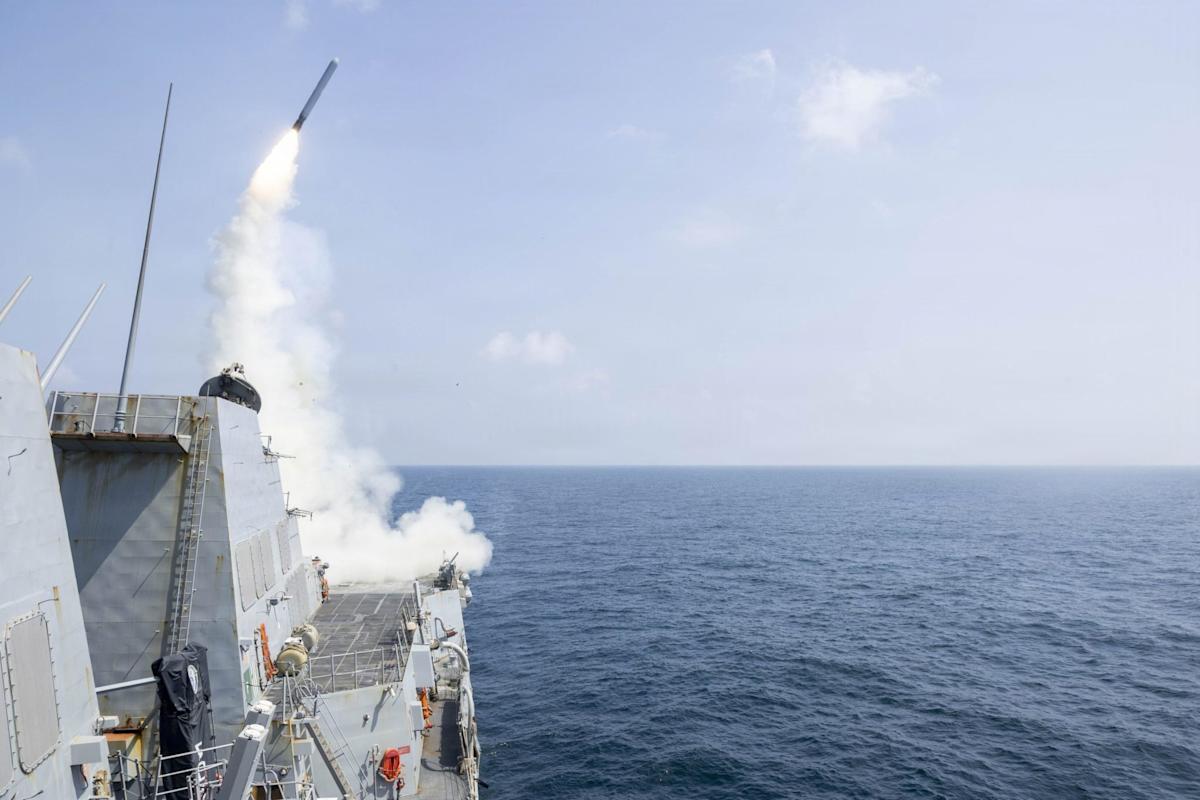
The Iran conflict has confirmed a transformation in the economics of warfare toward cheap, mass-produced weapons, forcing a wholesale rethinking of military procurement, according to a recent report.
While the U.S. and Israel have decimated Iran’s military, the Islamic republic still has enough combat power to inflict meaningful economic and physical damage, said Noah Ramos, chief innovation strategist at Alpine Macro, in a note earlier this month.
In particular, the regime has leveraged its Shahed drones, which cost only $20,000-50,000, forcing the U.S. and its allies to shoot them down with $4 million PAC-3 missiles or THAAD interceptors that cost $12 million-$15 million.
“Even with interception rates above 90%, the value of asset protection is diminished given the obscene economics,” Ramos wrote. “This imbalance has haunted Western military planners since the early days of Russia’s invasion of Ukraine.”
He explained that such lopsided attrition is the opposite of the West’s model of precision lethality and is a deliberate part of Iran’s strategy: mass losses are a feature not a flaw, because even the most advanced defenses can be overwhelmed with sufficient volume.
The cost asymmetry is worsened by severe production and supply-chain constraints. For example, no new THAAD interceptors have been delivered since August 2023, and the next batch is due in April 2027.
At the same time, the U.S. has rapidly drawn down stockpiles of its most expensive munitions during the Iran war. The Center for Strategic and International Studies put the tally at 45% of its Precision Strike Missiles, 50% of its THAAD interceptors, and almost half of its of PAC-3 missiles. CSIS estimated it would take one to four years to restock seven major munitions to prewar levels.
“The diminished munitions stockpiles have created a near-term risk,” the report said. “A war against a capable peer competitor like China will consume munitions at greater rates than in this war. Prewar inventories were already insufficient; the levels today will constrain U.S. operations should a future conflict arise.”
In fact, Alpine Macro’s Ramos pointed out that many critical components for a variety of U.S. munitions are deeply exposed to Chinese supply chains.
That includes the stealthy Joint Air-to-Surface Standoff Missile, the Tomahawk cruise missile, the Long-Range Anti-Ship Missile, and the Joint Direct Attack Munition guidance kit.
The U.S. military’s reliance on Chinese suppliers “poses a grave threat given geopolitical fragmentation or a conflict over Taiwan,” Ramos warned.










Leave a Reply