
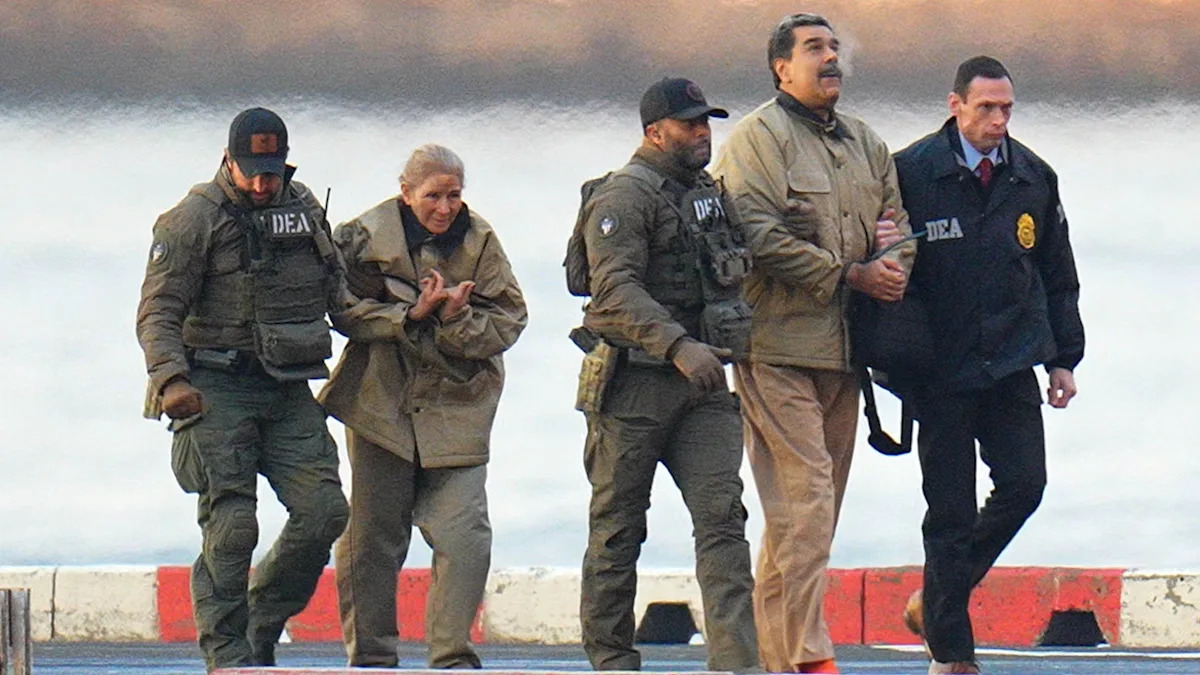
A U.S. Army special forces soldier who made more than $400,000 in an online betting market on deposed Venezuelan Nicolás Maduro’s ouster has been charged by the Justice Department with using classified information.
According to an indictment unsealed in Manhattan federal court on Thursday, Master Sgt. Gannon Ken Van Dyke, 38, who was stationed at Fort Bragg in North Carolina, was involved in the “planning and execution” of the U.S. operation that led to the Jan. 3 capture of Maduro and his wife, Cilia Flores, from their Caracas compound.
Van Dyke was charged with five counts: unlawful use of confidential government information for personal gain; theft of nonpublic government information; commodities fraud; wire fraud; and making an unlawful monetary transaction.
What does the indictment allege?
From Dec. 27, 2025, through Jan. 2, Van Dyke allegedly placed approximately 13 bets related to the Maduro operation on Polymarket, an online prediction marketplace that allows users to bet on the outcomes of future events.
The soldier allegedly took the “Yes” position on various wagers, including U.S. forces invading Venezuela and Maduro being out by Jan. 31. Van Dyke bet about $33,034 on those outcomes while in possession of classified information, according to the indictment, profiting approximately $409,881.
The soldier allegedly placed most of the proceeds into a foreign cryptocurrency vault before depositing them into a newly created online brokerage account, the DOJ said.
Then, after reports of unusual betting on prediction markets related to the Maduro raid surfaced, Van Dyke allegedly asked Polymarket to delete his account, falsely claiming he had lost access to the email associated with it. He also allegedly changed the email associated with his cryptocurrency exchange account to an address “that was not subscribed to in his name.”
On Jan. 3, just hours after the U.S. military apprehended Maduro and transported him to the U.S.S. Iwo Jima, a photo was uploaded to Van Dyke’s Google account showing him standing “on what appears to be the deck of a ship at sea at sunrise, wearing U.S. military fatigues, and carrying a rifle,” according to the indictment.
Van Dyke joined the Army in 2008 and was promoted to the rank of master sergeant in 2023, per the indictment. As part of his work, Van Dyke signed nondisclosure agreements in which he promised to never divulge, publish or reveal “any classified or sensitive information” relating to military operations.
“Rather than safeguard that information as he was obligated to do, Van Dyke decided to use that classified information to place trades on a prediction market platform for his personal profit,” the indictment alleges.
“Prediction markets are not a haven for using misappropriated confidential or classified information for personal gain,” U.S. Attorney Jay Clayton for the Southern District of New York said in a statement. “The defendant allegedly violated the trust placed in him by the United States Government by using classified information about a sensitive military operation to place bets on the timing and outcome of that very operation, all to turn a profit. That is clear insider trading and is illegal under federal law.”
In a statement, Polymarket said it had cooperated with federal authorities.
“When we identified a user trading on classified government information, we referred the matter to the DOJ & cooperated with their investigation,” the company said in a post on X. “Insider trading has no place on Polymarket. Today’s arrest is proof the system works.”
Prediction markets draw increased scrutiny
Online prediction markets have exploded in popularity in the past few years and come under scrutiny for suspiciously timed transactions related to military operations, including the war in Iran.
The White House recently warned staffers against using insider information on the Iran war to bet on prediction markets.
Meanwhile, U.S. lawmakers are considering legislation to rein in betting on certain events, such as terrorism, assassinations or war.
Just this week, Kalshi, another popular prediction market, announced that it had fined and suspended three congressional candidates for wagering on the outcomes of their own elections.
Trump compares soldier to Pete Rose
When asked by a reporter about the Van Dyke case late Thursday, President Trump initially compared it to that of MLB legend Pete Rose, who received a lifetime ban from baseball for betting on games.
“Was he betting that they would get [Maduro], or that they wouldn’t get him? That’s like Pete Rose betting on his own team,” Trump said. “That’s a little like Pete Rose. Pete Rose, they kept him out of the Hall of Fame for betting on his own team. Now, if he bet against his team, that would be no good, but he bet on his own team.”
The president went on to bemoan the rise of prediction markets.
“The whole world, unfortunately, has become somewhat of a casino,” Trump said. “And you look at what’s going on all over the world, in Europe and every place, they’re doing these betting things. I was never much in favor. I don’t like it, conceptually, but it is what it is. No, I think that I’m not happy with any of that stuff.”









Leave a Reply