
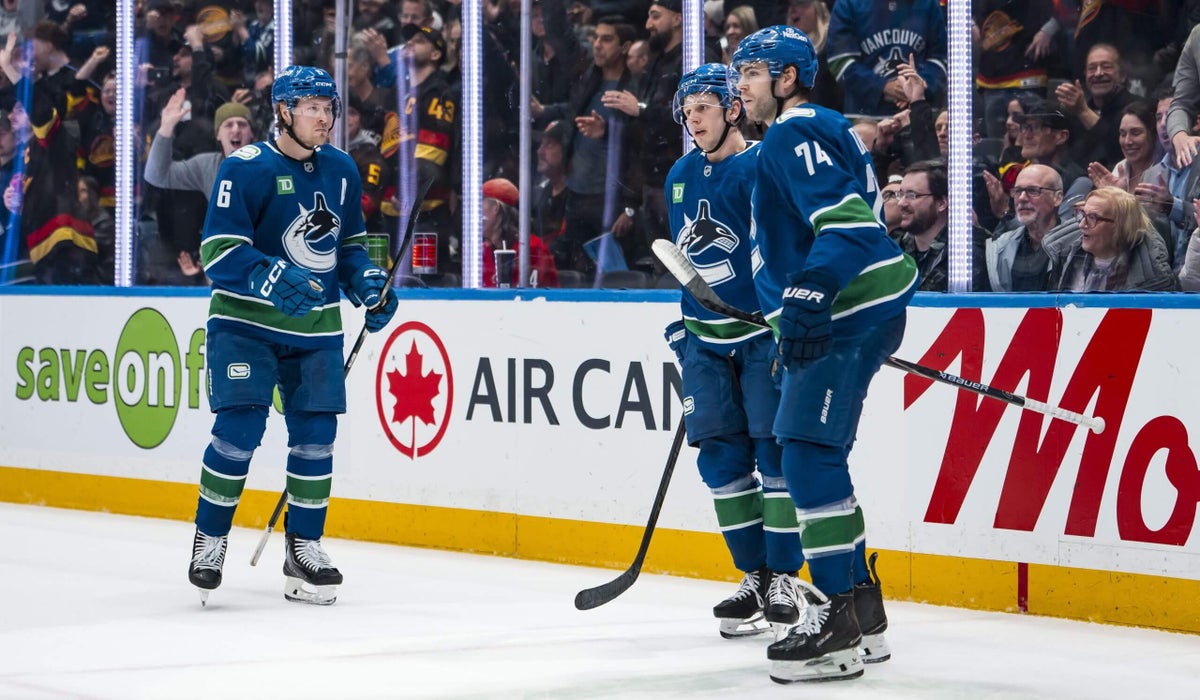
The Vancouver Canucks endured a miserable season, winning the fewest games in regulation in franchise history, and nearly every individual skater’s performance throughout the year reflected it.
There are only a few exceptions to this rule, a small handful of players who held up despite a disorganized defensive environment and an inconsistent team-level work rate. And at least some of the players who struggled for environmental reasons and were victims of an overmatched and poorly coached team remain good bets to bounce back.
Teasing out individual responsibility for team-level performance is one of the most difficult aspects of hockey evaluation, but it’s a critical exercise to undertake when evaluating players. This is why, at the end of every season, we hand out individual letter grades in our report cards, to try to mimic that process, and set offseason priorities for the team.
We’ll begin that exercise today with a look at every Canucks forward who appeared in at least 25 games and concluded the season on the roster. We’ll finish off our report cards tomorrow with an analysis of Vancouver’s defenders and goaltenders.
Elias Pettersson: D-minus
74 GP, 15-36-51
It wasn’t the bounce-back season that Pettersson, the Canucks and many fans would’ve hoped for. In fact, while Pettersson’s game didn’t have some dramatic further fall-off from the middle-six centre level that he’s hit since the spring of 2024, in a lot of ways, he was more effective during the 2024-25 campaign than he was this past year.
In particular, Pettersson’s defensive impact fell off even further this season, and he drew fewer penalties — a good proxy for how often he’s getting inside on defenders, and challenging them one-on-one — without any meaningful gains in his scoring profile. He’s still capable of holding up better against top competition at the top of the lineup than most of Vancouver’s other centres, but once Marco Rossi returned to full health, for example, he outperformed Pettersson by a wide margin down the stretch.
There are no easy answers here, and it’s not as if Pettersson isn’t willing to pay the price or go to dirty areas or stick his nose in and block shots. This isn’t about a player who, at least in the context of individual games, isn’t working hard enough.
It’s just that Pettersson’s dynamism with the puck has evaporated, both in terms of his “bro, do your dekes” element and his shooting accuracy.
The only real hopeful item that we can list is that Pettersson’s percentages were cruel and well below his historic standard. If the Canucks start finishing the way they historically have with Pettersson on the ice, he’s probably closer to a 70-point player. And, we should probably note that his most common linemate was Evander Kane at five-on-five, and Kane struggled enormously throughout the season.
Realistically finding Pettersson some linemates that can better hold onto the puck down low — the way his most successful linemates, from Andrei Kuzmenko to J.T. Miller, historically have — hoping for some shooting percentage regression and hoping that he can commit himself to an offseason program that helps him get his speed burst back (or closer to the level he was at before the 2023-24 campaign) is still a better bet than trading Pettersson at a low ebb of his value.
Brock Boeser: C-minus
75 GP, 22-26-48
That the Canucks fell below a baseline NHL level down the middle of their forward group makes it especially difficult to evaluate Boeser’s season.
By the surface-level numbers, Boeser started to produce down the stretch and salvaged what could’ve been a real outlier campaign for him from a goal-scoring and production standpoint. At five-on-five, however, Boeser was flattened by just about every metric, even when you correct for the impact of playing on the league’s worst team. That’s out of character, as Boeser has usually been a reasonably effective supporting-level piece at five-on-five. Not a play driver, but a legit top-of-the-lineup capable winger who can hang in tough minutes.
That wasn’t the case this year. The Canucks struggled enormously in Boeser’s minutes, and were outshot, out-chanced and outscored by a massive margin.
To the eye test, it seemed like Boeser’s game came on when he was united with Rossi down the stretch. While playing with a skilled centre, something Boeser probably requires to be effective, it looked a bit better than it looked when Boeser was playing on Drew O’Connor, Lukas Reichel or David Kämpf’s wing for games on end during December and January.
The underlying data, however, is somewhat less kind to how the Boeser-Rossi duo actually fared. While Rossi boosted the Canucks’ ability to control play five-on-five with Boeser on the ice, the club was still massively underwater in those minutes.
The fairest assessment is to conclude that Boeser legitimately struggled this season, but that the deterioration of Vancouver’s environment and its lack of skilled centres was a major contributor to those issues.
Jake DeBrusk: C-minus
81 GP, 23-19-42
DeBrusk scored three five-on-five goals all season, matching his career low in even-strength goal scoring set during the pandemic-abbreviated 2021 season in which DeBrusk played in 41 games.
DeBrusk’s five-on-five goal-scoring issues were so pronounced that it became something of a meme, a joking matter that DeBrusk would sheepishly refer to in postgame media availabilities. When he scored a three-on-three goal late in the year, for example, he hopefully asked the assembled Vancouver media pool whether or not that would count.
But while DeBrusk’s five-on-five goal scoring dried up to an almost comical proportion, his offensive impact remained pretty steady. Vancouver still generated more quality looks with him on the ice than it did in most other five-on-five minutes, and his shot, scoring chance and shot attempt rates were actually up versus his first season with the Canucks. It might not be a satisfactory answer, but a lot of DeBrusk’s goal-scoring struggles were probably a run of bad luck.
Where DeBrusk’s struggles were more pronounced this season were in the defensive end. DeBrusk, like Boeser, has generally been a complementary top-of-the-lineup winger. This season, however, Vancouver was flattened in his five-on-five minutes in terms of what other teams generated.
Ultimately, DeBrusk salvaged his season from a production standpoint with his stellar work at the net-front on the first power-play unit. His lacklustre defensive play and inability to finish at five-on-five, however, will need to be corrected next season if he’s going to continue to provide decent value for his cap hit.
Linus Karlsson: A
79 GP, 15-20-35
Karlsson was Vancouver’s best forward by a decent margin.
Somehow, despite being a completely dismal five-on-five team, the Canucks were only outshot by 13 shots in Karlsson’s minutes. To put in perspective how impressive that is, the second-best mark among Canucks forwards that appeared in at least 50 games belongs to Conor Garland and Vancouver was outshot by 47 in 55 games.
Not only was Karlsson far and away Vancouver’s most effective play driver, but he led the team in five-on-five scoring. He put together the sort of season that piques one’s curiosity about what he might be capable of in a larger role higher up the lineup, although the club inconceivably never even took the opportunity to take a sustained look at that during the stretch run of a tanking season.
Evander Kane: F
71 GP, 13-18-31
Kane’s offensive impact was decent at five-on-five in his first and only Canucks season, but may have been the product of him shooting at a high volume and without conscience, as opposed to playing the sort of clever hockey required to actually manufacture offence in the contemporary NHL.
Billed as a power forward, Kane’s physical impact on games was negligible. His only fight of the year came when he jumped non-fighting San Jose Sharks defender Timothy Liljegren on a night that he was struggling, and when the Canucks press box was packed with scouts evaluating his game ahead of the trade deadline. Ultimately, no team decided to make the Canucks a sufficient offer for his services.
Kane’s last game for the Canucks was played the afternoon of his 1,000th game milestone ceremony. He played fourth-line minutes, and his body language on the bench seemed surly. He didn’t appear in another game and left the club before the conclusion of the regular season.
Drew O’Connor: B-plus
82GP, 17-12-29
During a season in which Vancouver’s effort level was inconsistent, O’Connor was a welcome exception. Every game — and O’Connor is the only Canucks forward who appeared in all 82 contests — O’Connor brought a commendable level of effort and professionalism to the ice sheet. He was also solidly productive for a middle-six winger at five-on-five.
Marco Rossi: B-plus
33 GP, 8-14-22
Rossi produced at a 55-point-per-82-game pace with the Canucks, and even that probably underrates his impact, given that Rossi wasn’t really healthy in his first handful of games played following his acquisition from the Minnesota Wild.
Down the stretch, Rossi was easily Vancouver’s best centre. And it’s notable too that the first power-play unit started to cook when he was initiating plays off the left half wall, operating dynamically on his downhill side.
Max Sasson: B
66 GP, 13-6-19
Sasson cemented himself as a full-time NHL player and played his best hockey down the stretch when he was shifted full-time to left wing. An intelligent, highly competitive speedster, Sasson has also developed a sneaky efficient finishing game off the rush. It was a really solid first NHL season for the 2025 Calder Cup champion.
Liam Öhgren: B
51 GP, 8-10-18
Öhgren had some dynamic moments as a skilled player, both in the shootout and off the rush, but he produced at less than a 30-point-per-82-game pace across his 51 Canucks games.
Öhgren maintained a healthy shot and shot attempt rate and became a solid penalty killer down the stretch, which is a notable development. He’s clearly an NHL player and the tools are worth dreaming on, but he’ll have to produce at a much higher rate going forward, or he’s likely to top out as an O’Connor-type middle-six winger, as opposed to a potential core piece of the next great Canucks team.
Teddy Blueger: A-minus
35 GP, 9-8-17
Blueger shot the lights out in his 35 games for the Canucks, and was his usual diligent self — a reliable defensive centre capable of playing in the top nine, and an ace on the penalty kill — when he was healthy and in the lineup.
Aatu Räty: C
66 GP, 4-10-14
Räty’s defensive results were decent — although it’s clear that the Canucks coaching staff didn’t think so — and he was exceptional in the faceoff circle, but his foot speed limitation, lack of scoring and inability to win Adam Foote’s trust held him back.
Räty is young enough that he still has some time, and a full, healthy offseason may help to upgrade his foot speed. This is a critical summer for him, though, and the Canucks may want to consider taking a long look at him on the wing if they’re not comfortable utilizing him as a full-time fourth-line centre next season.
Nils Höglander: D
38 GP, 2-3-5
Höglander’s season was delayed by a significant injury, and it seemed like he never really caught up. While the puck battle-winning, speed and skill showed in flashes this season, he scored fewer points than Kämpf did for this team this season in the same number of games.
With two years remaining on a contract that carries a $3 million cap hit, Höglander — who’s now in his mid-20s — is running out of time to deliver on his potential and prove that he’s capable of earning the trust required from an NHL head coach to be utilized consistently in middle-six deployment.
Arshdeep Bains: F
28 GP, 1-4-5
Bains played 28 games for the Canucks this season after breaking camp with a real top-six shot. Ultimately, Bains couldn’t take advantage of that opportunity and fell back down the depth chart before being reassigned to Abbotsford.
Bains has one year remaining on his contract and a fully guaranteed NHL salary for next season. It’s clear that he’s going to have to change his approach to take a stab at becoming a regular.







Leave a Reply