
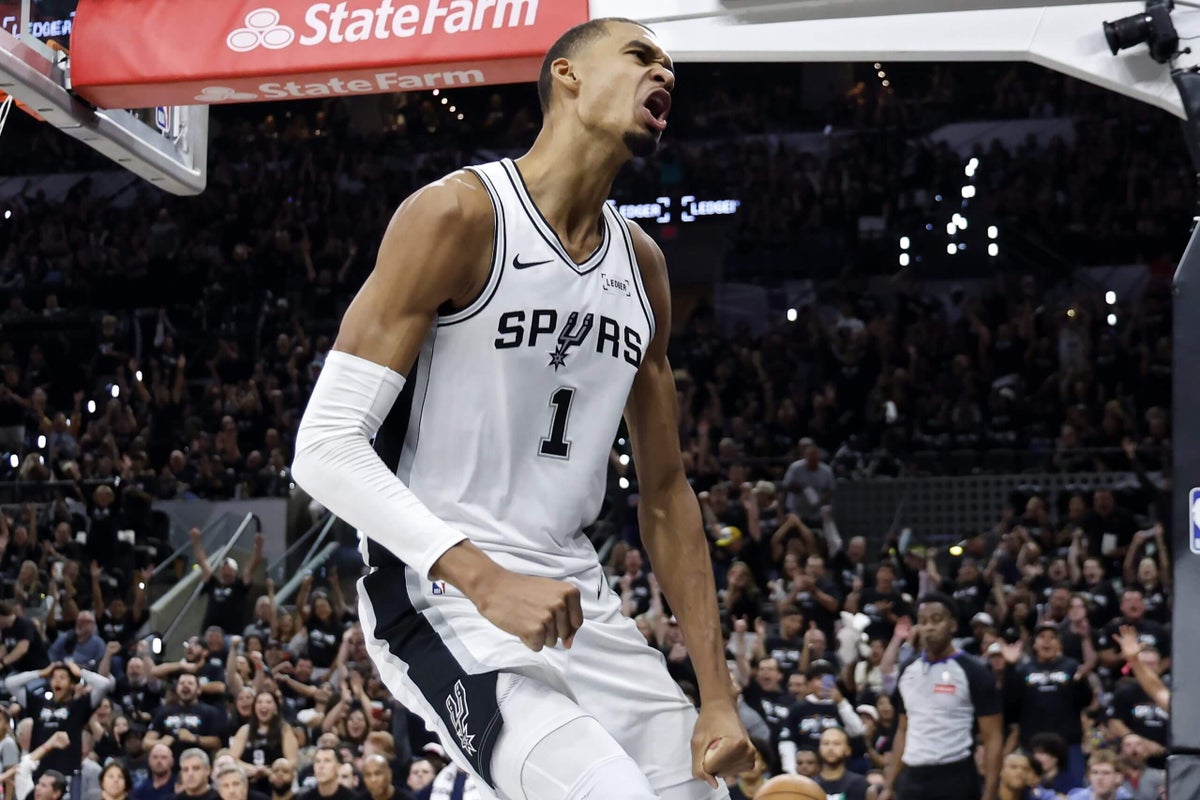
SAN ANTONIO — The ball seemed headed for the outstretched hands of Minnesota Timberwolves center Rudy Gobert. But what appeared to be a defensive rebound wound up on a tee for the alien.
Victor Wembanyama hadn’t made it to the offensive side of the court by the time San Antonio Spurs teammate Julian Champagnie pulled a transition 3 from the right wing. When the shot began its descent toward the rim, Wembanyama entered the scene at the 3-point line.
Just 83 seconds had elapsed in Game 2 of these Western Conference semifinals at the time, but anxiousness had already produced four turnovers and two missed open shots. The Frost Bank Center was filled with nerves.
Champagnie’s 3 bounced off the front rim and caromed off the backboard. A perfect miss for what unfolded.
In two steps, Wembanyama covered the distance between the arc and the restricted area, then leaped off one foot like a long jumper. With his right hand, he snatched the ball from Gobert’s awaiting hands and dunked home the putback.
This dunk operated as more than the first points of the game. Wembanyama’s opening salvo on Wednesday in San Antonio’s 133-95 win served as a release valve for his Spurs, whose excellence had been shackled by Minnesota in Game 1. Defeats typically stir up frustration in Wembanyama and trigger his competitive bent.
“There always is,” Wembanyama said. “And the playoffs magnify that.”
Adversity reveals. This test wasn’t as daunting as it will get for the 7-foot-4 Spurs center. But passing this one warrants a check mark.
Now that it’s over, the Spurs having throttled the Timberwolves until they squealed like chihuahuas, Wembanyama’s counterpunch seemed inevitable. Of course, the anointed one, the face of the NBA’s future, would respond.
Sure, Game 2 represented his first high-leverage playoff game. A proverbial must-win. However, how he’s handled everything in his ballyhooed career to this point suggested this occasion wouldn’t be a problem for the Frenchman.

Victor Wembanyama scored 19 points and grabbed 15 rebounds on Wednesday as the Spurs evened the series at one game apiece. (Ronald Cortes / Getty Images)
Still, the playoffs don’t operate on probabilities. Not even prodigies get free passes. After losing Game 1 and getting shoved around by Minnesota, Wembanyama still needed to deliver. He did on Wednesday to even the series as it switches to Minneapolis.
It took him fewer than a minute and a half to proclaim his excellence had arrived in this series. And it was a trumpet call for his team’s dominance. It didn’t amount to one of his more ridiculous performances. His numbers — 19 points, 15 rebounds and two blocks — were suppressed by the Timberwolves, who had accomplished the split they hoped for in San Antonio, folding like a lawn chair when pressed by the Spurs’ A-game.
However, this performance popped because of his leadership. At 22, he already comprehends the gravity of the postseason and the responsibility of the superstar example.
“To be honest,” Wembanyama said, “I’m expecting this kind of response from myself, from my teammates. So I’m not surprised by any means. I’m just going to keep working so we approach more games like we did tonight.”
The playoffs demand a different kind of maturity. Talent gets a player to this level. Matchups, adjustments and schemes prove vital in winning series. But completing the postseason crucible requires superstars to sense and respond to the moments. And any player expected to carry the league eventually learns the hard lesson about how the postseason punishes hesitation and rewards urgency.
What Wembanyama showed Wednesday was that he already grasps this demand. He’s still developing his playoff skin, the kind of armor only earned in the fire of a seven-game series. Seven games into his postseason career, it’s clear Wembanyama boasts the edge required of champions.
One win doesn’t earn a crown. Especially because the Timberwolves will respond. Anthony Edwards doesn’t take kindly to embarrassing beatdowns. And the Minnesota crowd will apply pressure by volume. But the significance of Game 2 lies in how quickly Wembanyama course-corrected.
Not even three minutes after his tip-dunk, he set a screen for Devin Vassell and rolled to the basket. In Wembanyama’s way? Julius Randle.
The Timberwolves’ big bad forward pushed Wembanyama around in Game 1. His bulk underlined the frailty of the Spurs’ big man. So Wembanyama went at him. He caught the lob with one hand, crashed into Randle, and banked in the shot off the glass, drawing a foul in the process. He pumped his fist and walked closer to the frenzied audience so he could join them in roaring.
Wembanyama seemed to naturally understand the danger of falling 0-2 and acted accordingly. That recognition, immediate and forceful, felt every bit as important as the performance itself.
For the better part of two years, the NBA and its devotees have imagined what Wembanyama could become. The highlights can be captivating. The numbers can be surreal. But Wembanyama’s prophecy hinges on his competitive fervor and how he handles the inevitable struggles.
Game 2 offered a clearer glimpse of the moxie and presence that feels so special. Such matters most this time of year.








Leave a Reply