As the conflict in Iran continues and engulfs an ever-widening swath of the Middle East, choking off transit through the critical Strait of Hormuz, oil prices continue to surge higher — forcing reevaluations of previous assumptions about US inflation and the Federal Reserve’s path for interest rates.
Treasury yields (^FVX, ^TNX) climbed and expectations for rate cuts pared back this week as traders digested the risk that higher crude prices could slow progress toward the Fed’s 2% inflation goal. For policymakers, the question is: How much inflationary pressure does a sustained rise in oil prices create — and for how long?
“As in 2022, war has proven to be ‘inflationary,’ as it is associated with negative supply shocks,” Macquarie’s Thierry Wizman said in a recent client note. “The ‘dogs’ of this war may bite the hands of central bankers, given that with the prospect of renewed inflation may come more hawkish monetary policy signals.”
The global economy depends heavily on energy flows from the Persian Gulf, locked behind the Strait of Hormuz. Roughly 20 million barrels per day of oil and about 10 billion cubic feet per day of liquefied natural gas (TTF=F) pass through the region, according to energy analysts.
“We’re starting to see both potential points of failure affecting the market right now,” Clay Seigle, a senior fellow at the Center for Strategic and International Studies, said in comments on MS NOW, pointing to the ability of ships to transit the strait and the functionality of export terminals in the region.
“This is sort of the perfect storm for an oil supply disruption,” he added.
Read more: What an extended war with Iran could mean for gas prices
As of Wednesday, futures on Brent crude (BZ=F), the international pricing benchmark, had gained roughly 15% from Friday’s closing price, while those on US benchmark West Texas Intermediate crude (CL=F) had picked up a slightly slimmer 14%.
Goldman Sachs estimates that a sustained $10 per barrel increase in oil prices would trim roughly 0.1 percentage point from 2026 GDP growth if prices remain elevated through year-end, according to a recent client note, largely reflecting a hit to consumers’ real disposable income.
On inflation, the pass-through is more immediate. A sustained 10% increase in oil prices would likely boost core CPI by four basis points and headline CPI by 28 bps, Goldman said. In scenarios where oil prices remain elevated for several months, year-over-year headline inflation could temporarily climb back toward 3%.
Read more: How to protect your savings against inflation
In a more extreme scenario, Apollo Global’s Torsten Sløk estimated that if oil prices were to climb by $50 per barrel, second quarter inflation would be likely to increase by one percentage point, or 100 bps, above baseline. (Disclosure: Yahoo is a portfolio company of funds managed by affiliates of Apollo Global Management.)
“The events dovetail into an existing fear in the markets that inflation, at least in the States, could be quite sticky,” Capital analyst Kyle Rodda said in emailed commentary.
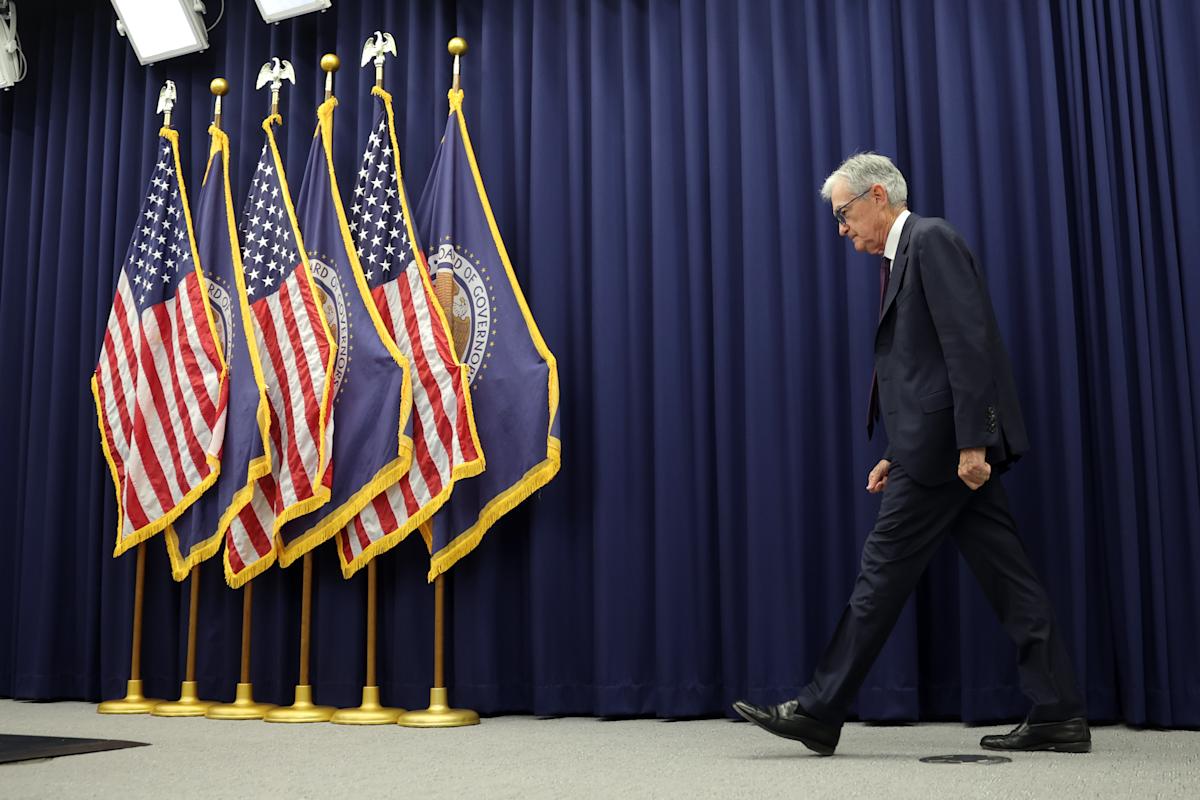
Fed Chair Jerome Powell speaks during a press conference following a two-day meeting of the Federal Open Market Committee (FOMC) in January. (Reuters/Jonathan Ernst) ·Reuters / Reuters
The key risk is that energy prices stay elevated long enough to affect consumer expectations, creating broader second-round effects and complicating the Fed’s easing calculus, analysts said. The two-year Treasury break-even rate — a market measure of inflation expectations — has climbed to roughly 2.9% from around 2.3% earlier this year, according to Oxford Economics lead analyst John Canavan.
In comments on Tuesday, New York Federal Reserve president John Williams said the conflict in Iran could impact the outlook for inflation and raise uncertainty for the economic outlook.
“[Energy price increases are] something that would obviously affect kind of a nearer-term inflation outlook,” Williams said. “We’ll have to see how persistent this is and how long this is, but it would have an effect on overall inflation.”
Similarly, Minneapolis Fed president Neel Kashkari said on Tuesday that he was no longer as confident in his previous call for one quarter-point cut this year, noting that “with the geopolitical events, we need to get a lot more data in.”
Traders are in near-consensus that the Fed will maintain its target rate of 3.5% to 3.75% at the upcoming March meeting, but predictions have strengthened that rates will remain untouched through June.
Historically, the Fed has tended to look past temporary supply shocks, particularly when they primarily affect headline inflation. But if energy-driven price pressures persist and begin feeding into core measures or inflation expectations, policymakers may find it harder to justify cutting rates in the near term.
For now, most baseline forecasts assume disruptions are short-lived, especially as US growth remains relatively resilient. But the longer crude prices remain elevated, the more difficult it becomes for the Federal Reserve to argue that inflation risks are firmly behind it.
“While the terms of trade shock on the US from higher oil prices might be small for the US as a net producer of oil, we caution that the US can still suffer beyond a single quarter if the consumer acts on perceived fears of higher prices and lowered real incomes,” Wizman said.
Jake Conley is a breaking news reporter covering US equities for Yahoo Finance. Follow him on X at @byjakeconley or email him at jake.conley@yahooinc.com.
Click here for the latest economic news and indicators to help inform your investing decisions
Read the latest financial and business news from Yahoo Finance










Leave a Reply