
January 30, 2026
5 min read

Key takeaways:
- The consortium has enrolled approximately 1,000 patients with immune-related adverse events from checkpoint inhibitor therapy.
- Inflammatory arthritis and polymyalgia rheumatica are the most common irAEs.
Three years after enrolling its first patients, a consortium of researchers examining the growing issue of immune-related adverse events due to immune checkpoint inhibitor cancer therapy released a bounty of data at ACR Convergence 2025.
The Rheumatology Adverse Events Due to Immunotherapy Observational Studies (RADIOS) consortium, created by researchers at Johns Hopkins University, enrolled its first patients in late 2022 and early 2023, according to Laura Cappelli, MD, MHS, of the division of rheumatology at Johns Hopkins University School of Medicine.

As of late 2025, the cohort has enrolled approximately 1,000 patients with a spectrum of immune-related adverse events. The majority of patients have reported inflammatory arthritis or polymyalgia rheumatica (PMR), while the remainder have developed other conditions, including myositis and Sicca syndrome.
“We have learned so much. Starting with inflammatory arthritis, which is the most common irAE, we have learned about the heterogeneity and severity of clinical disease,” Cappelli told Healio. “We have learned about practice patterns and how people are treating irAEs in the absence of evidence-based guidelines.”
Twelve sites across the United States are currently enrolling patients. Cappelli added she hopes that this number will expand in the coming months and years.
Healio sat down with Cappelli to discuss the creation of RADIOS, what rheumatologists and oncologists can learn from the data being collected, and where the next phase of research can go.
Healio: Why was the RADIOS consortium created and what were you hoping to accomplish with it?
Cappelli: We realized pretty early on in the days of trying to understand immune-related adverse events (irAEs) from immune-checkpoint inhibitors that we would need to work together across centers to have enough numbers to understand all the rheumatic and autoimmune outcomes in these patients. We wanted to understand the more common events like inflammatory arthritis and PMR, but also some of the less common events like myositis.
We met people who were interested in these events at different centers, including Brigham & Women’s Hospital, Cleveland Clinic, Hospital for Special Surgery and MD Anderson Cancer Center. For several years, we tried to figure out funding for RADIOS, and how to get it off the ground.
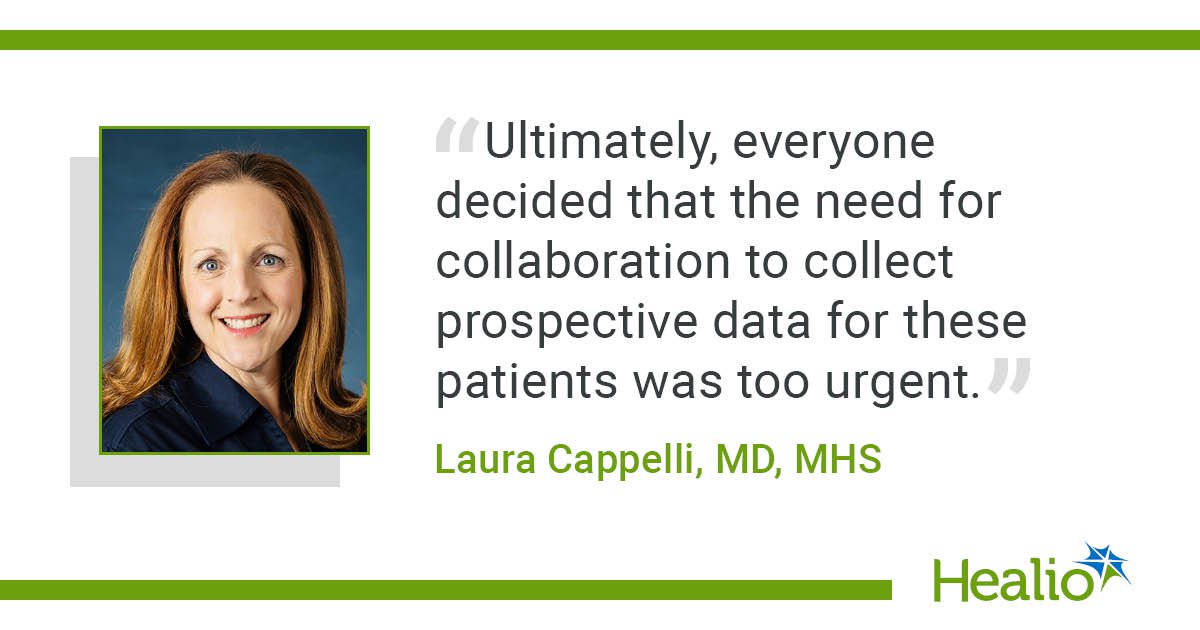
Ultimately, everyone decided that the need for collaboration to collect prospective data for these patients was too urgent. Participants at the different centers agreed to use their own resources and just start the consortium, with the hope to get funding later. So, it has been a labor of love for all the people who have been involved who have given time and resources.
We are now up to 12 sites across the United States enrolling patients. We have expanded our data collection forms, and expanded what biospecimens people are collecting across the consortium. All of this will enable scientists to understand not just the different phenotypes of irAEs but how they occur and how to treat them.
Healio: How many papers at ACR Convergence 2025 featured RADIOS data, and what types of data were presented?
Cappelli: There were five abstracts presented at ACR Convergence 2025 using RADIOS data. One evaluated steroid dosing and progression of cancer, one looked at the features of PMR in the RADIOS cohort and how it compared to traditional PMR.
A few abstracts focused on baseline characteristics of two different patient populations that we capture in RADIOS — those with de novo autoimmune disease and those with known preexisting autoimmune disease from immune checkpoint inhibitors.
We were very happy to get our data out there. We are hoping to follow up with peer-reviewed manuscripts in the coming months.
Healio: What are some of the major themes or lessons on irAEs that have emerged from RADIOS data?
Cappelli: Starting with inflammatory arthritis, which is the most common irAE, we have learned about the heterogeneity and severity of clinical disease. We have learned about practice patterns and how people are treating irAEs in the absence of evidence-based guidelines. There are guidelines from the oncology standpoint but they are mostly expert consensus. There is really a lack of high quality data out there guiding treatment.
So, at the moment, we are trying to figure out what are the most efficacious and safe treatments. We are hoping to design trials to figure out the best treatments for these events.
Another theme that has emerged is that there is a spectrum of inflammatory diseases that spans inflammatory arthritis and PMR to myositis. Some patients develop more peripheral disease in the muscle and fascia that is not limited to joints. The idea of well-defined phenotypes like we see in our traditional autoimmune diseases does not always apply.
These irAEs might not be as straightforward. As the numbers grow, we will be able to understand the details of how patients and patient groups differ from one another and what that means for treatment and long term outcomes.
Healio: What do the RADIOS data suggest regarding whether checkpoint therapy is unmasking subclinical or preclinical disease, or whether these irAEs represent a new disease triggered by checkpoint inhibition?
Cappelli: The answer is likely both. It depends on the person.
There is a small minority of people who had anti-CCP antibodies or rheumatoid factor before undergoing checkpoint inhibitor therapy and developed an irAE. Would we classify those people as having pre- or subclinical RA, and that the checkpoint inhibitor kicked it off? That is a reasonable way to think about it.
For patients who lack clinical antibodies, the picture is less clear. They might have autoreactive T cells or antibodies before immune checkpoint inhibitor therapy, but we are just not aware of it.
Healio: How have the themes or lessons that have emerged helped with cancer care?
Cappelli: We have learned that the patients who are seeing a rheumatologist for an irAE generally seem to have better cancer outcomes from their immune checkpoint inhibitor therapy. We were surprised that cumulative dose of corticosteroids did not associate with cancer progression. There might be other features of the timing of immunosuppression that influence tumor outcomes.
Healio: What are the next steps for these data, short-term or long-term? More study and analysis? Will they be used to inform guidelines?
Cappelli: A couple of areas we would like to look at more closely are sicca syndrome and myositis as irAEs. The other thing we would like to do is collaborate on translational work and to grow the consortium, so we can understand treatment efficacy data and inform guidelines and clinical trials to further refine practice.
One other thing we would like to look at is when are people being referred to rheumatology. How severe does their irAE have to be and how much are oncologists managing them on their own before referring to rheumatology? There are differences from site to site in how these patients are being managed that we would like to understand.
For more information:
Laura Cappelli, MD, MHS, can be reached at lcappel1@jhmi.edu.
Sources/Disclosures
Source:
Healio Interview
References:
Cappelli L, et al. Abstract 1107. Presented at: ACR Convergence 2025; Oct. 24-29, 2025; Chicago.
Cappelli L, et al. Abstract 1108. Presented at: ACR Convergence 2025; Oct. 24-29, 2025; Chicago.
Jannat-Khah D, et al. Abstract 1730. Presented at: ACR Convergence 2025; Oct. 24-29, 2024; Chicago.
Tison A, et al. Abstract 1088. Presented at: ACR Convergence 2025; Oct. 24-29, 2024; Chicago.
Tison A, et al. Abstract 1089. Presented at: ACR Convergence 2025; Oct. 24-29, 2024; Chicago.
Disclosures:
Cappelli reports receiving research funding from Bristol-Myers Squibb and consulting fees from Amgen, AbbVie, Bristol Myers Squibb and Sanofi.

Ask a clinical question and tap into Healio AI’s knowledge base.
- PubMed, enrolling/recruiting trials, guidelines
- Clinical Guidance, Healio CME, FDA news
- Healio’s exclusive daily news coverage of clinical data
<








Leave a Reply