
February 06, 2026
4 min read

The ongoing opioid epidemic highlights health care’s role in fueling the crisis as well as the highly addictive nature of opioids.
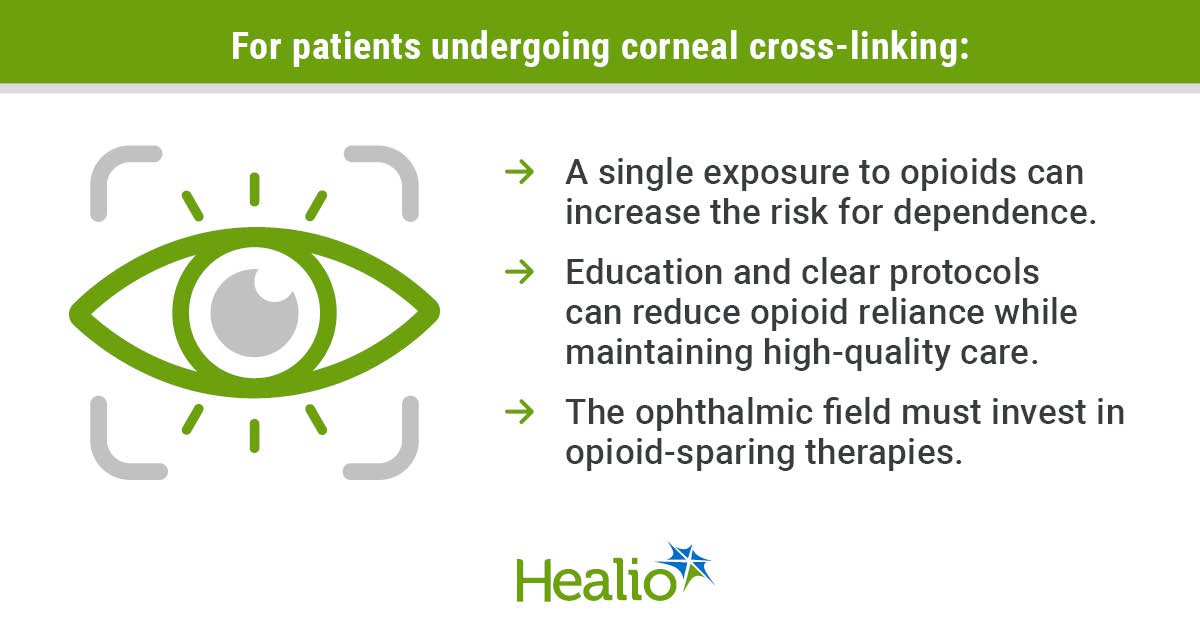
Even a single exposure to opioids can increase the risk for dependence (Sun et al.; Thao et al.).

Data were derived from “Opioid use for corneal cross-linking: Potential concerns and drug stewardship.”
Although postoperative opioid prescriptions in ophthalmology are typically low dose and written without refills, the specialty is not spared from unintended harms. In one analysis, patients who received even a single opioid prescription after ophthalmic surgery had higher rates of hospitalization, overdose and mortality compared with those who did not, with risk escalating as dosage increased (Thao et al.).
A 2025 study from Massachusetts Eye and Ear brought ophthalmology’s role in the opioid crisis into sharper focus. Of all ophthalmic procedures in 1 year, 2.2% had associated opioid prescriptions. Cornea specialists accounted for roughly one-third of those prescriptions, and more than half were for patients undergoing cross-linking. Strikingly, a significant portion of these prescriptions were written by fellows and residents, underscoring the role of trainee education in prescribing patterns (Boychev et al.).

Jack Parker
Part of this pattern can be explained by the unique physiology of the cornea. The cornea is the most densely innervated tissue in the human body, with high nociceptor density and sensitivity (Goyal et al.). In CXL, wide epithelial removal exposes these nociceptors, and ultraviolet A-induced stromal injury further intensifies pain. As a result, postoperative discomfort peaks within the first 24 to 72 hours and is often described as excruciating (Goyal et al.; van der Valk Bouman et al.).
This acute but severe pain explains why physicians may reach for opioids, even in low-dose short-course regimens, to meet patient expectations for relief. Yet physicians must strike a delicate balance between providing comfort and minimizing exposure to harm. Because even one prescription can be enough to trigger dependence, reducing unnecessary opioid use is an important target for improving outcomes.
However, no standardized guidelines currently exist for pain management following CXL (van der Valk Bouman et al.). Therefore, prescription frequency varies across providers, as demonstrated in the Mass Eye and Ear study, in which rates differed among attendings, residents and fellows, with more than half of opioid prescriptions written by trainees.
This is especially concerning because CXL is increasingly performed in younger patients, including pediatric populations, who may be more vulnerable to the long-term consequences of early opioid exposure (van der Valk Bouman et al.).
One clear area for improvement is training. Surveys of surgical trainees across specialties reveal wide variability in opioid education, with many reporting inadequate preparation (Yorkgitis et al.; Bleicher et al.).

Christiana Han
One major contributor to this inconsistency is the absence of evidence-based specialty-specific prescribing protocols. Current postoperative opioid practices in CXL vary widely and often depend on individual surgeon preference rather than established norms. For example, a study by Woodward and colleagues reduced the standard prescription from 20 tablets of combination acetaminophen/codeine (acetaminophen 300 mg and codeine 30 mg; approximately 4.5 oral morphine equivalent [OME] per tablet) to five tablets while allowing surgeon discretion. Patients maintained adequate pain control despite receiving significantly fewer tablets, suggesting that routine higher-quantity prescriptions may be unnecessary (Woodward et al.).
At the Mayo Clinic, Starr and colleagues implemented standardized ophthalmology-specific prescribing guidelines that categorized surgeries into three tiers based on expected opioid needs (< 0 OME, < 40 OME and < 80 OME). Their intervention led to marked reductions in both opioid dose and prescribing frequency without compromising patient outcomes. Together, these findings demonstrate that education and clear protocols can meaningfully reduce opioid reliance while maintaining high-quality care.
In our own clinic, the standard prescription for post-CXL pain is 10 tablets of oxycodone 5 mg. Although there is growing consensus across ophthalmology that “the less, the better,” a significant gap remains: There are no widely adopted evidence-based guidelines for opioid prescribing specific to CXL. While individual clinics may develop internal standards, field-wide guidance would decrease variability, support trainees in clinical decision-making and reduce unnecessary community opioid exposure.

Philip Dockery
Beyond training, the field must also invest in opioid-sparing therapies. Multimodal regimens, standardized prescribing protocols and novel options such as drug-eluting contact lenses represent promising strategies to address postoperative pain without fueling dependence.
Another option to reduce opioid dependence following CXL is to minimize procedural pain itself. Emerging “epi-on” protocols, which leave the corneal epithelium intact, may substantially lessen postoperative discomfort compared with traditional “epi-off” approaches, potentially decreasing the need for opioid prescriptions (Khan et al.).
As the indications for CXL continue to expand, providers and the field at large must commit to evidence-based standardized approaches that prioritize both patient comfort and safety. Managing CXL pain effectively, while avoiding the unintended harms of opioid exposure, remains one of the most urgent challenges for cornea specialists today.
For more information:
Philip Dockery, MD, MPH, of Parker Cornea in Vestavia Hills, Alabama, can be reached at phildock2020@gmail.com.
Christiana Han, BS, a medical student at The Ohio State University College of Medicine, can be reached at christiana.han@osumc.edu.
Jack Parker, MD, PhD, of Parker Cornea in Vestavia Hills, Alabama, can be reached at jack.parker@gmail.com.
Sources/Disclosures
Source:
Expert Submission
References:
- Bleicher J, et al. J Surg Educ. 2023;doi:10.1016/j.jsurg.2023.02.013.
- Boychev N, et al. BMJ Open Ophthalmol. 2025;doi:10.1136/bmjophth-2024-002012.
- Goyal S, et al. Semin Ophthalmol. 2016;doi:10.3109/08820538.2015.1114853.
- Khan M, et al. Cureus. 2024;doi:10.7759/cureus.51565.
- Starr MR, et al. Ophthalmology. 2020;doi:10.1016/j.ophtha.2020.04.015.
- Sun EC, et al. JAMA Intern Med. 2016;doi:10.1001/jamainternmed.2016.3298.
- Thao V, et al. Ophthalmology. 2024;doi:10.1016/j.ophtha.2024.01.028.
- van der Valk Bouman ES, et al. BMJ Open Ophthalmol. 2021;doi:10.1136/bmjophth-2021-000878.
- Woodward MA, et al. JAMA Ophthalmol. 2020;doi:10.1001/jamaophthalmol.2019.4432.
- Yorkgitis BK, et al. J Surg Educ. 2018;doi:10.1016/j.jsurg.2017.08.023.
Disclosures:
Dockery, Han and Parker report no relevant financial disclosures.

Ask a clinical question and tap into Healio AI’s knowledge base.
- PubMed, enrolling/recruiting trials, guidelines
- Clinical Guidance, Healio CME, FDA news
- Healio’s exclusive daily news coverage of clinical data
<










Leave a Reply