
April 28, 2026
5 min read
Key takeaways:
- The FDA approved Palforzia for patients with peanut allergy aged 4 to 17 years in 2020 and aged 1 to 3 years in 2024.
- Product safety, quality or efficacy were not related to the discontinuation decision.
Commercialization of Palforzia, the first FDA-approved peanut allergy oral immunotherapy, will be discontinued at the end of July, according to the treatment’s website.
This note on Palforzia’s (Peanut [Arachis hypogaea] Allergen Powder-dnfp) website comes from the manufacturer, Stallergenes Greer, and outlines that product safety, quality or efficacy were not related to this decision.

In a statement Stallergenes Greer shared with Healio, the company said, “the complex administrative and dosing requirements have contributed to limited adoption in clinical practice.”
The company added that it “will continue to fulfil all its regulatory obligations as long as it holds the marketing authorization for the product and will work with the authorities to complete a safe and orderly market withdrawal.”
Healio interviewed Sung Poblete, PhD, RN, CEO of FARE (Food Allergy Research & Education), and Scott H. Sicherer, MD, professor of pediatrics and director of the Jaffe Food Allergy Institute at the Icahn School of Medicine at Mount Sinai and author of The Complete Guide to Food Allergies in Adults and Children, to learn more about how Palforzia has impacted the allergy space, their thoughts on the discontinuation and immunotherapy options on the horizon.
Healio: How is Palforzia different from other oral immunotherapy or sublingual immunotherapy (SLIT) options?
Poblete: Palforzia was the first FDA-approved therapeutic to treat any food allergy, marking a shift from avoidance as the only option for kids with a peanut allergy. It was a watershed moment. FDA approval of Palforzia meant that the treatment was safer and effective, and standardized OIT could be more widely available.
Sicherer: Palforzia allowed for a convenient means to have carefully pre-measured and well-characterized peanut protein, including very small doses, available for peanut OIT alongside having studies that carefully informed the risk-benefit profile.
Healio: How has Palforzia positively impacted patients and clinicians?
Sicherer: With an FDA-approved pharmaceutical type prescribable product, it allowed for practice-based allergists to have access to an important therapeutic for treatment of their patients.
Healio: How has this immunotherapy impacted the allergy space as a whole? Did its approval open up the doors for other treatments?
Sicherer: Palforzia proved initially that food could be “medicine,” carefully characterized, studied and turned into a prescribable therapy for oral use. OIT in general is an approach that takes commitment, carries risks, ends up successful for most but not all and can have outcomes that are highly valued to allow patients less risk from accidental ingestions of the allergen while taking daily doses, or possibly to increase the threshold to a point where meal size amounts can be ingested. Palforzia was just about peanut, but OIT has been studied for many foods with pretty similar conclusions. In that sense, it increased interest in OIT for other foods.
Healio: What was your reaction to hearing that Palforzia is being discontinued?
Poblete: Palforzia is one of only two FDA-approved therapeutics for food allergy — the other being omalizumab (Xolair; Genentech, Novartis) — so it’s really disappointing to see the loss of all of its research and development, not to mention the brave patients who participated in the clinical trials to get the drug to approval.

A contributing factor to the decision to discontinue Palforzia may have been the cumbersome nature of administering Palforzia, requiring lengthy in-office visits.
At a time when care delivery is evolving, I would have liked to see the manufacturer submit Risk Evaluation and Mitigation Strategies (REMS) changes to the FDA to enable a hospital-at-home type of model, which might have addressed some of those challenges. Frankly, I would love the manufacturer to donate Palforzia to FARE to see if FARE could create that opportunity.
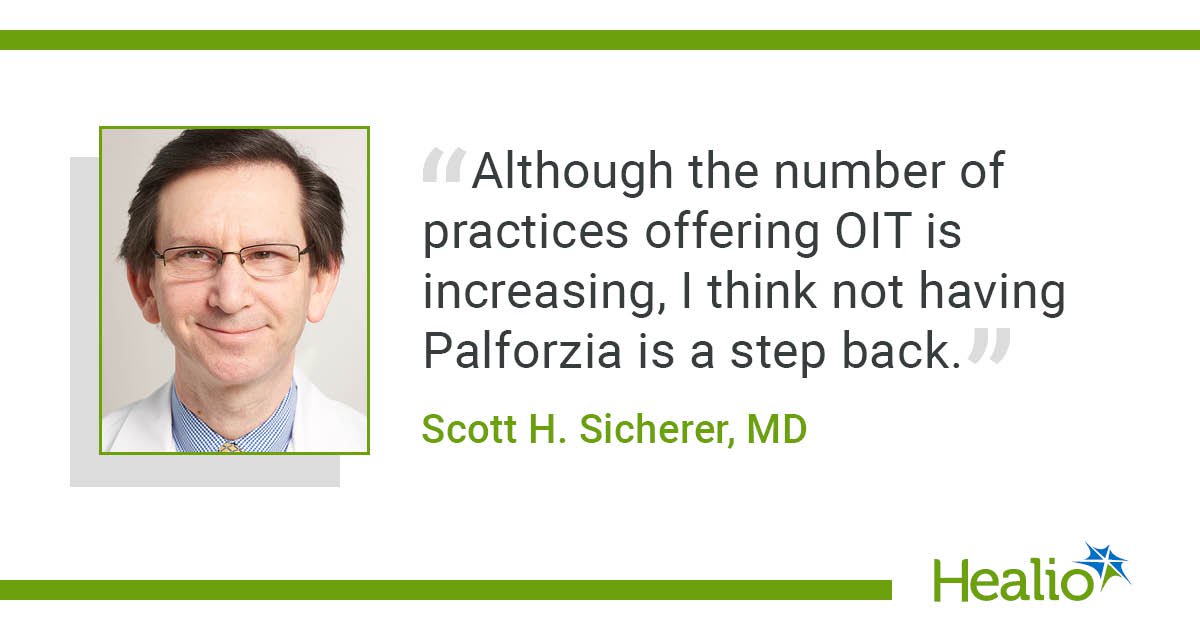
Sicherer: It is really unfortunate that this FDA-approved, well-characterized, pharmaceutically measured product will no longer be available because I think it will reduce options available from allergists in practice to offer patients. While an increasing number of programs at academic centers and private practices are offering OIT with peanut and other foods using “off the shelf” grocery store products, doing this is more complicated, time consuming and highly involved for the allergists. Deciding to take this on in a practice setting is potentially difficult. Although the number of practices offering OIT is increasing, I think not having Palforzia is a step back in general.
Healio: How is this discontinuation going to impact patients?
Poblete: Eliminating one of only two FDA-approved therapies for food allergy is difficult and further diminishes access to care for this community. Fortunately, omalizumab is FDA-approved for food allergy, there are centers offering OIT like Latitude Food Allergy Care, centers offering SLIT like Nectar and there are other innovations coming.
Healio: Are there any other immunotherapy options on the horizon?
Sicherer: Lots of options are emerging! Omalizumab is already FDA approved for a wide age range and covers multiple foods. More studies are being published about office-based OIT. Studies continue toward potential eventual FDA approvals of epicutaneous immunotherapy (EPIT) and SLIT. Additional novel treatments (biologics, small molecules, modified vaccines, combination therapies) that are allergen specific and not allergen specific are in the pipeline.
Poblete: DBV is investigating an EPIT for peanut, milk and egg allergies, although each is at a different stage of research. EPIT is not yet available, but we hope that it will be very soon.
As always, FARE is driving advancements in food allergy by funding key research. For example, FARE awarded funding in 2024 for the first study of SLIT to address the feasibility and safety of treating multiple tree nut allergens simultaneously in children. The study is being administered by Edwin Kim, MD, MS, director of the University of North Carolina Food Allergy Initiative.
Healio: Does FARE provide any resources for patients who are looking for more information about immunotherapy?
Poblete: We work hard to ensure that information about both existing and new options for patients is available on our website. We have webpages for OIT, SLIT and EPIT.
Notably, the 2025 Mind Meld Innovation Summit — held at the Massachusetts Institute of Technology — convened an unprecedented intersection of experts from academia, industry and federal agencies and began building an ecosystem designed to transform the future of food allergy science and defined multiple opportunities for future study. FARE plans to announce a request for applications that catalyze these possibilities by soliciting collaborative, milestone-driven proposals for investigation from those affiliated with FARE Clinical Network sites. The FARE Scientific Advisory Council will evaluate proposals and provide oversight to selected projects.
For more information:
Sung Poblete, PhD, RN, and Scott H. Sicherer, MD, can be reached at allergy@healio.com.
Sources/Disclosures
Source:
Healio Interviews
References:
Disclosures:
Poblete reports having employment with FARE. Sicherer reports receiving royalty payments from UpToDate and from Johns Hopkins University Press; grants to his institution for research studies from FARE, Genentech, National Institute of Allergy and Infectious Diseases, Pfizer and Regeneron; and personal fees from the American Academy of Allergy, Asthma & Immunology as deputy editor of The Journal of Allergy and Clinical Immunology: In Practice.

Ask a clinical question and tap into Healio AI’s knowledge base.
- PubMed, enrolling/recruiting trials, guidelines
- Clinical Guidance, Healio CME, FDA news
- Healio’s exclusive daily news coverage of clinical data
<










Leave a Reply