
April 29, 2026
6 min read

Key takeaways:
- Real-time clinical trials allow FDA scientists to track efficacy endpoints and safety signals while studies are in progress.
- The goal is to streamline data collection and facilitate earlier regulatory decisions.
An FDA initiative to implement real-world clinical trials could dramatically accelerate the pace at which new treatments become available to patients, according to physicians from two institutions involved in the effort’s initial phase.
The approach will leverage electronic health records and an AI-powered platform to allow FDA scientists to track safety signals and efficacy endpoints while studies are in progress. The goal is to streamline data collection and facilitate earlier regulatory decisions.

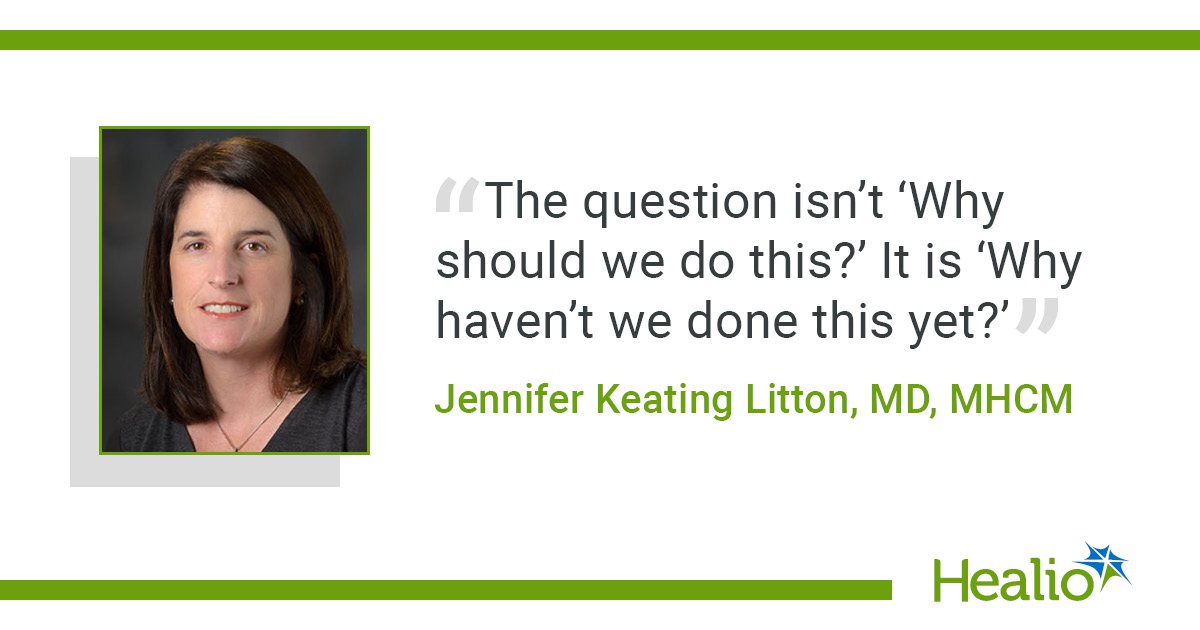
“Our capabilities for drug and device development, and our ability to evaluate data, are much more profound than even 5 or 10 years ago. We need our clinical trials to evolve at the same pace that scientific breakthroughs are happening,” Jennifer Keating Litton, MD, MHCM, chief clinical research officer and professor in the department of breast medical oncology at The University of Texas MD Anderson Cancer Center, told Healio. “We need to look not only at the science but also the process, because the process might be slowing us down more than the rate of scientific discoveries. The question isn’t ‘Why should we do this?’ It is ‘Why haven’t we done this yet?’”
Despite valuable lessons learned during the COVID-19 pandemic about clinical trial inefficiencies, innovation in the research process has been “sorely lacking,” Emma A. Meagher, MD, vice president for clinical research at University of Pennsylvania Health System and senior vice dean for clinical and translational research at Perelman School of Medicine, said in an interview.

Emma A. Meagher
“There are so many specific pain points that center around how we handle data. It is a tedious process and painful work,” Meagher told Healio. “If we can analyze that volume of data using algorithms, we can save huge amounts of time. It reduces wasted [staff] hours, reduces the time needed to get to a regulatory decision about the product and — if approved — gets it to patients sooner. We need reform. If we align that need for reform with the potential that data science brings to the enterprise, it becomes a thing of beauty.”
Fundamental transformation
The implementation of real-time clinical trials has the potential to “fundamentally transform” the research landscape, FDA Commissioner Martin Makary, MD, MPH, said during a press briefing on April 28.

Martin Makary
“For the last 50 years, the medical profession has sadly grown to accept a 10- to 12-year timeframe for new drugs to come to market,” Makary said. “[This] is a milestone day for us to challenge that deeply held assumption.”
Approximately 45% of the drug development process — the period between initiation of a phase 1 trial and submission of a regulatory application — is “dead time,” Makary said. During this period, no active research takes place. Instead, investigators and staff complete paperwork and perform other “tedious” tasks that are not always necessary, he added.
The FDA collaborated with Paradigm Health to implement a model designed to accelerate trial execution and regulatory review. The technology company’s AI-powered platform will automate data collection and analysis, allowing FDA reviewers to access EHR data in the cloud to monitor data related to predetermined efficacy or safety endpoints in real time.
“When a patient in a clinical trial develops a fever or is hospitalized, or when their tumor shrinks and a radiologist reads the new tumor size, FDA regulators can see in real time exactly what is happening,” Makary said.
Makary called the initiative “a critical step” in the agency’s broader goal to facilitate continuous trials and move away from the traditional clinical development model that consists of multiple distinct phases — each with its own protocol, a separate study and lag time in between.
Two proof-of-concept real-time trials — both of which are evaluating oncology therapies — got underway this month.
The randomized phase 2 TRAVERSE study is evaluating acalabrutinib (Calquence, AstraZeneca) in combination with venetoclax (Venclexta; AbbVie, Genentech) and rituximab for treatment-naive mantle cell lymphoma. MD Anderson and Penn are among the trial sites.
The phase 1B STREAM-SCLC trial will evaluate tarlatamab (Imdelltra, Amgen) for treatment of limited-stage small cell lung cancer.
Paul Burton, MD, PhD, FACC, MRCS, FRCP, Amgen’s senior vice president and chief medical officer, thanked FDA officials for their “openness to new approaches that can advance patient care while upholding the high standards of safety and scientific integrity.”
“Innovation should not only deliver breakthrough medicines but also rethink how we deliver them,” Burton said during the press briefing. “That means supporting approaches that bring research closer to patients where they are and help reduce the barriers to participation.
“This is where the promise of more integrated data-driven approaches comes into focus,” Burton added. “By leveraging data from electronic health records, we have an opportunity to help democratize clinical research. We can reach broader patient populations and generate insights in ways that are more reflective of everyday clinical practice, and this is a meaningful step toward greater heath equity and innovation.”
The agency intends to launch a broader pilot program this summer. As part of that effort, FDA released a request for information seeking public input on that program’s design and implementation, including metrics and criteria to measure success. Comments will be accepted until May 29.
‘Thoughtful’ approach
FDA officials have discussed the potential value of real-time clinical trials “for years” and committed last spring to developing an implementation strategy, according to Jeremy Walsh, the agency’s chief AI officer.
Initially, the FDA will continue to collect trial data through the traditional regulatory process in addition to via real-time monitoring. At the conclusion of the pilot process, agency officials will assess what worked well and how the concept can be improved.
“The primary objectives of this agency are safety and efficacy, and neither of those things will change,” Walsh said during the press briefing. “The goal is to get to a regulatory decision in a faster timeline without compromising safety. We have been getting tons of data for decades. We get information overload sometimes and we don’t need everything that we receive. This is kind of a transformative thing where the FDA is trying to reimagine what information we need and when we need it in order to make a decision.”
Litton praised the dual approach for data collection.
“It is really thoughtful to do it in this way and not just flip the switch,” she said. “It won’t be perfect. If we expect perfection out of the gate, I can promise you we will be disappointed, but perfection should not stop progress. We’ll compare this to what we’re doing currently, we’ll learn, we’ll iterate and we’ll grow.”
Real-time clinical trials should streamline the collection of vast amounts of trial data that currently are entered — often manually — into multiple systems “that were never designed to talk to each other,” Litton said.
That consumes valuable time and increases costs, she said.
“The way we collect data makes it very hard for researchers and for patients,” Litton said. “We are collecting so many points of data that never get looked at. If we are faxing a bunch of different forms to eight different places, it might take much longer to see a signal.
“If we know what data we really need to evaluate and prospectively collect it — knowing we can go back to the electronic health record to get anything else we need — we can see a signal of efficacy as early as possible,” she added. “We also may get an earlier signal that something isn’t working and we need to move on, or we may pick up early signals of toxicity that can help us understand how to better manage our patients.”
The real-time clinical trials initiative comes at an “absolutely pivotal stage” for the drug development industry, Meagher said, noting more clinical trials than ever are being conducted outside the United States.
Data transfer automation could have an invaluable downstream effect, Meagher said.
“We need to keep our workforce trained and engaged, and we need to consider the barriers they face,” Meagher said. “This particular innovation … will help our research coordinators, our nurses and our project managers, who are so hard to find … and virtually impossible to keep. Easing this process at the academic interface of patient care will have an absolutely revolutionary [effect] on our ability to sustain this workforce and to keep this type of work occurring within the U.S.”
Meagher also suggested the real-time clinical trials initiative — coupled with a Trump administration that she noted is “squarely focused on speed” and a desire to streamline processes and eliminate barriers — could pave the way for other innovative strategies.
“The fact that we could start with something so practical could open the door to more versatile utilization of AI in the process,” Meagher said. “If the FDA shows an appetite for this type of innovation, maybe they will be more willing to work with sponsors using real-world data and simulated data sets for drug approval. This could open the door for application of data science to multiple different aspects of how we evaluate novel therapies, which ideally — in aggregate — could result in speeding up the process.”
For more information:
Jennifer Keating Litton, MD, MHCM, can be reached at jlitton@mdanderson.org.
Emma A. Meagher, MD, can be reached at emma@upenn.edu.
Sources/Disclosures
Source:
Healio Interviews
Reference:
Disclosures:
Litton and Meagher report no relevant financial disclosures.

Ask a clinical question and tap into Healio AI’s knowledge base.
- PubMed, enrolling/recruiting trials, guidelines
- Clinical Guidance, Healio CME, FDA news
- Healio’s exclusive daily news coverage of clinical data
<









Leave a Reply