
April 29, 2026
3 min read

Key takeaways:
- The physician said he wants people “to ask why the government” is not publishing it.
- HHS stood by the decision to nix the study based on issues with its methodology.
After a top U.S. health official blocked the publication of a study showing that COVID-19 vaccines prevent hospitalization, an emergency physician in Boston obtained the study and published it online himself.
Jeremy Faust, MD, MS, attending physician at Brigham and Women’s Hospital and assistant professor at Harvard Medical School, published the study on his popular Substack, “Inside Medicine,” after obtaining a copy through an anonymous source.

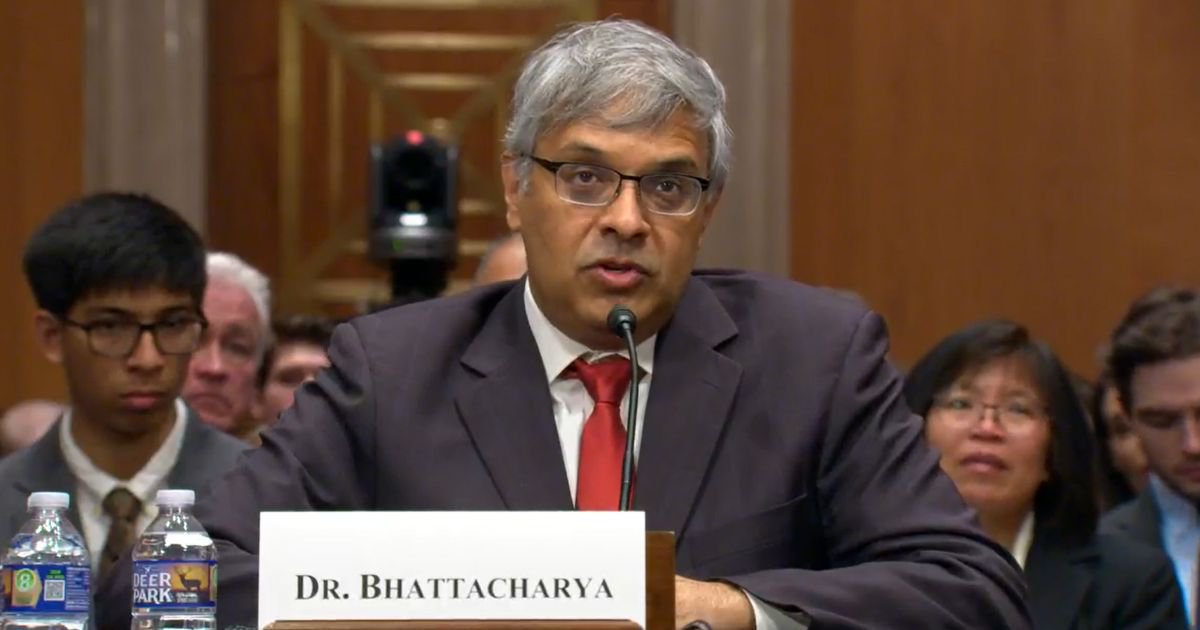
Acting CDC director Jay Bhattacharya, MD, PhD, reportedly prevented publication of a Covid-19 study. Image: help.senate.gov.
“I want people to ask why the government is suddenly not publishing its own noncontroversial science,” Faust told Healio.
The study showed that that this season’s vaccines reduced the chance that an adult would need an emergency room or urgent care visit because of COVID-19 by 50% and reduced their risk for COVID-19-associated hospitalization by 55%. It was set to be published in the CDC’s flagship journal, Morbidity and Mortality Weekly Report.
However, as first reported by The Washington Post, NIH Director Jay Bhattacharya, MD, PhD, prevented publication of the study because he had issues with its methodology. Bhattacharya is still performing the duties of CDC director while Erica Schwartz, MD, MPH, JD, awaits a confirmation hearing.
The study used a test-negative design to analyze vaccine effectiveness, enrolling patients with COVID-19-like illness who tested positive for SARS-CoV-infection as cases and patients with COVID-19-like illness who tested negative as controls.
“Scientific reports are routinely reviewed at multiple levels to ensure they meet the highest standards before publication,” HHS spokesman Andrew Nixon told Healio. “The MMWR’s editorial assessment identified concerns regarding the methodological approach to estimating vaccine effectiveness and the manuscript was not accepted for publication.”
An HHS official told Healio that Bhattacharya met with scientific staff about the study and that the authors did not want to alter their methodology. The official called concerns about the methodology “real and well understood, particularly for respiratory viruses like COVID, where prior infection, behavior, and care-seeking patterns can meaningfully affect results.”
Debra Houry, MD, MPH, who resigned in protest as the CDC’s chief medical officer last year, said she had not reviewed the study but is familiar with test-negative design.
“In general, the methodology used for it was done for a recent flu vaccine study and other COVID vaccine studies and is a good real-world methodology to look at effectiveness,” Houry told Healio. [Editor’s note: Those studies were published recently in MMWR and are linked below in the references.]
Paul A. Offit, MD, director of the Vaccine Education Center at the Children’s Hospital of Philadelphia, raised another potential explanation for why the study was not published.
“We have a secretary of HHS who for 20 years has been an antivaccine activist,” Offit told Healio, referring to Robert F. Kennedy Jr., who views COVID-19 vaccines unfavorably and has moved to restrict their use, including by appointing members to an influential CDC vaccine advisory committee who rose to prominence as critics of the vaccines.
“He has done everything he can to put bad information out there about vaccines,” Offit said. “It’s not a leap that he would hide good information. … He’s trying hide from the public that vaccines work and are safe.”
It was not the first time MMWR was at the center of a controversial decision during this administration. Last January, just days after President Trump was inaugurated for a second term, the 65-year-old journal went unpublished for the first time ever amid an HHS communications freeze. When the CDC resumed publishing the journal 2 weeks later, it was missing multiple expected reports on the U.S. bird flu outbreak.
Faust explained why he published the COVID-19 study, writing in his Substack that “Bhattacharya believes that the public should not see this work — or at least that the CDC should not publish solid science carried out, in part, by its own experts. That’s why we have to read it now.”
For more information:
Jeremy Faust, MD, MS, can be reached at infectiousdisease@healio.com.
Debra Houry, MD, MPH, can be reached at dhoury@emory.edu.
Paul A. Offit, MD, can be reached at offit@chop.edu.
Sources/Disclosures
Source:
Website
Reference:
Disclosures:
Faust and Offit report no relevant disclosures. Houry reports having an LLC called DH Leadership and Strategy Solutions and receiving funding from the California Department of Public Health to help with regional collaboratives while also being an advisor for Jimini Health.

Ask a clinical question and tap into Healio AI’s knowledge base.
- PubMed, enrolling/recruiting trials, guidelines
- Clinical Guidance, Healio CME, FDA news
- Healio’s exclusive daily news coverage of clinical data
<













Leave a Reply