
April 29, 2026
3 min read
Key takeaways:
- Among more than 16,000 neurologic patients, initial visits done virtually or in-person did not significantly differ.
- The authors did note some differences in subsequent care with certain diagnoses.
There were no major differences among neurologic patients when seen virtually or in-person for their first visit, with similar 90-day follow-up, ED visits and hospitalizations, according to a study published in Neurology.
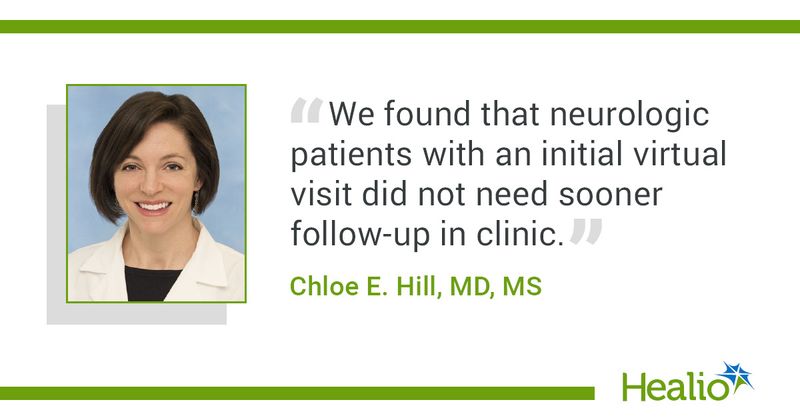
“We wanted to understand the impact of virtual visits on clinical outcomes and to consider if some neurologic patients might be better served by an initial in-person visit rather than a virtual visit,” Chloe E. Hill, MD, MS, assistant professor of neurology at the University of Michigan Medical School, told Healio.

The retrospective multicenter cohort study included 10,428 virtual and 36,767 in-person adult patients from three academic medical centers and used data spanning September 2020 to December 2021 from the Vizient Clinical Data Base and Clinical Practice Solutions Center database. After considering demographics, clinical characteristics, time period and prior health care utilization, patients were propensity score-matched 1:1 to result in 8,202 patients per group.
Hill and colleagues analyzed both overall outcomes, further stratifying these outcomes among chief neurologic complaint and institution. They compared rates of follow-up care with the neurologic clinic, ED visits and hospitalizations.
“In general, we found that neurologic patients with an initial virtual visit did not need sooner follow-up in clinic and were not more likely to go to the ED or be hospitalized compared to neurologic patients who were evaluated in-person,” Hill said. “We did find some differences in subsequent care after initial visit by diagnosis.”
The researchers found that there was no significant difference between virtual and in-person visits within 90 days (24.6% vs. 23.7%). While there was a significant difference in 30-day follow-up (virtual, 7.3% vs. in-person, 8.4%; P = .01), the study noted no significant difference in follow-up at 6 months (42.1% vs. 41.8%) and 1 year (52.4% vs. 51.2%).
When analyzing by chief complaint, the researchers noted “there was no difference in subsequent care utilization between virtual and in-person cohorts at 90 days and 30 days” for most.
They did find, however, that in-person visits were increased at 90 days for dementia visits (24.3% vs. virtual, 14.2%; P < .01), and virtual visits saw an increase at 30 and 90 days for Parkinson’s disease (30 days, 8.6% vs. in-person, 1.9%; 90 days, 42.4% vs. in-person, 26.7%; P < .01 for both) and MS (30 days, 20.5% vs. in-person, 8.3%; 90 days, 45.5% vs. 23.1%; P < .01 for both), as well as at 90 days for headache (24% vs. in-person, 18.4%; P < .01).
The study further noted neurologic hospitalizations were higher at 90 days in those who experienced stroke (4.1% vs. in-person, 1.2%; P = .02).
The researchers reported that patients with virtual and in-person visits had similar proportions of neurologic ED visits (0.9% vs. 0.8%) and hospitalizations (1.8% vs. 1.7%) within 90 days, which was also found to be true when assessing all-cause ED visits (1.8% vs. 1.7%) and hospitalizations (2.2% vs. 1.8%) within the same time period.
The researchers noted more tests among patients with certain chief complaints who had an initial in-person visit, including with epilepsy, sleep disorders, PD, headache and stroke, adding a reason for this finding was unknown.
Overall, Hill told Healio an initial virtual evaluation is “effective and safe” for most neurologic patients.
“Virtual visits in this context do not lead to more testing ordered and do not result in a need for sooner in-person evaluation,” Hill said. “We would like to repeat this study with more recent data, to further evaluate difference between diagnoses and for more detailed assessment of indicators of high-quality care.”
For more information:
Chloe E. Hill, MD, MS, can be reached at chloehi@med.umich.edu.

Ask a clinical question and tap into Healio AI’s knowledge base.
- PubMed, enrolling/recruiting trials, guidelines
- Clinical Guidance, Healio CME, FDA news
- Healio’s exclusive daily news coverage of clinical data
<










Leave a Reply