
April 29, 2026
2 min read

Key takeaways:
- Both ultrasound-guided and open carpal tunnel release provided safe and effective symptom relief.
- Ultrasound-guided carpal tunnel release improved symptom severity, function and pain at 3 months.
Results published in Journal of Hand Surgery Global Online showed both ultrasound-guided and open carpal tunnel release provided safe and effective symptom relief.
“Carpal tunnel surgery should be performed in a wide-awake fashion,” Victor M. Marwin, MD, MBA, orthopedic surgeon, hand and upper extremity surgery at Bluegrass Orthopaedics, told Healio. “We have really good minimally invasive techniques that are incredibly safe; it can be done in less intimidating clinical environments, like the office or surgery center; and a lot of these patients who are being put to sleep under general anesthesia do not need to be.”

Data derived from Marwin VM, et al. J Hand Surg Glob Online. 2026;doi:10.1016/j.jhsg.2025.100931.
Marwin and colleagues prospectively collected data from patients with carpal tunnel syndrome enrolled in the MISSION registry, the largest ever multicenter carpal tunnel release study in the United States. MISSION enrolled more than 1,400 patients treated with carpal tunnel release using three techniques. This publication used propensity score matching to identify similar patients between groups, yielding 178 patients who underwent either ultrasound-guided or open carpal tunnel release. Outcomes collected included Boston Carpal Tunnel Questionnaire Symptom Severity and Functional Status Scales, pain, opioid use, EuroQol-5D-5L, satisfaction and adverse events through 3 months.

Victor M. Marwin
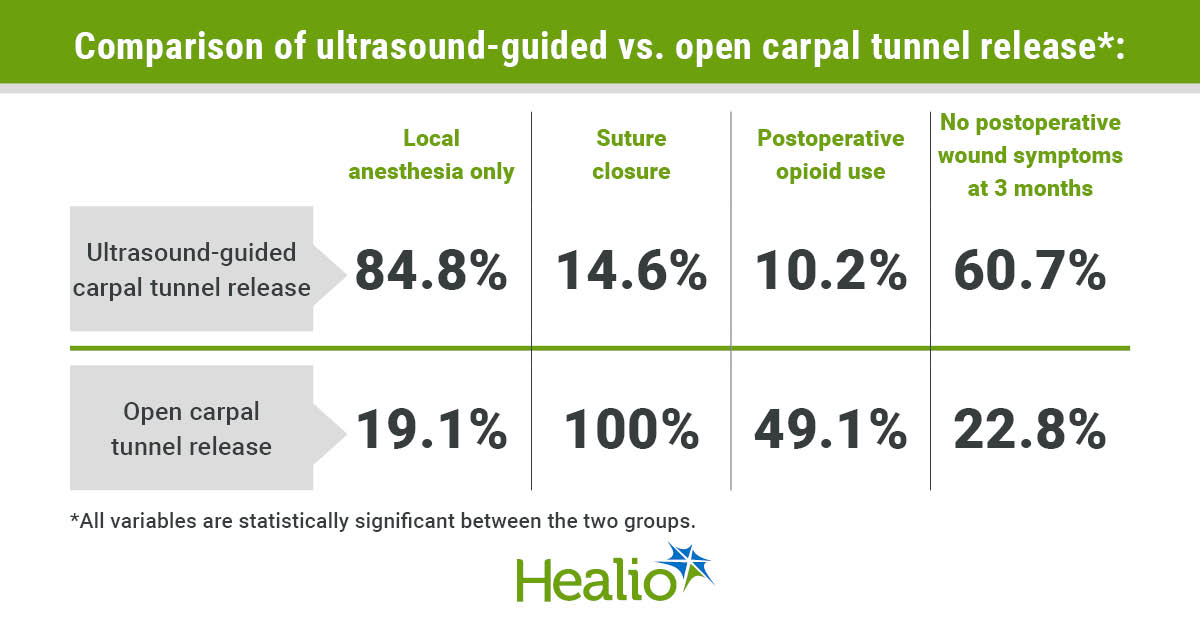
“The key takeaways were 84.8% of the ultrasound-guided carpal tunnel release surgeries were done with just local anesthesia compared with 19.1% for open carpal tunnel patients,” Marwin said.
Marwin also said patients who received ultrasound-guided carpal tunnel release had a shorter incision (5.2 mm vs. 16.5 mm) and rarely required suture closure based on surgeon preference (14.6% vs. 100%). However, ultrasound-guided carpal tunnel release yielded a longer procedure time. Only 10.2% of patients in the ultrasound-guided carpal tunnel release group used opioids vs. 49.1% of patients in the open carpal tunnel release group, according to Marwin.
“Improvements in symptom severity and functional status favored the ultrasound group, although there were improvements in both groups,” Marwin said.
In addition, he said patients in the ultrasound-guided carpal tunnel release group had better symptom resolution, with a complete resolution of sensitivity and pain reported in 60.7% of patients vs. 22.8% of patients in the open carpal tunnel release group.
According to Marwin, these results “highlight the ability to do a minimally invasive surgery without the use of a tourniquet, wide-awake with local anesthesia only in an office-based setting” and “sets the standard for the future of carpal tunnel release surgery.” Marwin said the addition of a new CPT code for ultrasound-guided carpal tunnel release that was announced this year helps pave the way to perform this procedure in an office, a stand-alone ASC or a hospital setting.
“Surgeons certainly have their choice of which environment to perform this in, and it is my hope they take full advantage of this technique and end up transitioning to the office where patients prefer to have this procedure,” Marwin said.
For more information:
Victor M. Marwin, MD, MBA, wishes to be contacted at victor.marwin@bluegrassortho.com.
Perspective
Back to Top

Victor M. Marwin, MD, MBA, and colleagues present a comparative analysis of patients having undergone either an ultrasound-guided carpal tunnel release or an open carpal tunnel release by analyzing patients from the MISSION registry — a carpal tunnel release registry initiated in 2024. Like past studies comparing ultrasound-guided vs. open carpal tunnel release, the results identified comparable clinical outcomes, less anesthesia, longer procedure times but no need for an OR, and less surgical complications with ultrasound-guided carpal tunnel release.
I would consider these findings credible as ultrasound-guided carpal tunnel release can be done under local anesthetic in an office setting with a smaller surgical footprint. As such, the validity of ultrasound-guided carpal tunnel release is not in question. However, the two ongoing concerns to consider with the ultrasound-guided carpal tunnel release technique relative to the traditional open carpal tunnel release is the learning curve with the use of an ultrasound and the potential for nonsurgeons performing carpal tunnel procedures. Learning to use an ultrasound requires active education by the surgeon as ultrasound has not traditionally been taught in surgical training. But performing ultrasound-guided carpal tunnel release by nonsurgeons creates a dilemma that can both compromise broader surgical volume while exposing patients to risk by technicians who do not have the surgical ability to convert to open if necessary nor the surgical experience to avoid or manage procedural complications.
Asif M. Ilyas, MD, MBA, FACS
Disclosures: Ilyas reports being a consultant for Arthrex, Axogen, Globus and Stryker, as well as being an executive with Walant Surgical Solutions Inc.

Ask a clinical question and tap into Healio AI’s knowledge base.
- PubMed, enrolling/recruiting trials, guidelines
- Clinical Guidance, Healio CME, FDA news
- Healio’s exclusive daily news coverage of clinical data
<














Leave a Reply