

Key takeaways:
- Advanced cardiovascular-kidney-metabolic syndrome was linked to elevated risk for cancer.
- The association was strongest in people with clinical or subclinical heart disease or kidney failure.
Advanced cardiovascular-kidney-metabolic syndrome was associated with increased risk for incident cancer among a large cohort of Japanese adults, according to data published in Circulation: Population Health and Outcomes.
These results demonstrate the importance of risk assessment outside of CV and kidney outcomes in patients with cardiovascular-kidney-metabolic (CKM) syndrome, researchers reported.

Data derived from Azegami T, et al. Circ Popul Health Outcomes. 2026;doi:10.1161/CIRCOUTCOMES.125.012921.
“CKM syndrome represents a complex interplay among the cardiovascular, kidney and metabolic systems, where dysfunction in one area may trigger or exacerbate dysfunction in others,” Hidehiro Kaneko, MD, PhD, associate professor in the department of cardiovascular medicine at the University of Tokyo, said in a press release. “Dysfunction in each of these systems is independently associated with cancer risk due to shared risk factors. This study suggests that the accumulation of risk factors within the framework of CKM syndrome may contribute to the development of various types of cancer.”
As Healio previously reported, the term CKM syndrome, coined by the American Heart Association in 2023, was created to describe the association between obesity, diabetes, chronic kidney disease and heart disease, and acknowledges therapies that affect glycemic control and prevent progression of chronic kidney disease (CKD) and CVD.
Patients with CKM syndrome are stratified into one of four stages, according to the American Heart Association presidential advisory and accompanying scientific statement: stage 0 is ideal CV health; stage 1 is overweight or obesity; stage 2 is having cardiometabolic and renal risk factors such as hypertension, diabetes or CKD; stage 3 is having subclinical atherosclerotic CVD or subclinical heart failure; and stage 4 is having CVD or kidney failure.
For the present study, researchers evaluated the health checkup data of 1.3 million participants in the DeSC Healthcare administrative claims database in Japan from April 2014 to August 2023 (mean age, 64 years; 45% men). People with a history of cancer at baseline were excluded from the analysis.
Researchers evaluated the relationship between patient CKM stage and the primary outcome of incident cancer, defined as ICD-10 codes C00 through C97, during a median follow-up of 3.4 years.
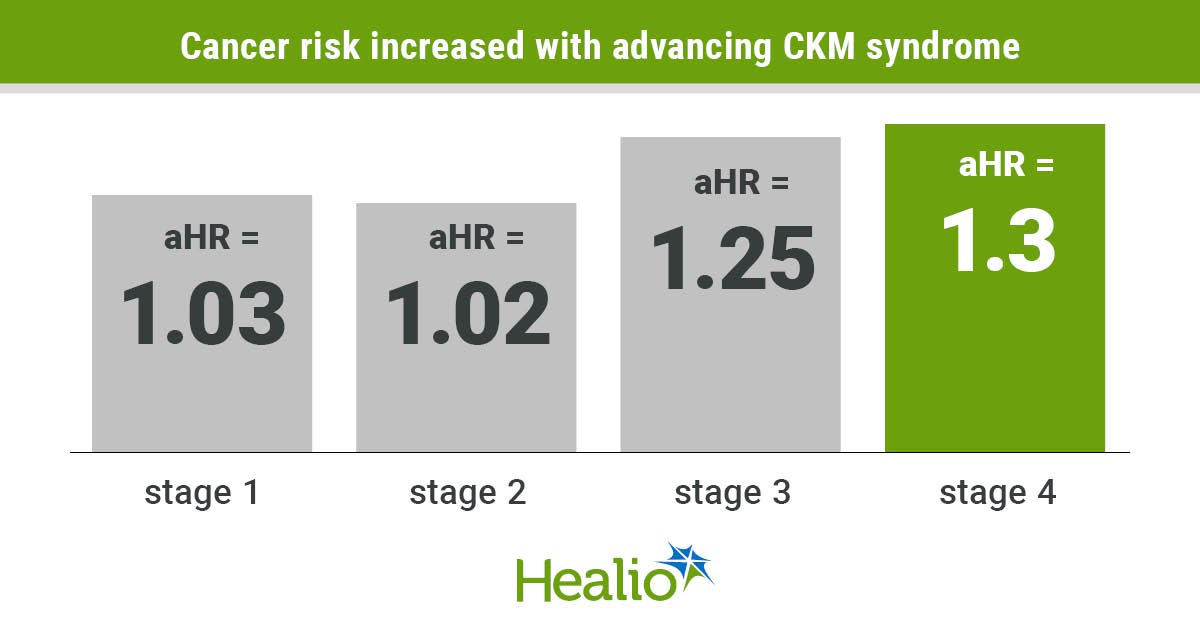
The researchers reported that higher baseline CKM stage was associated with higher risk for cancer compared with stage 0:
- stage 1 (adjusted HR = 1.03; 95% CI, 0.99-1.08);
- stage 2 (aHR = 1.02; 95% CI, 0.99-1.05);
- stage 3 (aHR = 1.25; 95% CI, 1.21-1.29); and
- stage 4 (aHR = 1.3; 95% CI, 1.25-1.35).
Risk for most individual cancers increased with higher baseline CKM stage, but there was no relationship between CKM stage and risk for esophageal cancer, malignant melanoma or Hodgkin lymphoma, the researchers wrote.
The effect of baseline CKM stage on risk for cancer was stronger in people younger than 65 years than in people aged 65 years or older, and was stronger in men than in women (P for interaction for both < .001), according to the researchers.
Moreover, Kaneko and colleagues observed baseline CKM stage affected risk for prostate cancer in men and risk for breast cancer, cervical cancer and uterine cancer in women.
“Our findings, derived from a Japanese nationwide cohort with a high health checkup coverage and an aging population, may not be fully generalizable to countries with different health care systems or demographic structures,” the researchers wrote. “However, meta-analyses and systematic reviews have consistently reported that metabolic and kidney dysfunction are associated with an increased risk of cancer, supporting a biologically plausible relationship between CKM status and carcinogenesis that extends beyond a single population.”

Ask a clinical question and tap into Healio AI’s knowledge base.
- PubMed, enrolling/recruiting trials, guidelines
- Clinical Guidance, Healio CME, FDA news
- Healio’s exclusive daily news coverage of clinical data
<









Leave a Reply