

Key takeaways:
- Surgeons should have a high level of suspicion for fracture-related infections.
- Infection prevention is as critical as prompt diagnosis and proper treatment.
Fracture-related infection is a frequent and costly complication after fracture fixation, with previously published literature citing a wide range in incidence from as low as 1% in closed fractures to as high as 30% in severe open injuries.
While fracture-related infections can be similar to periprosthetic joint infections, Ashley E. Levack, MD, MAS, FAAOS, said there are important differences between the two.

“The host matters a lot,” Levack, associate professor of orthopedic surgery at Loyola University Medical Center and Stritch School of Medicine, told Healio. “In fracture-related infection, we have a wide number of anatomic locations that can be involved and our population is different than the population undergoing joint arthroplasty.”
She also said fractures occur in uncontrolled situations and involve soft tissue damage, damage to the blood supply and, in cases of open fractures, contamination.
“Those factors make a difference and play a significant role in the pathogenesis and the treatment considerations compared with PJI,” Levack said.
Prompt treatment
Although most fracture-related infections occur due to bacterial contamination at the fracture site either at the moment of injury or at the time of surgery, Jessica Seidelman, MD, MPH, said hematogenous seeding can also be the culprit, although much less common. In addition, she said biofilm can form on implant hardware, allowing bacteria to persist despite antibiotic therapy.
“Once bacteria are introduced, it can redirect the host response away from the coordinated process of bone healing and toward prolonged inflammation, which impairs union of the fracture,” Seidelman, associate professor of medicine in the division of infectious diseases at Duke University School of Medicine, told Healio.
Surgeons should be suspicious of fracture-related infections when patients present with surgical site redness, a wound that does not heal in an appropriate time frame or new or persistent drainage, according to Levack.
“Certainly, there are other infection signs, like fever or elevated inflammatory markers that could raise suspicion, or any radiographic findings,” Levack said. “If the fracture loses its reduction or the implant is pulling out of the bone or failing early, those are signs that you would want a workup for infection earlier.”
And the earlier fracture-related infections are diagnosed, the better.
“Prompt identification reduces the risk for chronic infection and reduces the risk that the fracture would progress to nonunion as a result of the infection,” Levack said.
Seidelman also said prolonged, untreated infection may lead to sepsis, which can occur if the bacteria go from the implant to the soft tissues and seed the blood stream.
“Once that happens, that is when you have a patient who gets very sick and needs systemic antibiotics quite quickly,” Seidelman said. “It depends a lot, when that happens, on the host, the bacterial inoculum, if there is an implant or not and if there is the presence or absence of a draining sinus tract.”
Proper treatment
Not only should fracture-related infections be treated promptly but also properly, according to Levack, who said “systemic antibiotics alone are not sufficient.” She said treatment strategies include getting the patient to the OR promptly, collecting good tissue cultures to identify the pathogen and starting targeted antibiotics.
“We need to make sure there is adequate debridement, that we do not leave any dead or infected bone, and we take out the burden of infection so whatever is remaining microscopically can be addressed by the antibiotics,” Levack said.
She also said surgeons “need to make sure that there is adequate soft tissue envelope. The further management options get a little complicated depending on the fracture, but we can consider implant exchange or removal if the fracture can tolerate this, and consider various local antibiotic strategies depending on what we are dealing with.”
Infection prevention
In addition to prompt diagnosis and treatment, infection prevention is also critical, according to Levack.
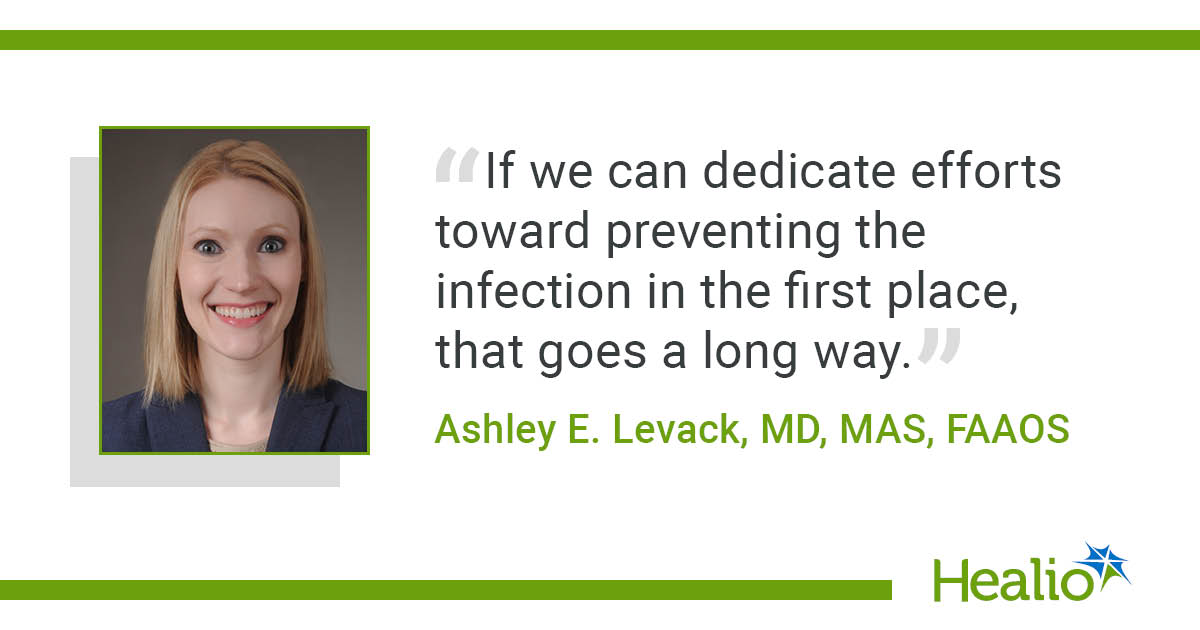
“Once the infection occurs, it is costly and time consuming,” she said. “If we can dedicate efforts toward preventing the infection in the first place, that goes a long way.”
Seidelman said optimizing the patient prior to surgery, if possible, and appropriate interventions intraoperatively, such as appropriate antibiotic prophylaxis, thorough preoperative skin cleaning and soft tissue management, can improve outcomes when treating fracture-related infections.
“Thinking about appropriate surgical site, hand hygiene, reducing OR traffic, antibiotic prophylaxis, normothermia, normoglycemia, cleaning the skin and clipping the hair appropriately — all of these things can dramatically reduce the burden of fracture-related infection and improve long-term outcomes for your patients,” Seidelman said.
The PREPARE trial, published in the New England Journal of Medicine in February 2024, showed patients with closed limb fractures who received iodine povacrylex in alcohol experienced a 26% reduction in surgical site infection compared with chlorhexidine gluconate in alcohol. Sensitivity analysis showed a 96% to 98% probability of a treatment effect, according to Levack.
“With the 0.9% absolute risk reduction seen in this study, we would theoretically only need to treat 111 patients in this manner to prevent one infection,” she said. “Adopting evidence like this could have a profound impact on the outcomes of our patients and greatly reduce costs by reducing the prevalence of fracture-related infections.”
Engaging with a multidisciplinary team is also important for reducing and treating fracture-related infections, according to Seidelman, who said team members should go beyond the orthopedic surgeon and infectious disease physician.
“Make sure that you have your infectious disease specialist, your perioperative nursing, your infection control specialist, your endocrinologist, plastic surgeons, vascular surgeon, clinical microbiologist and pathologist,” Seidelman said. “These are all people who need to be on your roster so that you can treat and diagnose these patients as effectively and efficiently as possible.”
More research to come
While it can be difficult to study fracture-related infection prevention due to the variety of injuries, unreliable patients and a low incidence of this type of infection, Levack said research like the VANCO study and the Program of Randomized trials to Evaluate Preoperative antiseptic skin solutions in Orthopaedic Trauma (PREP-IT) trials have started to provide guidance in terms of prevention of fracture-related infections.
“There are a lot of other studies going on in this arena, and some of them are investigating further options for local antibiotic use. Some of them are evaluating systemic antibiotics and how to better cover open fractures in the current modern-day era and the pathogens that are happening currently,” Levack said. “Some are evaluating wound coverage and dressing options, and then some important research is happening nowadays to identify how to visualize infected tissue during debridement and how to improve our culture results and our culture yields using more advanced technology. There is a lot of research in the pipeline that I am excited about that will come out in, hopefully, the next few years.”
For more information:
Ashley E. Levack, MD, MAS, FAAOS, can be contacted at alevack@gmail.com.
Jessica Seidelman, MD, MPH, can be contacted at jessica.seidelman@duke.edu.
Sources/Disclosures
Source:
Healio Interviews
References:
Disclosures:
Levack reports receiving a grant from the Patient-Centered Outcomes Research Institute. This article was partially funded through a Patient-Centered Outcomes Research Institute (PCORI) Dissemination and Implementation Award (DI-2024C3-42367). The statements in this article are solely the responsibility of the authors and do not necessarily represent the views of the Patient-Centered Outcomes Research Institute (PCORI), its Board of Governors or Methodology Committee. Seidelman reports receiving consulting fees from Osteal Therapeutics; being a lecturer at the Society for Healthcare Epidemiology of America National Conference and Specialized Program for Infectious Disease Care Everywhere course; and providing expert testimony for 3M; Bendin, Sumrall & Ladner LLC; and Nichol & Associates.

Ask a clinical question and tap into Healio AI’s knowledge base.
- PubMed, enrolling/recruiting trials, guidelines
- Clinical Guidance, Healio CME, FDA news
- Healio’s exclusive daily news coverage of clinical data
<












Leave a Reply