

Key takeaways:
- Perfusion density was lower in the superficial vascular complex 1 hour after instillation but not at 24 hours.
- The finding could guide future studies into atropine’s mechanism of action.
Atropine eye drops may lead to temporary changes in retinal perfusion, potentially giving a clue to their efficacy for myopia control, according to a study published in Eye and Vision.
“Atropine is widely used for myopia control, but its exact mechanism of action is still not fully understood,” study coauthor Lisa Ostrin, OD, PhD, FAAO, FARVO, associate professor at the University of Houston College of Optometry, told Healio. “We wanted to better understand the short-term functional, structural and vascular responses of the eye after a single dose of low-concentration atropine.”

Along with postdoctoral researcher Barsha Lal, PhD, Ostrin conducted a double-masked randomized study of 20 healthy adults (mean age, 25.5 years). Across five sessions, spaced 1 to 3 weeks apart, participants randomly received a single instillation of atropine, at concentrations of 0.01%, 0.025%, 0.05% or 0.1%, or placebo.
After 1 hour and 24 hours, the researchers assessed change in axial length and thickness of the retina and choroid. They also evaluated perfusion density in different layers of the retina and choroid.
According to the results, the only significant change was lower perfusion density in the superficial vascular complex (P = .02), specifically in the area around the fovea.
A post hoc analysis found perfusion density was significantly lower at 1 hour (P = .03) but not at 24 hours. There was no relationship between perfusion density and atropine concentration.
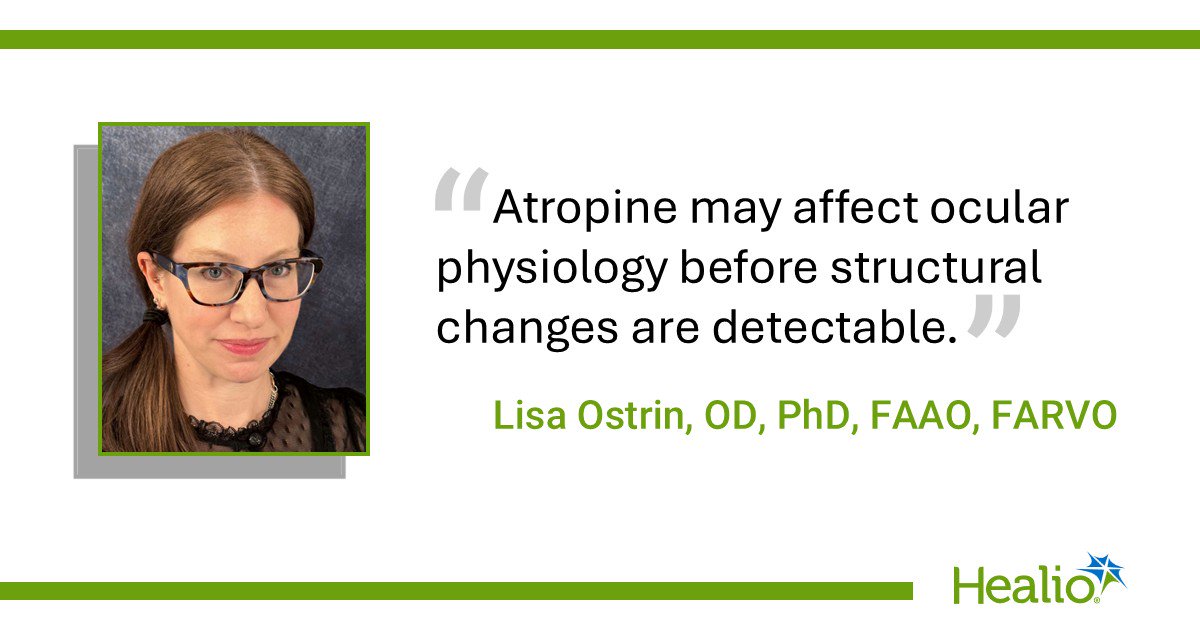
“The transient change in superficial retinal perfusion was interesting because it suggests that atropine may affect ocular physiology before structural changes are detectable,” Ostrin said.
Ostrin cautioned that the results do not mean “the perfusion change is necessarily beneficial or harmful.”
“Rather, they provide insight into the early physiological response of the eye to atropine and may help guide future studies on its mechanism of action,” she said.
The study found no significant effect on axial length or retinal or choroidal thickness at any time point.
“Future studies should examine these effects in children with myopia since they are the primary group using atropine for myopia control,” she added. “Longer-term studies are also needed to determine whether these short-term structural and vascular responses are related to treatment efficacy.”
Use of atropine also had dose- and time-dependent relationships with pupil size and certain accommodation metrics, according to a separately published analysis of the data.
“The finding that pupil dilation and reduced accommodation persisted up to 24 hours after a single low-dose atropine drop was surprising, especially because these are clinically noticeable effects for patients,” Ostrin said.
That analysis was published in Investigative Ophthalmology & Visual Science in June 2025.
For more information:
Lisa Ostrin, OD, PhD, FAAO, FARVO, can be reached at lostrin@central.uh.edu.

Ask a clinical question and tap into Healio AI’s knowledge base.
- PubMed, enrolling/recruiting trials, guidelines
- Clinical Guidance, Healio CME, FDA news
- Healio’s exclusive daily news coverage of clinical data
<














Leave a Reply